Biography
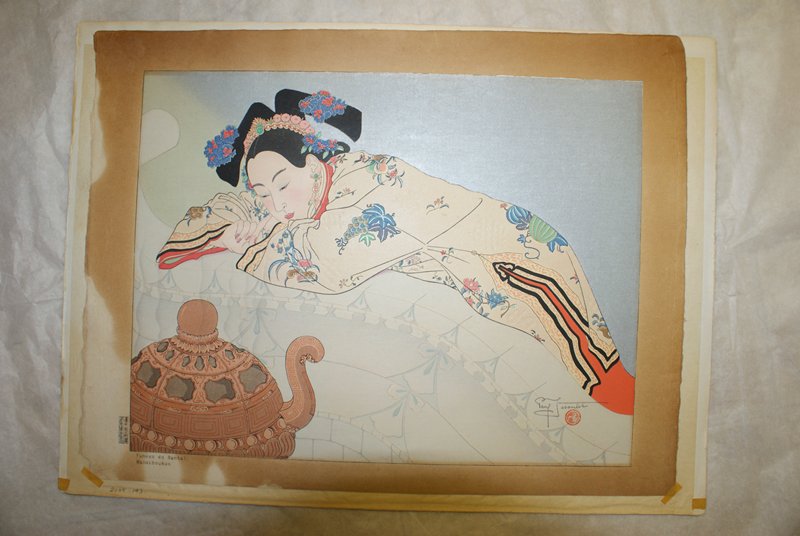
Paul Jacoulet (1896-1960) was a French-born artist who became one of the most remarkable and unusual figures in the history of Japanese woodblock printmaking. Although European by birth, Jacoulet spent virtually his entire life in Japan and the Pacific Islands, creating a body of work that occupies a unique position at the intersection of Western and Japanese artistic traditions. His luminously colored prints depicting the peoples of Micronesia, Korea, China, Japan, and other regions of East Asia and the Pacific are among the most distinctive and beautiful works produced in the shin-hanga style, notable for their ethnographic sensitivity, technical perfection, and sumptuous use of color.
Jacoulet was born on November 28, 1896, in Paris, France, but his family moved to Tokyo when he was only three years old. His father was a professor of French at the Gakushuin (Peers' School), and young Paul grew up immersed in Japanese culture, language, and artistic traditions from his earliest memories. He attended Japanese schools, became fluent in Japanese, and developed a deep affinity for Japanese art and aesthetics that would define his entire career. In many respects, Jacoulet was culturally Japanese despite his French parentage, and this bicultural identity — at home in both Western and Japanese artistic worlds — gave his work its distinctive character.
As a young man, Jacoulet studied painting and drawing, developing exceptional skills in both Western and Japanese techniques. He was particularly drawn to the tradition of Japanese woodblock printing, and he studied the methods of the ukiyo-e masters as well as the contemporary shin-hanga movement then being championed by the publisher Watanabe Shozaburo. However, unlike most shin-hanga artists who worked with commercial publishers, Jacoulet chose to produce his prints independently, maintaining complete control over every aspect of the creative process. He employed his own team of master carvers and printers, working closely with them to achieve the extraordinary level of technical refinement for which his prints are renowned.
Jacoulet's artistic vision was shaped by extensive travel throughout East Asia and the Pacific Islands. Beginning in the 1920s, he made numerous journeys to Korea, Manchuria, China, and the islands of Micronesia — particularly the Mariana Islands, the Caroline Islands, and Palau, which were then under Japanese mandate. These travels provided the subject matter for the great majority of his prints: portraits of the indigenous peoples he encountered, depicted with a combination of ethnographic precision and aesthetic idealization that reflects both his Western training in portraiture and his Japanese-influenced sense of design and color.
His first major series of prints appeared in the 1930s, and over the following decades he produced approximately 166 designs, each printed in strictly limited editions of 350 impressions. This limited-edition approach was unusual in the world of Japanese printmaking, where editions were typically open-ended, and it reflected Jacoulet's understanding of the Western art market's valuation of scarcity. Each print was numbered, signed with his distinctive red personal seal (designed in the style of a Japanese hanko), and produced to the highest possible standards of craftsmanship.
Key Facts
- Active Period
- 1896–1960
- Nationality
- 🇫🇷France
- Movement
- Shin-hanga
Frequently Asked Questions
Paul Jacoulet (1896-1960) was a French-born artist who became one of the most remarkable and unusual figures in the history of Japanese woodblock printmaking. Although European by birth, Jacoulet spent virtually his entire life in Japan and the Pacific Islands, creating a body of work that occupies a unique position at the intersection of Western and Japanese artistic traditions. His luminously colored prints depicting the peoples of Micronesia, Korea, China, Japan, and other regions of East Asia and the Pacific are among the most distinctive and beautiful works produced in the shin-hanga style, notable for their ethnographic sensitivity, technical perfection, and sumptuous use of color.
Paul Jacoulet was active from 1896 to 1960. They were associated with the Shin-hanga movement.
Paul Jacoulet's work was shaped by the Shin-hanga tradition in Japanese woodblock printmaking. Shin-hanga: ## What is Shin-hanga? Shin-hanga (新版画), literally "new prints," is the early twentieth-century revival of the collaborative Japanese woodblock workshop, organized between roughly 1915 and 1960 by the Tokyo publisher Watanabe Shōzaburō (1885–1962) and a handful of competing houses.
Paul Jacoulet's prints frequently feature figures, portraits, bijin-ga, landscapes, still life, seascapes.
Original prints by Paul Jacoulet can be found in collections including Ronin Gallery, ukiyo-e.org, robynbuntin, Victoria and Albert Museum.
Western artist in Japan, unique style, dedicated collector base. Based on 946 sales of comparable artist.