Biography
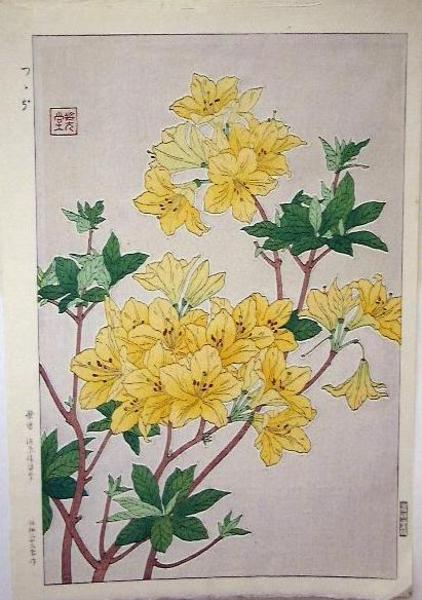
Shodo Kawarazaki (河原崎奨堂, 1889-1973) devoted his career almost entirely to kacho-ga, the Japanese tradition of bird-and-flower painting, translating it into woodblock prints of exceptional botanical precision. Born in Kyoto in 1889, he trained in nihonga painting and developed an intimate knowledge of plant morphology that informed every aspect of his printmaking.
Kawarazaki worked primarily within the shin-hanga collaborative system, designing prints that were carved and printed by professional craftsmen. His principal publishing relationship was with Unsodo in Kyoto, for whom he produced his most recognized body of work: the large kacho-e series depicting flowers, grasses, fruits, and birds through the cycle of the Japanese seasons. These prints, depicting subjects such as poppies, morning glories, chrysanthemums, roses, camellias, irises, wisteria, cherry blossoms, and peonies, achieved a balance between decorative beauty and naturalistic accuracy that distinguished them from purely ornamental flower prints.
His compositions typically isolated a single plant specimen or a small grouping against a plain or lightly graded background, allowing the viewer to study the structure of petals, stems, and leaves with the attention of a botanical illustration while retaining the aesthetic sensitivity of Japanese brush painting. When birds appeared, they were rendered with equal care, perched on or hovering near the flowering branches in poses drawn from direct observation.
Kawarazaki's technique depended on close collaboration with skilled block carvers who could reproduce the fine gradations of his brush strokes and the delicate transitions of color within individual petals. The bokashi shading technique, in which the printer applies a graduated tone by varying pressure and moisture, was central to his work, producing the soft blushes of color that give his flower prints their characteristic luminosity.
He was a quieter figure than many of his shin-hanga contemporaries, rarely depicted in the biographical accounts that center on the Watanabe workshop circle in Tokyo. His Kyoto base and his specialization in kacho-ga placed him somewhat apart from the landscape artists and figure painters who attracted the most collector attention. The bulk of his woodblock output belongs to the 1950s, when Unsodo published his flower prints during a period of strong demand for traditional handmade Japanese prints. He died in 1973 at eighty-four, leaving a body of work that represents one of the most sustained engagements with botanical subjects in twentieth-century Japanese printmaking. His prints remain widely collected, valued both as art objects and as records of the traditional Japanese floral aesthetic.
Key Facts
- Active Period
- 1889–1973
- Nationality
- 🇯🇵Japan
- Movement
- Shin-hanga
- Works Indexed
- 30
Frequently Asked Questions
Shodo Kawarazaki (河原崎奨堂, 1889-1973) devoted his career almost entirely to kacho-ga, the Japanese tradition of bird-and-flower painting, translating it into woodblock prints of exceptional botanical precision. Born in Kyoto in 1889, he trained in nihonga painting and developed an intimate knowledge of plant morphology that informed every aspect of his printmaking.
Shodo Kawarazaki was active from 1889 to 1973. They were associated with the Shin-hanga movement.
Shodo Kawarazaki's work was shaped by the Shin-hanga tradition in Japanese woodblock printmaking. Shin-hanga: ## What is Shin-hanga? Shin-hanga (新版画), literally "new prints," is the early twentieth-century revival of the collaborative Japanese woodblock workshop, organized between roughly 1915 and 1960 by the Tokyo publisher Watanabe Shōzaburō (1885–1962) and a handful of competing houses.
Shodo Kawarazaki's prints frequently feature birds & flowers, still life, cherry blossoms, spring, trees, nature.
Original prints by Shodo Kawarazaki can be found in collections including Japanese Art Open Database, Honolulu Museum of Art, wbp, ukiyo-e.org.