Biography
Komori Sōseki (小森漱石) — also encountered in older catalogues as Komori Shōseki, the result of two possible readings of the same characters — was a designer of bird-and-flower (kachō-e) woodblock prints active in the 1920s and 1930s. Almost no biographical record has been recovered for him: his birth and death dates are unknown, no training affiliation has been established, and his name does not appear in the standard biographical dictionaries of shin-hanga artists. He surfaces in the historical record almost entirely through his prints, and even those circulated quietly until the dispersal of the Robert O. Muller collection, following the dealer's death in 2003, brought his work to wider attention. Muller, who had assembled one of the largest private collections of late-nineteenth- and twentieth-century Japanese prints outside Japan, held Komori's prints in unusually fine impressions, and the transfer of that collection — more than four thousand prints — to the Smithsonian's Arthur M. Sackler Gallery put his name into international circulation more or less for the first time.
The prints that can be securely attributed to Komori belong to the shin-hanga publishing environment of interwar Tokyo, and the best known of them were issued by the Tokyo house of Sakai and Kawaguchi, whose short-lived 1929–1931 joint venture also produced prints by leading shin-hanga figures such as Kawase Hasui, Ohara Koson, and Torii Kotondo. Komori's prints carry the publisher's seal alongside his own artist's seal and were made within the standard shin-hanga division of labour between designer, block carver, and printer — the printing for the Kawaguchi–Sakai workshop being the work of Komatsu Wasakichi.
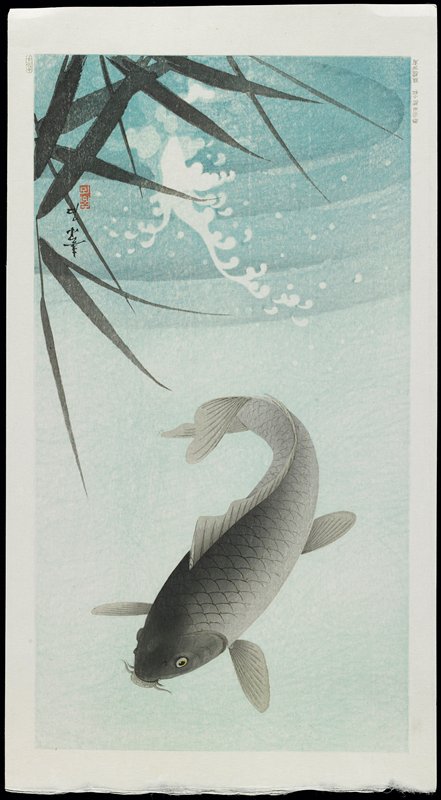
His subjects are tightly focused: goldfish (most famously the print known as "Two Goldfish," dated 1929), carp, geese, snipe, moorhens, and a small repertoire of seasonal flower-and-bird compositions. The compositions are unhurried and carefully balanced, with broad areas of unprinted paper used as ground; the carving registers the fine lines of feathers and fins cleanly, and the printing of his fishes in particular is marked by careful gradations of colour and the use of overprinted transparent washes to suggest water. He is recognisably a designer rather than a self-printer — Komori sits inside the shin-hanga workshop tradition, not the sōsaku-hanga avant-garde — but he works at the more restrained end of that tradition, closer in feeling to Ohara Koson's late kachō-e than to the more decorative output of his publisher-stablemates.
Beyond the prints themselves, the documentary record is exceptionally thin: scholars have not located studio photographs, exhibition reviews, or personal papers, and dealers and print databases alike describe him as a "mysterious printmaker" whose biography remains effectively unwritten. His work is now held in the Smithsonian's Arthur M. Sackler Gallery and the Art Institute of Chicago, as well as in private collections, and the goldfish prints in particular continue to attract collectors' attention out of proportion to what is known about their designer.
Key Facts
- Nationality
- 🇯🇵Japan
- Movement
- Shin-hanga
- Works Indexed
- 36
Frequently Asked Questions
Komori Sōseki (小森漱石) — also encountered in older catalogues as Komori Shōseki, the result of two possible readings of the same characters — was a designer of bird-and-flower (kachō-e) woodblock prints active in the 1920s and 1930s. Almost no biographical record has been recovered for him: his birth and death dates are unknown, no training affiliation has been established, and his name does not appear in the standard biographical dictionaries of shin-hanga artists. He surfaces in the historical record almost entirely through his prints, and even those circulated quietly until the dispersal of the Robert O. Muller collection, following the dealer's death in 2003, brought his work to wider attention. Muller, who had assembled one of the largest private collections of late-nineteenth- and twentieth-century Japanese prints outside Japan, held Komori's prints in unusually fine impressions, and the transfer of that collection — more than four thousand prints — to the Smithsonian's Arthur M. Sackler Gallery put his name into international circulation more or less for the first time.
Komori Soseki's work was shaped by the Shin-hanga tradition in Japanese woodblock printmaking. Shin-hanga: ## What is Shin-hanga? Shin-hanga (新版画), literally "new prints," is the early twentieth-century revival of the collaborative Japanese woodblock workshop, organized between roughly 1915 and 1960 by the Tokyo publisher Watanabe Shōzaburō (1885–1962) and a handful of competing houses.
Komori Soseki's prints frequently feature birds & flowers, rivers & lakes, abstract, landscapes, animals, fish.
Original prints by Komori Soseki can be found in collections including Minneapolis Institute of Art, Japanese Art Open Database, Art Institute of Chicago, ukiyo-e.org.