Biography
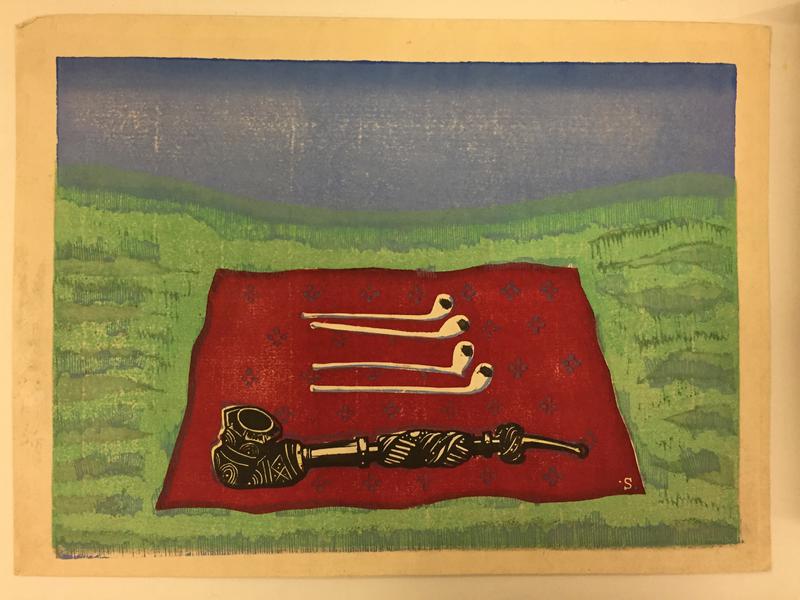
Sumio Kawakami (川上澄生, 1895–1972) made woodblock prints that looked like nothing else in the sōsaku-hanga movement: flat, bright, deliberately naive compositions that mixed Japanese and Western imagery with a folk-art directness that owed as much to playing cards and signboards as to any fine-art tradition.
Born in Yokohama in 1895 to a father who was an enthusiastic supporter of Western culture, Kawakami absorbed an interest in things Western early, and it left a permanent mark on his artistic sensibility. He was educated at Aoyama Gakuin in Tokyo, where he first learned to draw. In 1917 he set off for North America on his own, spending about a year in Canada and the United States at odd jobs — among them a salmon cannery in Alaska and house painting in Seattle — before returning to Japan in 1918. Largely self-taught as a printmaker, he became associated with the creative-print (sōsaku-hanga) movement, though his deliberately flat, graphic manner — influenced by early European woodcuts, Meiji-era copperplate prints, and the bold patterning of folk textiles — bore little resemblance to the lyrical abstraction of the movement's leading figure, Kōshirō Onchi, who nonetheless admired his work.
One of his most consequential prints, 'Early Summer Wind' (Shoka no kaze, 初夏の風, 1926) — a small black-and-white image of a woman walking in the wind, paired with a poem — stunned the young Shikō Munakata when he encountered it. Munakata later credited the print as the catalyst that made him abandon oil painting for woodblock printmaking, one of the most consequential artistic decisions in twentieth-century Japanese art.
From 1921 Kawakami spent decades teaching English in Tochigi Prefecture — first at Tochigi Prefectural Utsunomiya Middle School (now Utsunomiya High School) and later at Utsunomiya Girls' High School — while maintaining a steady printmaking practice. His subjects ranged widely: Meiji-era street scenes with gas lamps, horse carriages, and Western-dressed figures; sailing ships and foreign harbors; Biblical narratives rendered in a style suggestive of European folk illustration; playing-card motifs; and scenes of the Tochigi countryside. His 'Nanban' prints depicted the sixteenth-century Portuguese and Spanish visitors to Japan, combining Japanese and Iberian visual elements with characteristic irreverence.
His color sense was bold and unapologetic, favoring saturated reds, blues, and yellows applied in flat fields bounded by heavy black outlines. He carved with deliberate roughness, leaving visible tool marks that reinforced the handmade, folk-craft quality of the work. Text, both Japanese and Roman letters, appeared frequently in his compositions, blurring the boundary between image and inscription.
Kawakami produced more than thirty illustrated books of woodcuts, most of which he printed himself, and remained active in the creative-print circles throughout his career. He received a Tochigi prefectural cultural prize in 1949 and continued working until his death in Utsunomiya in 1972 at seventy-seven. His prints are held by the Art Institute of Chicago, the Museum of Fine Arts Boston, and the Portland Art Museum, while the Kawakami Sumio Graphic Art Museum in Kanuma, Tochigi Prefecture — established in 1992 with more than two thousand works — holds the most comprehensive collection of his art.
Key Facts
- Active Period
- 1895–1972
- Nationality
- 🇯🇵Japan
- Movement
- Sōsaku-hanga
- Works Indexed
- 89
Frequently Asked Questions
Sumio Kawakami (川上澄生, 1895–1972) made woodblock prints that looked like nothing else in the sōsaku-hanga movement: flat, bright, deliberately naive compositions that mixed Japanese and Western imagery with a folk-art directness that owed as much to playing cards and signboards as to any fine-art tradition.
Sumio Kawakami was active from 1895 to 1972. They were associated with the Sōsaku-hanga movement.
Sumio Kawakami's work was shaped by the Sōsaku-hanga tradition in Japanese woodblock printmaking. Sōsaku-hanga: ## What is sōsaku-hanga? Sōsaku-hanga (創作版画, "creative prints") was a twentieth-century Japanese print movement defined by a single commitment: the artist must design, carve, and print every work alone.
Sumio Kawakami's prints frequently feature figures, travel scenes, urban scenes, still life, daily life, seascapes.
Original prints by Sumio Kawakami can be found in collections including Minneapolis Institute of Art, Art Institute of Chicago, Art of Japan, British Museum.