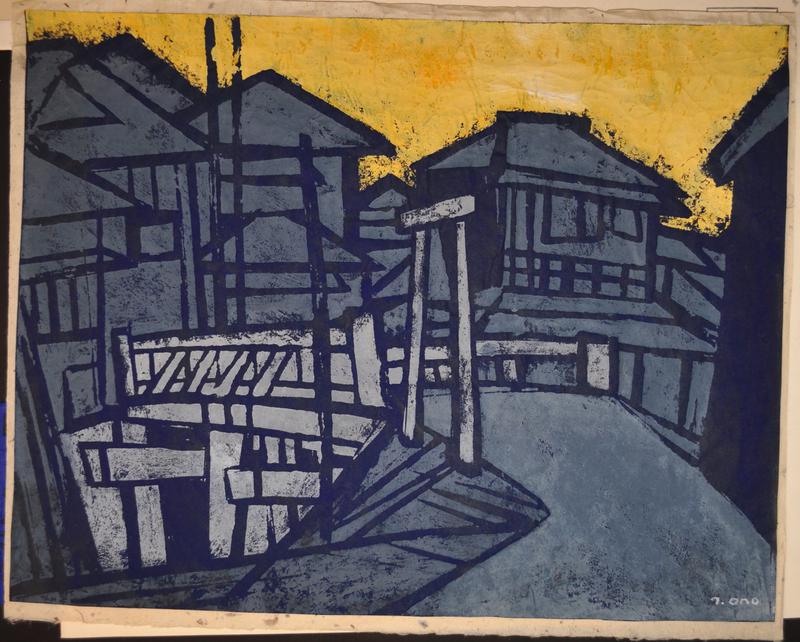
Biography
Tadashige Ono (小野忠重, 1909–1990) was both a practitioner and a historian of the sōsaku-hanga movement, producing prints for over fifty years while also writing important critical and historical accounts of Japanese creative printmaking. Born in Tokyo on January 19, 1909, he studied art at the Hongo Art Institute in the mid-1920s and from an early age was actively involved in the sōsaku-hanga (creative print) and proletarian art movements of the period.
Ono's prints of the 1930s reflected the leftist social consciousness that ran through one current of the sōsaku-hanga movement. He produced stark, high-contrast black-and-white prints depicting urban workers, factory scenes, and the industrial landscape of prewar Tokyo. His early work was deeply rooted in the social-critical current of German Expressionism and engaged with the contemporary Chinese woodcut movement, aligning him with a politically engaged strand of printmaking that was often suppressed by wartime authorities.
During the war years, Ono's printmaking was curtailed, and the political currents that had informed his early work were silenced by government censorship. He reemerged in the postwar period with a broader range of subjects, producing prints of Japanese architecture, cityscapes, and landscapes while retaining the bold compositional clarity of his prewar style — an interest in the city and the industrialized face of Japan that remained constant throughout his career.
Ono's parallel career as a print historian gave him unusual standing in the sōsaku-hanga world. He authored several books on modern Japanese woodblock prints, along with one on Chinese prints, and his essays helped provide informed accounts of the creative-print movement's origins, philosophy, and major figures. He wrote as a participant in the movement he documented, able to describe its concerns and internal debates from direct experience.
Active as both a printmaker and a writer, he is remembered for a dual legacy: as a printmaker whose socially engaged early work evolved into a broader practice, and as a writer who helped establish the historical framework through which sōsaku-hanga is understood. He died in Tokyo in 1990 at the age of eighty-one.
Key Facts
- Active Period
- 1909–1990
- Nationality
- 🇯🇵Japan
- Movement
- Sōsaku-hanga
- Works Indexed
- 197
Frequently Asked Questions
Tadashige Ono (小野忠重, 1909–1990) was both a practitioner and a historian of the sōsaku-hanga movement, producing prints for over fifty years while also writing important critical and historical accounts of Japanese creative printmaking. Born in Tokyo on January 19, 1909, he studied art at the Hongo Art Institute in the mid-1920s and from an early age was actively involved in the sōsaku-hanga (creative print) and proletarian art movements of the period.
Tadashige Ono was active from 1909 to 1990. They were associated with the Sōsaku-hanga movement.
Tadashige Ono's work was shaped by the Sōsaku-hanga tradition in Japanese woodblock printmaking. Sōsaku-hanga: ## What is sōsaku-hanga? Sōsaku-hanga (創作版画, "creative prints") was a twentieth-century Japanese print movement defined by a single commitment: the artist must design, carve, and print every work alone.
Tadashige Ono's prints frequently feature seascapes, urban scenes, landscapes, rivers & lakes, trees, birds & flowers.
Original prints by Tadashige Ono can be found in collections including wbp, Minneapolis Institute of Art, Japanese Art Open Database, ukiyo-e.org.
Based on 36 recorded auction sales from 2010–2025, most Tadashige Ono prints sold in the $250–$425 range, with a median around $350. Top results exceeded $600. Actual prices vary widely with edition, condition, and subject.