Biography
Takashi Murakami (村上隆, born February 1, 1962) is one of the most influential Japanese artists of the late twentieth and early twenty-first centuries, renowned for founding the Superflat movement and for dissolving the boundaries between fine art and commercial culture. Born and raised in Tokyo, he trained in nihonga (traditional Japanese-style painting) at Tokyo National University of Fine Arts and Music, earning his BFA in 1986, his MFA in 1988, and his PhD in 1993.
Though classically trained, Murakami quickly moved beyond nihonga's conventions. He recognized a deep continuity between the flat compositional strategies of historical Japanese art—from Edo-period ukiyo-e woodblock prints to Rinpa school screens—and the two-dimensional aesthetics of postwar manga and anime. In 2000, he formalized this insight in his Superflat theory, articulated in the catalog for a group exhibition he curated at the Museum of Contemporary Art, Los Angeles. The theory argued that Japanese visual culture had always privileged flatness over Western perspectival depth, and that contemporary pop imagery was the legitimate heir of traditions stretching back centuries to woodblock printing masters like Hokusai and Hiroshige.
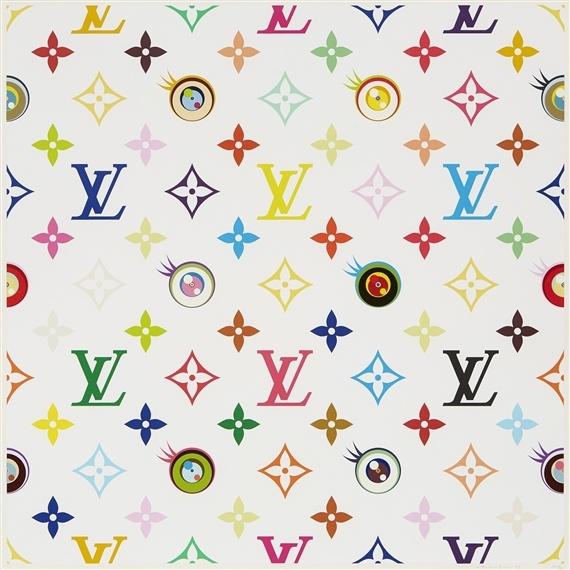
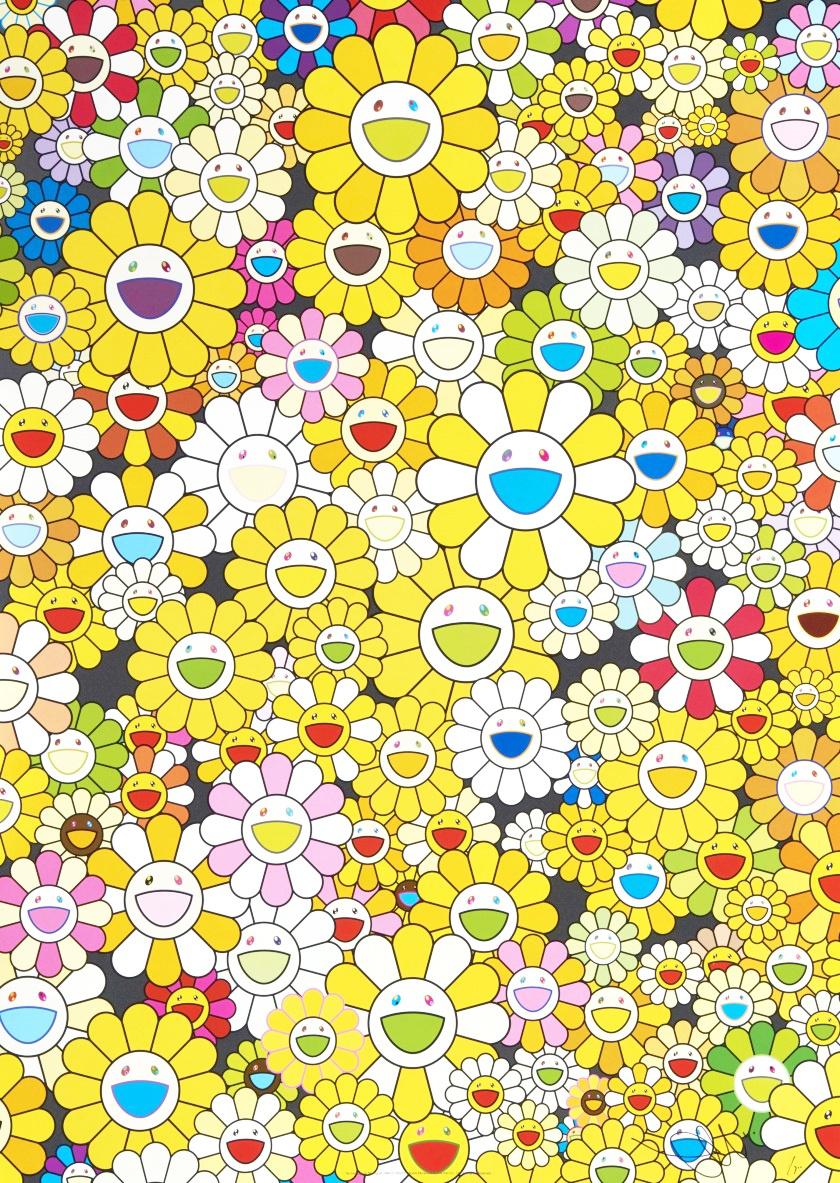
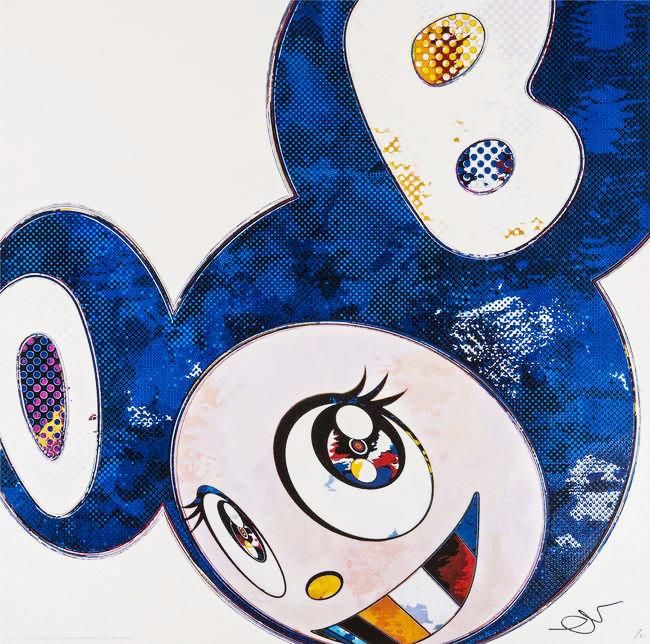
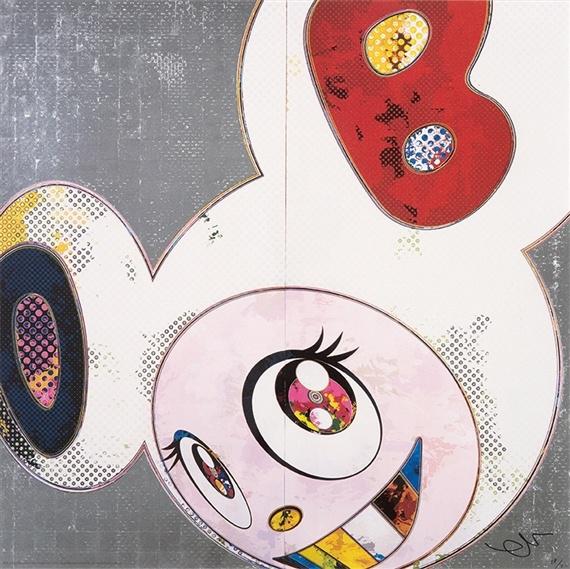
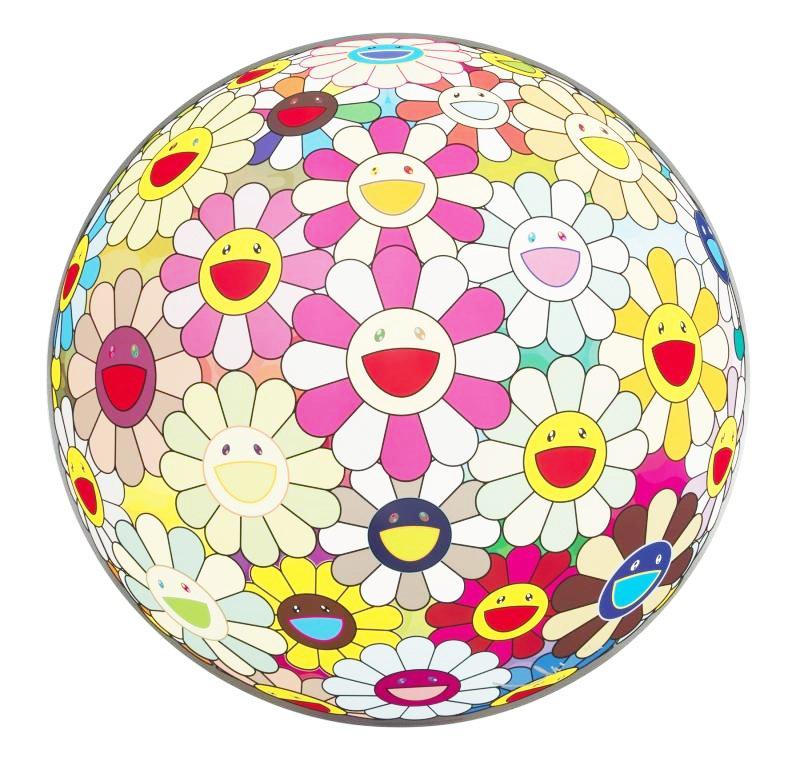
Murakami's own work embodies this synthesis. His signature motifs—grinning flowers, the cartoon alter-ego Mr. DOB, grinning skulls, psychedelic mushrooms, and Buddhist iconography—are rendered in vivid, saturated color with glossy, flattened surfaces that refuse the distinction between high art and commercial product. His paintings, sculptures, and prints have been exhibited at the world's leading institutions, including retrospectives at the Museum of Contemporary Art, Los Angeles (2007), the Guggenheim Museum Bilbao (2009), the Palace of Versailles (2010), and the Museum of Contemporary Art Chicago (2017), as well as major works held by The Broad in Los Angeles.
Beyond his own studio practice, Murakami founded Kaikai Kiki Co., Ltd., a Tokyo-based art production and management company through which he mentors emerging artists including Chiho Aoshima, Mr., Aya Takano, and others whose work extends the Superflat aesthetic. His commercial collaborations—most notably with Louis Vuitton, Kanye West, Billie Eilish, and the streetwear-and-culture convention ComplexCon—have been both celebrated and debated as provocations that question where art ends and commerce begins.
Murakami's print editions, ranging from signed screenprints and lithographs to large-format offset editions, have made his imagery accessible to a broad collector base. His "My First Art" series of signed prints, published through Kaikai Kiki, was conceived to bring his imagery within reach of a wider audience. Throughout these varied formats, the compositional DNA of ukiyo-e—bold outlines, flat color fields, serial imagery, and the erasure of depth—remains visible, connecting Murakami's global pop enterprise back to the woodblock printing traditions from which Superflat theory draws its genealogy.
He is represented by Gagosian and Perrotin galleries and continues to live and work in Japan, where the Tokyo-based Kaikai Kiki studio oversees the production of his paintings, sculptures, and editions.
Key Facts
- Active Period
- 1962
- Nationality
- 🇯🇵Japan
- Movement
- Contemporary Mokuhanga
- Subjects
- SuperflatPop ArtFlora & Fauna
- Works Indexed
- 6
Frequently Asked Questions
Takashi Murakami (村上隆, born February 1, 1962) is one of the most influential Japanese artists of the late twentieth and early twenty-first centuries, renowned for founding the Superflat movement and for dissolving the boundaries between fine art and commercial culture. Born and raised in Tokyo, he trained in nihonga (traditional Japanese-style painting) at Tokyo National University of Fine Arts and Music, earning his BFA in 1986, his MFA in 1988, and his PhD in 1993.
Takashi Murakami was active born in 1962. They were associated with the Contemporary Mokuhanga movement.
Takashi Murakami's work was shaped by the Contemporary Mokuhanga tradition in Japanese woodblock printmaking. Contemporary Mokuhanga: Contemporary mokuhanga (literally "wood-block print") encompasses artists working from approximately 1970 to the present who continue or reinvent traditional Japanese woodblock printing techniques.
Takashi Murakami's prints frequently feature superflat, pop art, flora & fauna.