Tani Bunchō
谷文晁
1763–1841
Japan
Biography
Tani Bunchō (谷文晁, 1763–1841) was one of the most influential bunjinga (literati) painters of the late Edo period, a synthesizer who absorbed Chinese, Japanese, and even Western pictorial traditions and forged from them an idiom that defined Edo-based nanga painting for two generations. Born in Edo in 1763 to a samurai family in service to the Tayasu, a branch of the Tokugawa house, he received the kind of broad classical education that gave bunjinga its name: he was a poet and calligrapher as well as a painter, and his career unfolded inside the cultural and political world of the late-Tokugawa elite. His father, Tani Rokkoku, was a poet, and the boy was trained from youth in painting under the Kanō-school master Katō Bunrei, absorbing the orthodox brushwork that would always underpin his more eclectic mature manner.
After Bunrei's death in 1782 he continued his studies under a series of teachers and through direct copying of Chinese paintings circulating in Edo collections — Ming and early Qing landscape masters in particular — and made study trips to Kyoto and to provincial centers where important Chinese works were held. Out of this broad apprenticeship he built the eclectic competence for which he became famous: he could paint in the conservative Kanō manner when a commission called for it, in the orthodox literati landscape mode of Shen Zhou and Dong Qichang when a connoisseur wanted a Chinese-style hanging scroll, in the bird-and-flower idiom of the Ming academic painters, in the decorative Yamato-e tradition for historical and narrative subjects, and increasingly, after the 1790s, in a hybrid mode that incorporated Western-influenced shading and perspective absorbed from Dutch-imported (ranga) sources. His early landscapes show him already fluent in the classical Chinese landscape repertoire, while his later work from sketching trips around Japan adapts that vocabulary to Japanese topography and light.
In the early 1790s he entered the service of Matsudaira Sadanobu — chief senior councilor (rōjū shuza) to the shogun and the architect of the Kansei Reforms — as official painter, a position that placed him at the heart of late-Tokugawa cultural patronage. Under Sadanobu's commission he contributed to the Shūko jisshu (集古十種), a vast illustrated antiquarian compendium organized into ten categories of antiquities — ancient bells, mirrors, weapons, seals, inscriptions, and other objects drawn from the daimyō collections; the project consumed years of his life and remains a foundational document of Edo-period antiquarian scholarship. He traveled with Sadanobu on coastal-defense inspections and produced topographical scrolls that recorded the coastline with a precision drawing on both Chinese landscape conventions and ranga shading. Through Sadanobu's patronage he became one of the most sought-after painters in Edo, the man elite collectors hired when they wanted a literati landscape, a documentary portrait, or a copy of a treasured Chinese hanging scroll.
From his Edo studio — Shazanrō (写山楼), the 'Studio for Copying Mountains' — Bunchō ran what was effectively a private academy. His pupils included Watanabe Kazan, Tachihara Kyōsho, and Takaku Aigai, painters who carried the Bunchō manner into the bakumatsu generation and, in Kazan's case, into the synthesis of Western-influenced portraiture that defined late-Edo painting. He also published woodblock-printed picture books that disseminated his style well beyond his own clientele — among them the Nihon Meizan Zufu, an illustrated survey of Japan's famous mountains — works that circulated as study models throughout the country. He continued painting prolifically through his seventies, producing landscapes, bird-and-flower works, portraits, and antiquarian illustrations, and died in Edo in 1841. His historical position is unusual: he was simultaneously the central nanga painter of late Edo, a creature of the shogunal cultural establishment, and a relentless cross-tradition synthesizer whose eclecticism became one of the defining features of nineteenth-century Japanese painting.
Key Facts
- Active Period
- 1763–1841
- Nationality
- 🇯🇵Japan
- Works Indexed
- 8
Frequently Asked Questions
Tani Bunchō (谷文晁, 1763–1841) was one of the most influential bunjinga (literati) painters of the late Edo period, a synthesizer who absorbed Chinese, Japanese, and even Western pictorial traditions and forged from them an idiom that defined Edo-based nanga painting for two generations. Born in Edo in 1763 to a samurai family in service to the Tayasu, a branch of the Tokugawa house, he received the kind of broad classical education that gave bunjinga its name: he was a poet and calligrapher as well as a painter, and his career unfolded inside the cultural and political world of the late-Tokugawa elite. His father, Tani Rokkoku, was a poet, and the boy was trained from youth in painting under the Kanō-school master Katō Bunrei, absorbing the orthodox brushwork that would always underpin his more eclectic mature manner.
Tani Bunchō was active from 1763 to 1841.
Tani Bunchō's prints frequently feature waterfalls, autumn foliage, birds & flowers.
Original prints by Tani Bunchō can be found in collections including Cleveland Museum of Art, Art Institute of Chicago.
Woodblock Prints by Tani Bunchō (8)
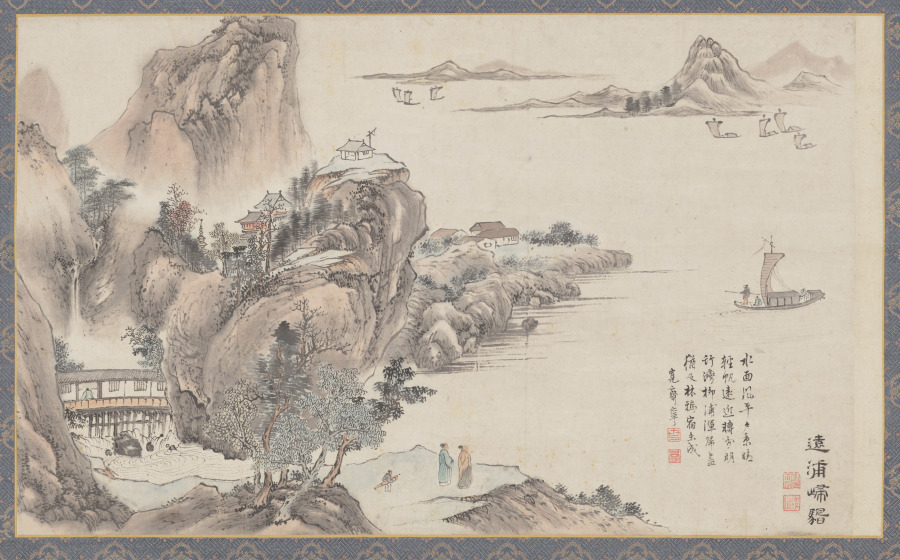
Returning Sails off a Distant Shore, from Eight Views of Xiao-Xiang
瀟湘八景・遠浦帰帆
1788
Album leaf remounted as a hanging scroll; ink and color on paper
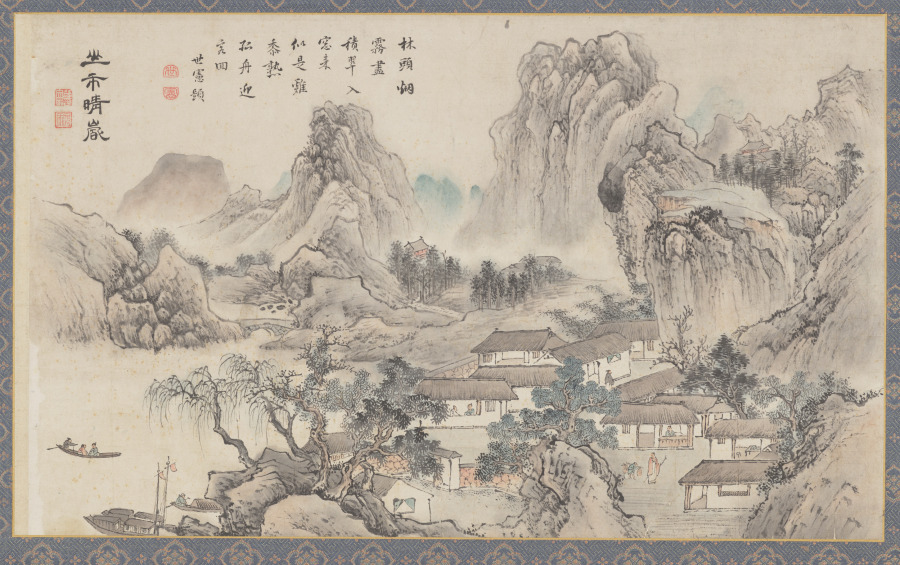
Mountain Market in Clearing Mist, from Eight Views of Xiao-Xiang
瀟湘八景・山市晴嵐
1788
Album leaf remounted as a hanging scroll; ink and color on paper
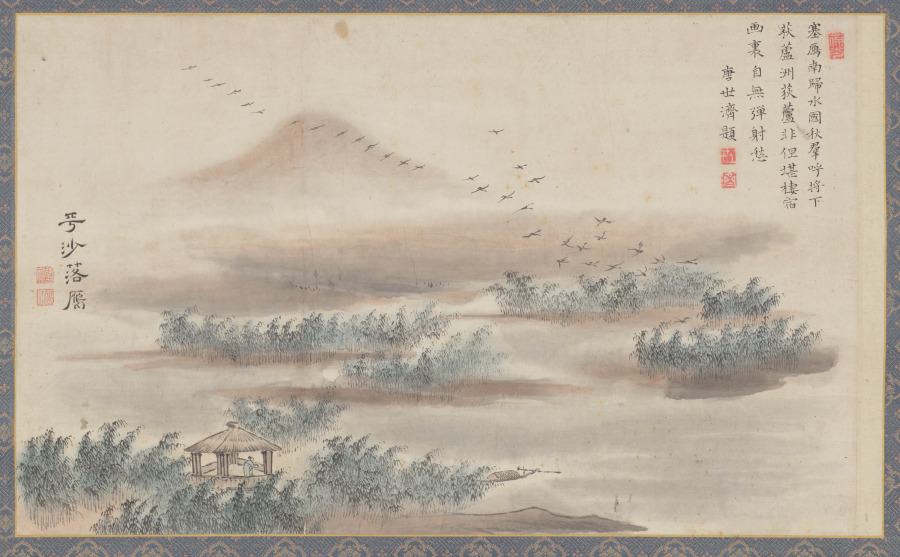
Wild Geese Descending on a Sandbar, from Eight Views of Xiao-Xiang
瀟湘八景・平沙落雁
1788
Album leaf remounted as a hanging scroll; ink and color on paper
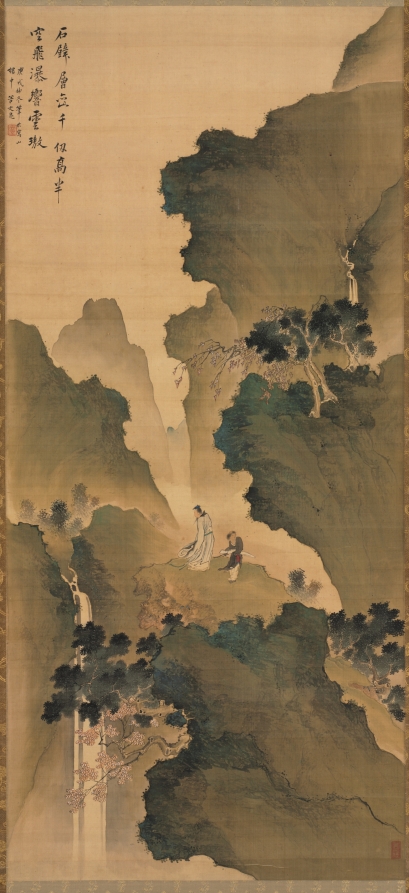
Gazing at a Waterfall
観瀑図
1790
Hanging scroll; ink and color on silk

Bird on Bough, Design Fourteen from Shazanrō Picture Book
写山楼画譜
1816
Woodblock-printed book; ink and color on paper

Grapevine, Design Ten from Shazanrō Picture Book
写山楼画譜
1816
Woodblock-printed book; ink and color on paper

Abidingly Quiet Beneath the Frost, Design Eighteen from Shazanrō Picture Book
写山楼画譜
1816
Woodblock-printed book; ink and color on paper

Honchō gasan and Bunchō's Copy of Toba Sōjō
本朝画纂・文晁臨鳥羽僧正
18th to 19th century
Woodblock-printed book; 1 vol.