
Tomita Keisen
冨田渓仙
1879–1936
Japan
Biography
Tomita Keisen (1879–1936) was a Meiji, Taishō, and early Shōwa nihonga painter whose work bridged the Kyoto Shijō school in which he trained, the Chinese-derived literati (nanga) tradition he helped revive for a modern audience, and the Buddhist iconography of Heian-period Japan that he studied at length. Born in Hakata in northern Kyushu (in what is now Fukuoka City) with the given name Shingorō, he moved to Kyoto as a young man and entered the world of Kyoto painting at a moment when the Maruyama-Shijō tradition was being reformulated by Takeuchi Seihō, Kikuchi Hōbun, and others into the modern Kyoto nihonga that would dominate the prefectural art schools and national exhibitions through the early twentieth century.
Keisen's first teacher was Kinugasa Morimasa (1852–1912), a Kanō-school painter who served as an official artist to the Kuroda clan of Fukuoka. In 1896 he moved to Kyoto and became a student of Tsuji Kakō, a leading Shijō painter and a younger contemporary of Takeuchi Seihō, who emphasized the disciplined sketching-from-life (shasei) of the Maruyama-Shijō tradition while remaining open to broader pictorial experiment. Under Kakō, Keisen acquired the formal grounding in observational drawing of landscape, figure, and bird-and-flower subjects that distinguished Kyoto painting from the more academic Tokyo nihonga schools, while pursuing on his own a deep study of Heian-period Buddhist painting in the temples of Kyoto and Nara, of nanga literati models, and of the decorative Sōtatsu-Kōrin (Rinpa) tradition.
Keisen won national recognition when his Ubune (Cormorant Fishing Boats) was accepted at the Bunten — the salon-style competition established by the Ministry of Education in 1907 — in 1912, a breakthrough that brought him wider fame. From 1915, however, his allegiance shifted to the Saikō Nihon Bijutsuin (Reorganized Japan Art Institute), the Inten exhibition group revived in 1914 by Yokoyama Taikan, Shimomura Kanzan, Imamura Shikō, and other artists as a vehicle for an experimentally minded nihonga that resisted the conservatism of the official salons. He first exhibited with the revived Inten in 1915 and was made a member in 1916, and the Inten became his principal exhibition venue for the rest of his career. Working in Kyoto rather than Tokyo, however, kept his work somewhat apart from the Inten mainstream and gave it a distinctive flavor: nanga compositional habits applied to the wide horizontal sweep of folding screens; literati subjects rendered with the careful colorism and gold-ground decorative practice of Kyoto nihonga; and Japanese landscape and genre subjects — such as the cormorant-fishing boats of his celebrated Ubune — reframed through the same nanga and Rinpa sensibility.
Keisen is credited within the history of modern Japanese painting with reviving the nanga tradition for a twentieth-century audience and with developing a new approach to kachō-ga (bird-and-flower painting) that placed familiar subjects in compositions of unusual atmospheric breadth, often using the wide format of paired folding screens or long hanging scrolls. His treatment of Buddhist subjects reflects the years he spent studying esoteric and Heian-period Buddhist painting in the temples of Kyoto and Nara, while his Chinese-themed works carry the literati sensibility of an artist steeped in classical poetry. In 1923 he was introduced to the French poet and diplomat Paul Claudel, who served as ambassador to Japan from 1921 to 1927, and the two collaborated on illustrated collections of poetry — a collaboration that helped bring Keisen's work to the notice of European literary and artistic circles in the 1920s.
Anchored at the Inten and in the Kyoto painting world, Keisen was elected a member of the Imperial Art Academy (Teikoku Bijutsuin) in 1935. His works are held today by the National Museum of Modern Art, Kyoto — which owns his Ubune of 1912 — the Metropolitan Museum of Art, and other major Japanese and international collections. He died in Kyoto on 6 July 1936, at the age of fifty-six. Although he was less of a system-builder than Yokoyama Taikan in Tokyo or Takeuchi Seihō in Kyoto, his contribution to early twentieth-century nihonga — particularly to the modern reinterpretation of nanga and to the broadening of kachō-ga and figure painting in screen format — places him among the distinctive figures of the Inten generation and a painter whose work has continued to attract serious study in both Japanese and Western scholarship.
Key Facts
- Active Period
- 1879–1936
- Nationality
- 🇯🇵Japan
- Subjects
- Autumn FoliageWinterFish
- Works Indexed
- 8
Frequently Asked Questions
Tomita Keisen (1879–1936) was a Meiji, Taishō, and early Shōwa nihonga painter whose work bridged the Kyoto Shijō school in which he trained, the Chinese-derived literati (nanga) tradition he helped revive for a modern audience, and the Buddhist iconography of Heian-period Japan that he studied at length. Born in Hakata in northern Kyushu (in what is now Fukuoka City) with the given name Shingorō, he moved to Kyoto as a young man and entered the world of Kyoto painting at a moment when the Maruyama-Shijō tradition was being reformulated by Takeuchi Seihō, Kikuchi Hōbun, and others into the modern Kyoto nihonga that would dominate the prefectural art schools and national exhibitions through the early twentieth century.
Tomita Keisen was active from 1879 to 1936.
Tomita Keisen's prints frequently feature autumn foliage, winter, fish.
Original prints by Tomita Keisen can be found in collections including Honolulu Museum of Art (via Wikimedia Commons), Wikimedia Commons (exhibition catalog), National Museum of Modern Art, Kyoto (via Wikimedia Commons), Kyoto Municipal Museum of Art (via Wikimedia Commons).
Woodblock Prints by Tomita Keisen (8)
West Lake
西湖図
1909
Six-panel folding screen; ink and gold on paper

Cormorant Fishing Boats
鵜飼図
1912
Hanging scroll; ink and color on silk

Su Dongpo
蘇東坡
circa 1920
Hanging scroll; ink and color on silk

Autumn in Ohara (right screen)
大原の秋
1921
One of a pair of folding screens; ink and color on paper

Autumn Landscape
秋景図
1921
Hanging scroll; ink and color on silk

A Boat Crossing a Large River
大河渡舟図
1926
Hanging scroll; ink and color on silk
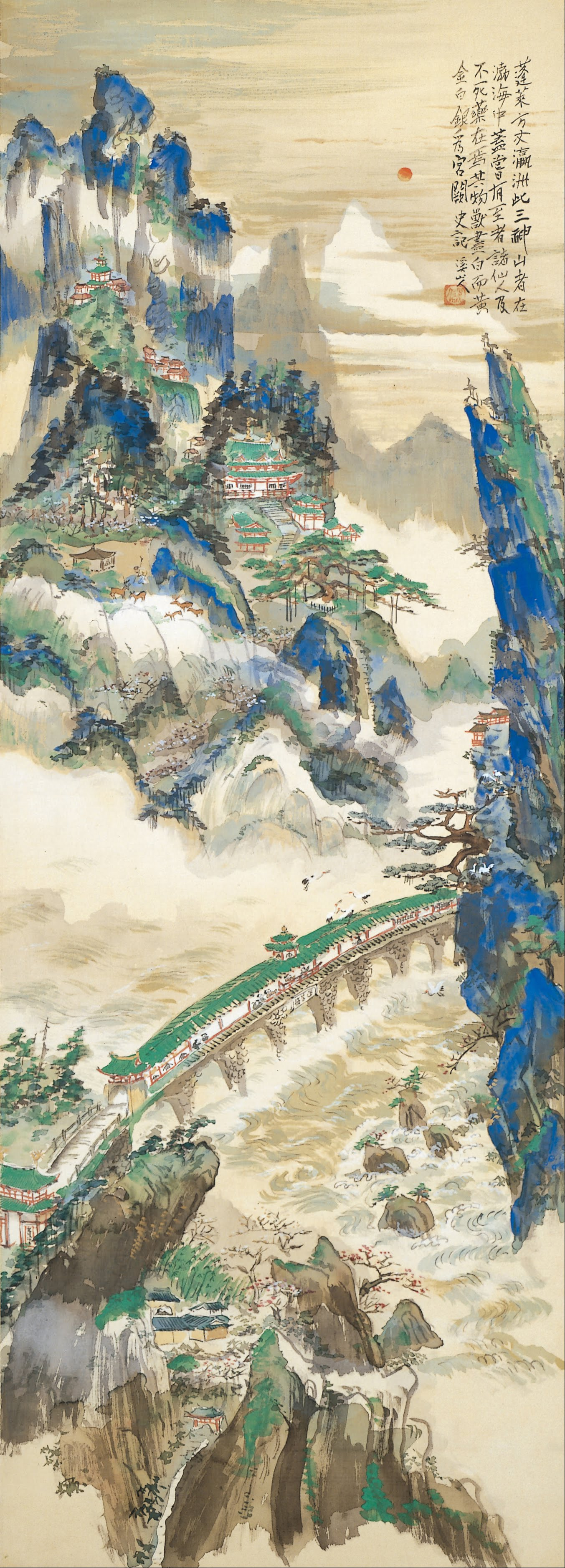
Mount Penglai (Mountain of Immortals)
蓬莱佳境図
1928
Hanging scroll; color on silk

Deer in the Snow
雪中鹿図
1930
Hanging scroll; ink and color on silk