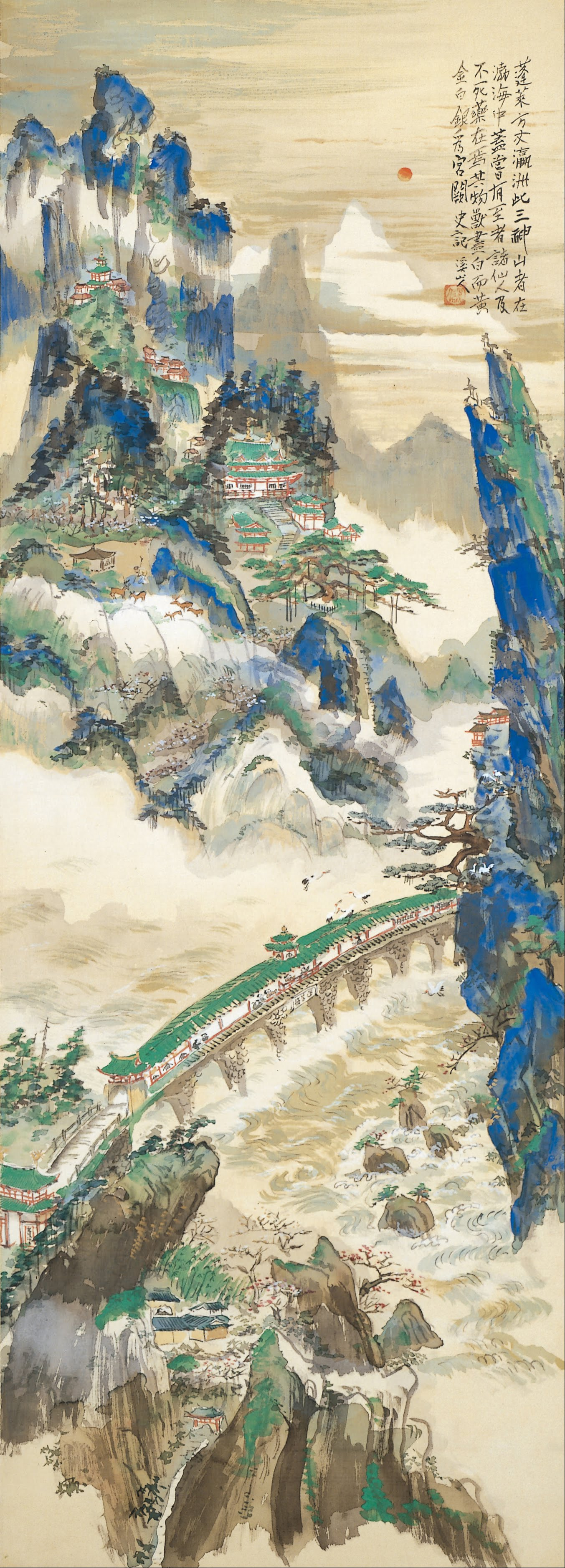
Mount Penglai (Mountain of Immortals)
蓬莱佳境図
- Date:
- 1928
- Medium:
- Hanging scroll; color on silk
Description
Mount Penglai (蓬莱佳境図, Hōrai kakyō-zu) is a hanging-scroll painting of 1928 by Tomita Keisen, in color on silk, measuring 142.7 by 51.4 centimeters and held by the Adachi Museum of Art in Yasugi, Shimane prefecture (accession 58). Mount Penglai (Japanese Hōrai) is the mythical island-mountain home of the immortals in Chinese Taoist cosmology, the easternmost of the three sacred islands of the eastern sea, traditionally said to be inhabited by transcendents amid auspicious flora — pines, plums, cranes — and impossible to reach by ordinary travelers. The motif entered Japanese painting from continental sources and became a standard subject for New Year and birthday paintings carrying associations of longevity, abundance, and immortality. Keisen's treatment, painted in his fiftieth year, organizes the mountain as a rising vertical composition in the tradition of Chinese 'blue-and-green' (qinglü) landscape, with rocky outcrops, layered pines, and atmospheric distance handled in the careful colorist manner of Kyoto nihonga of the late 1920s. The work belongs to the auspicious-landscape branch of his late career and was exhibited and reproduced through the Google Arts & Culture initiative as part of the Adachi Museum's substantial collection of modern Japanese painting.
More Prints by Tomita Keisen


Frequently Asked Questions
Mount Penglai (Mountain of Immortals) (蓬莱佳境図) was created by Tomita Keisen (冨田渓仙) in 1928.