Biography
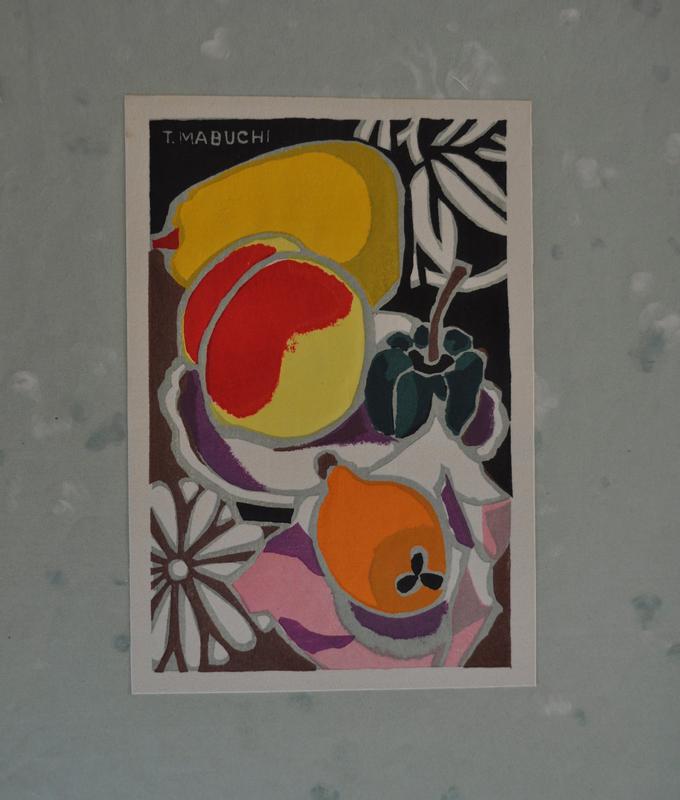
Toru Mabuchi (馬渕聖, 1920–1994) was a sosaku-hanga printmaker known for a meticulous, labor-intensive approach to the woodblock. Born in Tokyo, he was the son of the wood-engraver and commercial artist Mabuchi Rokutaro, and he handled carving tools early through his father's trade. He studied at the Tokyo School of Fine Arts, graduating in 1941, and attended the extracurricular print classes of Hiratsuka Un'ichi, a central teacher of the creative-print movement. In keeping with the sosaku-hanga principle, he designed, carved, and printed his own work.
Mabuchi is best remembered for a distinctive 'mosaic' woodblock technique: rather than carving broad areas from a single block, he cut and assembled numerous small pieces of thin wood into mosaic-like patterns, building each image through many successive printings from multiple blocks. By his own account he arrived at this method after experimenting with juxtaposed spots of color; its exacting nature kept his output relatively small. His subjects ranged across still lifes, landscapes, and the prehistoric haniwa clay figures of ancient Japan.
He exhibited with the Zokei Hanga Kyokai early in his career and was a member of the Nihon Hanga Kyokai (Japan Print Association), and his prints were shown both in Japan and abroad during the decades when Japanese creative prints were gaining international recognition. He also taught printmaking, including at Hiroshima University. Mabuchi remained active into the 1980s and died in 1994 at the age of seventy-four. His work is held today in major public collections, among them the Art Institute of Chicago, the British Museum, and the Museum of Fine Arts, Boston.
Key Facts
- Active Period
- 1920–1994
- Nationality
- 🇯🇵Japan
- Movement
- Sōsaku-hanga
- Works Indexed
- 65
Frequently Asked Questions
Toru Mabuchi (馬渕聖, 1920–1994) was a sosaku-hanga printmaker known for a meticulous, labor-intensive approach to the woodblock. Born in Tokyo, he was the son of the wood-engraver and commercial artist Mabuchi Rokutaro, and he handled carving tools early through his father's trade. He studied at the Tokyo School of Fine Arts, graduating in 1941, and attended the extracurricular print classes of Hiratsuka Un'ichi, a central teacher of the creative-print movement. In keeping with the sosaku-hanga principle, he designed, carved, and printed his own work.
Toru Mabuchi was active from 1920 to 1994. They were associated with the Sōsaku-hanga movement.
Toru Mabuchi's work was shaped by the Sōsaku-hanga tradition in Japanese woodblock printmaking. Sōsaku-hanga: ## What is sōsaku-hanga? Sōsaku-hanga (創作版画, "creative prints") was a twentieth-century Japanese print movement defined by a single commitment: the artist must design, carve, and print every work alone.
Toru Mabuchi's prints frequently feature still life, birds & flowers, spring, fish, food & drink, abstract.
Original prints by Toru Mabuchi can be found in collections including ukiyo-e.org, Ohmi Gallery, Art Gallery of Greater Victoria, Art Institute of Chicago.