Biography
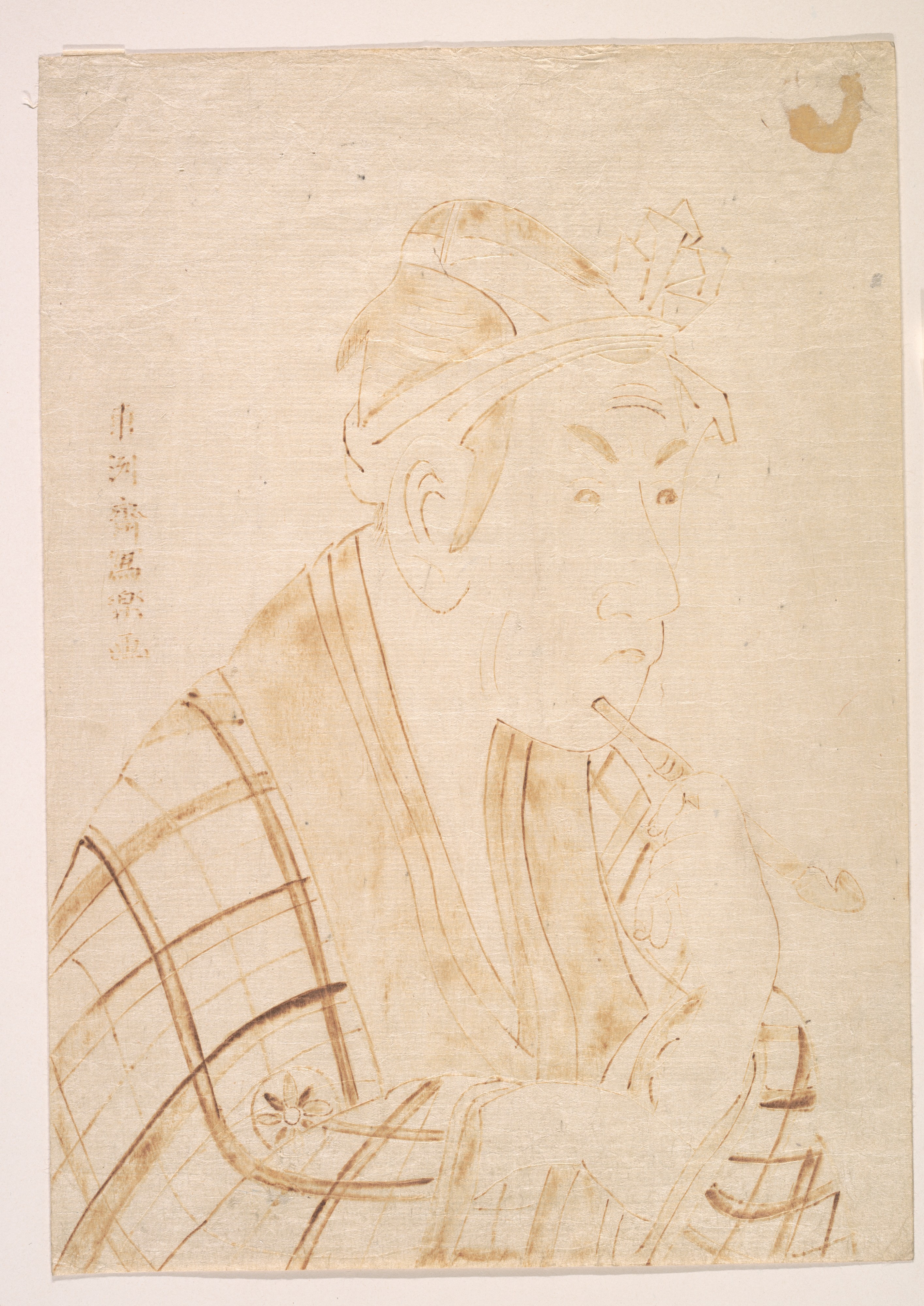
Tōshūsai Sharaku (東洲斎写楽) is among the most enigmatic and influential figures in the history of Edo ukiyo-e. Active for only about ten months between the fifth month of 1794 and the first month of 1795, he produced roughly 140 kabuki actor prints (yakusha-e) along with a small number of sumō prints before vanishing as suddenly as he had appeared. The brevity of his career, the audacity of his style, and the uncertainty surrounding his identity have made Sharaku one of the most studied and debated artists in the ukiyo-e canon, his work alternately dismissed by his contemporaries and exalted by later collectors as one of the supreme achievements of Japanese woodblock printing.
Nothing certain is known of Sharaku's life. The most widely accepted theory, advanced as early as the 1840s and developed by twentieth-century scholars, identifies him with Saitō Jūrobei, a Nō actor in the service of the Awa domain (the Hachisuka clan) living in Edo. This identification is supported by a near-contemporary reference in the encyclopedic source Ukiyo-e ruikō, which describes Sharaku as a Nō performer based in Hatchōbori. Other proposals, including identifications with figures such as Maruyama Ōkyo, Tani Bunchō, Hokusai, or even the publisher Tsutaya Jūzaburō himself, have circulated for centuries without conclusive evidence. The mystery has become inseparable from the appeal of his work.
What is documented beyond doubt is that every known Sharaku print was published by Tsutaya Jūzaburō (1750–1797), the most adventurous publisher of late-eighteenth-century Edo. Tsutaya had already shepherded the careers of Kitagawa Utamaro and the writer-illustrator Santō Kyōden when, in the fifth month of 1794, he launched the unknown Sharaku with an extraordinary debut: twenty-eight ōkubi-e, or large-head portraits, of actors performing in plays then on the Edo stage. These first prints carried mica-dust backgrounds (kira-zuri), a luxury technique that gave each portrait a shimmering silver or charcoal field and signaled Tsutaya's serious investment in the new artist.
Scholars conventionally divide Sharaku's output into four phases corresponding to the kabuki seasons of 1794–1795. Phase 1, in the fifth month of 1794, comprises the celebrated ōkubi-e bust portraits in ōban format on mica grounds—the prints on which his reputation rests. Phase 2, in the seventh and eighth months of 1794, expanded to full-figure and pair compositions, mostly in narrow hosoban format, with the mica ground often abandoned. Phase 3, in the eleventh month of 1794, continued the full-figure approach in less arresting designs. Phase 4, concentrated around the first month of 1795, comprises mainly hosoban images and a handful of sumō prints, after which Sharaku's name disappears from the publishing record.
The distinctive Sharaku style is most fully realized in Phase 1. His ōkubi-e abandon the idealized beauty that dominated yakusha-e by Katsukawa Shunshō, Utagawa Toyokuni, and their followers in favor of an almost caricatural psychological intensity. Hooked noses, jutting chins, asymmetrical mouths, glaring or downcast eyes, knotted brows, splayed fingers, and stage-makeup lines exaggerated to the point of grotesquerie capture each actor mid-performance—not the man in repose, but the role inhabited at a peak emotional moment. The mica ground isolates the figure on a luminous, depthless field, intensifying the confrontation between viewer and subject. The line work is taut and decisive, the color blocks restrained, the compositional cropping unusually tight.
Contemporary reception was mixed. The author of Ukiyo-e ruikō remarked that Sharaku tried so hard to capture the truth of his subjects that his work appeared unnatural, and that public taste turned against him. Whether commercial failure, conflict with the Tsutaya house, ill health, or a return to other duties caused his withdrawal, Sharaku produced nothing under that name after 1795 and is not mentioned again in the documentary record. His publisher Tsutaya Jūzaburō died in 1797, two years after the experiment ended.
Sharaku was effectively forgotten in Japan for most of the nineteenth century. His rediscovery began in the late 1800s through the eyes of Western collectors and critics—Edmond de Goncourt, Samuel Bing, Ernest Fenollosa, and especially the German art historian Julius Kurth, whose 1910 monograph Sharaku presented him as one of the three greatest portraitists in world art, alongside Rembrandt and Velázquez. Kurth's hyperbole helped establish Sharaku as an international canonical figure and prompted Japanese scholars to take up his case in turn. In the twentieth century, his work attracted intense scholarly study: the foundational modern catalogue was Harold G. Henderson and Louis V. Ledoux's The Surviving Works of Sharaku (1939), which reconstructed the actors, roles, and plays behind the prints, and later specialists such as Jūzō Suzuki extended the research on attributions and the chronology of the four phases. Major Sharaku impressions are now held by the Tokyo National Museum, the Museum of Fine Arts in Boston, the Metropolitan Museum of Art, the Art Institute of Chicago, the Cleveland Museum of Art, the British Museum, and the Honolulu Museum of Art, among others.
The influence of Sharaku on modern art has been substantial and broad. His unflinching, almost expressionist treatment of human features and his flat, mica-shimmering grounds resonated with early-twentieth-century European modernists, including the Expressionists and members of Die Brücke, who admired the way he subordinated decorative grace to raw character. Japanese sōsaku-hanga artists of the same period also looked to Sharaku as a precedent for psychological portraiture in the woodblock medium. His prints continue to be quoted, parodied, and reinterpreted in contemporary Japanese design and popular culture.
For a body of work made over a single Edo theatrical season, Sharaku's contribution to ukiyo-e is disproportionately large. He stands as one of the great kabuki actor portraitists of 1794, the partner of Tsutaya Jūzaburō in one of the most ambitious publishing experiments of the period, and a permanent test case for how art history reconstructs a career from prints alone. The unanswered questions of his identity and disappearance remain part of his legend, but the prints themselves—above all the Phase 1 ōkubi-e on mica grounds—have long since outgrown the mystery to take their place among the defining images of Edo ukiyo-e.
Key Facts
- Nationality
- 🇯🇵Japan
- Movement
- Ukiyo-e
- Subjects
- SumoBirds & Flowers
- Works Indexed
- 61
Frequently Asked Questions
Tōshūsai Sharaku (東洲斎写楽) is among the most enigmatic and influential figures in the history of Edo ukiyo-e. Active for only about ten months between the fifth month of 1794 and the first month of 1795, he produced roughly 140 kabuki actor prints (yakusha-e) along with a small number of sumō prints before vanishing as suddenly as he had appeared. The brevity of his career, the audacity of his style, and the uncertainty surrounding his identity have made Sharaku one of the most studied and debated artists in the ukiyo-e canon, his work alternately dismissed by his contemporaries and exalted by later collectors as one of the supreme achievements of Japanese woodblock printing.
Tōshūsai Sharaku's work was shaped by the Ukiyo-e tradition in Japanese woodblock printmaking. Ukiyo-e: ## What is ukiyo-e? Ukiyo-e ([浮世絵](/glossary/ukiyo-e)) — literally "pictures of the floating world" — is the Edo-period Japanese print and painting tradition that flourished from roughly 1660 to 1868, depicting the pleasures of urban life in Edo (modern Tokyo): courtesans, kabuki actors, sumo wrestlers, famous landscapes, and seasonal beauties.
Tōshūsai Sharaku's prints frequently feature sumo, birds & flowers.
Original prints by Tōshūsai Sharaku can be found in collections including Art Institute of Chicago, Metropolitan Museum of Art, ukiyo-e.org, Wikimedia Commons.