Biography
Tsuchiya Rakuzan (土屋楽山, 1896–1976) was a shin-hanga artist who specialized in kacho-e — the traditional genre of bird-and-flower prints — and produced some of the most botanically precise and decoratively refined nature studies in the movement. Born in 1896 in Hyogo prefecture, he worked in Kyoto during the peak decades of kacho-e publishing, when an audience prized technical virtuosity and natural-world subject matter. He first trained as a painter, becoming a pupil of the influential Kyoto master Takeuchi Seiho in 1913 before devoting himself to the woodblock print.
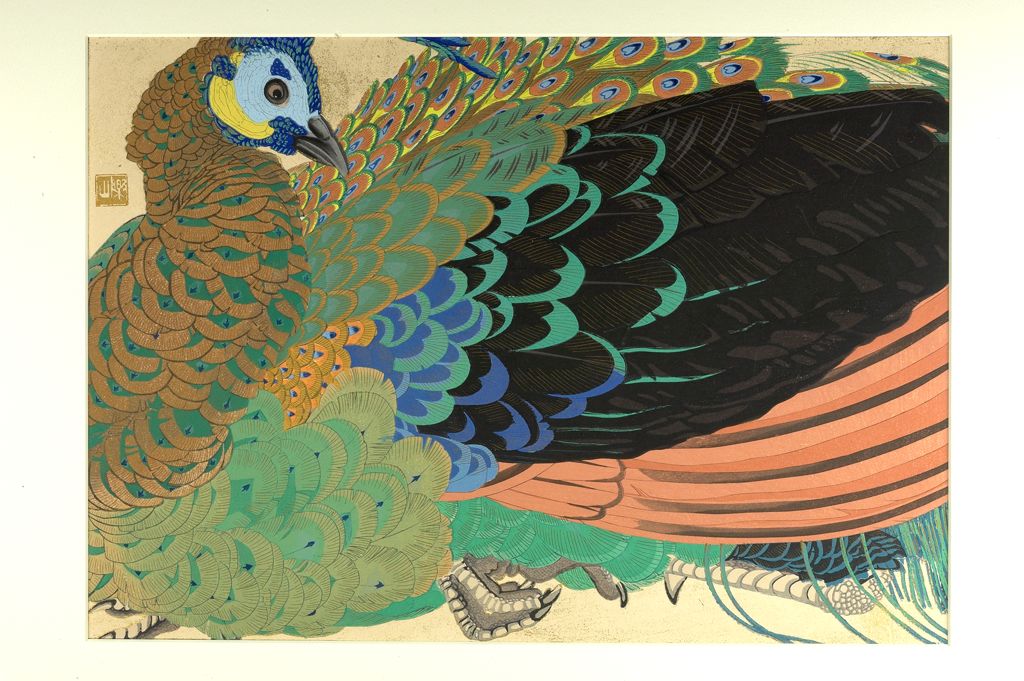
Rakuzan's kacho-e prints depict birds, insects, and plants with a fidelity that reflects careful observation from life: a kingfisher perched on a reed above running water, a pair of Java sparrows on a snow-laden camellia branch, a praying mantis poised on a chrysanthemum stem, dragonflies hovering over lotus pads. His compositions inherit the long tradition of East Asian bird-and-flower painting but adapt it to the woodblock medium with a sensitivity to the specific qualities of carved line and layered water-based pigment. The prints characteristically employ delicate bokashi shading in the backgrounds — pale washes of blue, gray, or rose that evoke atmosphere and season — while the botanical and avian subjects are rendered in crisp, detailed outlines filled with naturalistic color.
Unlike most shin-hanga designers, who worked under a commissioning publisher, Rakuzan largely self-published, overseeing the design, carving, printing, and issuing of his prints himself. His major achievement was the Rakusan Kacho Gafu, a series of roughly a hundred large-scale bird-and-flower prints produced between 1929 and 1933, whose fine registration and subtle color layering testify to the exacting standards he maintained across every stage of production. In the late 1940s his work reached an American audience through a partnership with the California publisher Walter T. Foster.
Rakuzan's work occupies a quieter corner of the shin-hanga world than the landscape prints of Hasui or the bijin-ga of Shinsui, but within the kacho-e specialty his prints are ranked among the finest of the era. He died in 1976 at the age of eighty. His prints are held in public and private collections and continue to appear in specialist dealer inventories worldwide.
Key Facts
- Active Period
- 1896–1976
- Nationality
- 🇯🇵Japan
- Movement
- Shin-hanga
- Works Indexed
- 47
Frequently Asked Questions
Tsuchiya Rakuzan (土屋楽山, 1896–1976) was a shin-hanga artist who specialized in kacho-e — the traditional genre of bird-and-flower prints — and produced some of the most botanically precise and decoratively refined nature studies in the movement. Born in 1896 in Hyogo prefecture, he worked in Kyoto during the peak decades of kacho-e publishing, when an audience prized technical virtuosity and natural-world subject matter. He first trained as a painter, becoming a pupil of the influential Kyoto master Takeuchi Seiho in 1913 before devoting himself to the woodblock print.
Tsuchiya Rakuzan was active from 1896 to 1976. They were associated with the Shin-hanga movement.
Tsuchiya Rakuzan's work was shaped by the Shin-hanga tradition in Japanese woodblock printmaking. Shin-hanga: ## What is Shin-hanga? Shin-hanga (新版画), literally "new prints," is the early twentieth-century revival of the collaborative Japanese woodblock workshop, organized between roughly 1915 and 1960 by the Tokyo publisher Watanabe Shōzaburō (1885–1962) and a handful of competing houses.
Original prints by Tsuchiya Rakuzan can be found in collections including Japanese Art Open Database, Harvard Art Museums, wbp, ukiyo-e.org.