Biography
Tsukioka Sessai (月岡雪斎, died 1839) was an Osaka-based ukiyo-e artist of the late Edo period, the son and pupil of the celebrated bijin-ga painter Tsukioka Settei (1710-1786), and one of the leading kamigata (Kyoto-Osaka region) figure painters working in the decades after his father's death. Active from the late eighteenth century through the Tenpō era (1830-1844), Sessai inherited the Tsukioka studio in Osaka and continued the family's specialism in hand-painted bijin-ga (pictures of beautiful women) while extending the workshop's range into bird-and-flower subjects and figure paintings drawn from Chinese literary and Buddhist sources.
He is properly distinguished from his father, with whom he shares a phonetically related but kanji-distinct art name: the father signed Settei (雪鼎), the son Sessai (雪斎). Both names use the character 雪 (yuki, snow), establishing the studio's lineage, but Sessai's chosen ideograph 斎 (sai, a studio or retreat) differentiates the second-generation master from the first. The kanji distinction matters because the two artists worked in overlapping styles and on overlapping subject matter, and Edo-period collectors and modern scholars alike rely on the signature to attribute works correctly. Sessai also held the honorific Buddhist ranks that the imperial court conferred on lay artists of distinction: he was awarded Hōkyō (Bridge of the Law) in 1778 and was later elevated to Hōgen (Eye of the Law) - titles formerly reserved for Buddhist sculptors and painters that had, by the late eighteenth century, been extended to secular artists of standing.
Sessai trained under his father in the Tsukioka studio, and his mature manner grew directly out of the family's bijin-ga line: refined, hand-painted figural compositions in ink and color on silk or paper, executed in the hanging-scroll and folding-screen formats favored by Osaka merchant patrons rather than in the mass-printed nishiki-e medium that dominated the Edo print market of the same period. Father and son also collaborated on woodblock-printed books that reproduced the compositions of famous earlier paintings - a project whose precise extent across the two careers remains a subject of scholarly attribution.
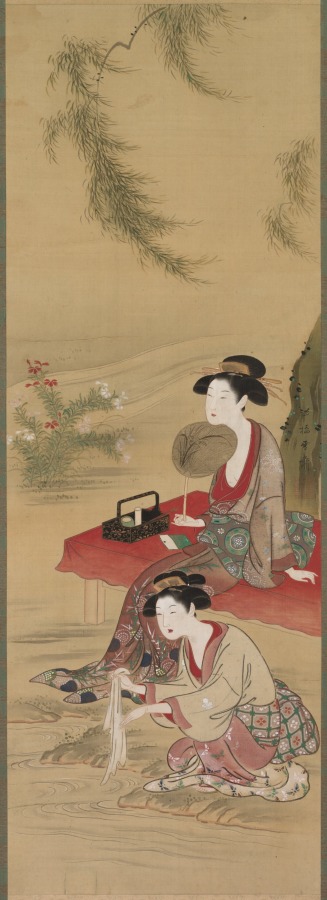
As a painter, Sessai specialized in two genres. The first was bijin-ga, the depiction of beautiful women - typically shown standing, seated by a stream or under a willow, or absorbed in the small everyday gestures of grooming and dress that constituted the visual vocabulary of late Edo women's culture. The second was kachō-ga (bird-and-flower painting), a long-established East Asian genre that Sessai handled in a refined ink-and-color manner. He also produced figure paintings drawn from Chinese literary and Buddhist sources, including the Kiku Jidō (Chrysanthemum Boy) subject - a Taoist immortal said to have lived 800 years by drinking dew from chrysanthemum leaves - whose iconography descended from Chinese painting and was naturalized into the late Edo kamigata visual repertoire.
Sessai's surviving works are held by major museum collections. The Metropolitan Museum of Art holds Puppeteer with Puppet, Kiku Jidō, and a Portrait of a Woman attributed to him, while the Cleveland Museum of Art holds Beneath the Willow (accession 1985.273). The Met's Kiku Jidō entered that collection through the Mary Griggs Burke Collection, reflecting the sustained American interest in kamigata painting that preserved a body of Osaka painted ukiyo-e complementing the Edo-print holdings more familiar to general audiences.
Sessai died in 1839, having spent his career in Osaka and carried the Tsukioka studio's bijin-ga tradition through the half-century after his father's death. He stands today as one of the principal painters of late Edo kamigata ukiyo-e, working in the same decades as Osaka and Kyoto masters such as Mori Sosen and Shibata Gitō, whose preference for the hand-painted format over the woodblock print preserved a tradition of figure and bird-and-flower painting that ran in parallel to the more commercial Edo print culture of the period.
Key Facts
- Active Period
- 1839
- Nationality
- 🇯🇵Japan
- Movement
- Ukiyo-e
- Works Indexed
- 1
Frequently Asked Questions
Tsukioka Sessai (月岡雪斎, died 1839) was an Osaka-based ukiyo-e artist of the late Edo period, the son and pupil of the celebrated bijin-ga painter Tsukioka Settei (1710-1786), and one of the leading kamigata (Kyoto-Osaka region) figure painters working in the decades after his father's death. Active from the late eighteenth century through the Tenpō era (1830-1844), Sessai inherited the Tsukioka studio in Osaka and continued the family's specialism in hand-painted bijin-ga (pictures of beautiful women) while extending the workshop's range into bird-and-flower subjects and figure paintings drawn from Chinese literary and Buddhist sources.
Tsukioka Sessai's work was shaped by the Ukiyo-e tradition in Japanese woodblock printmaking. Ukiyo-e: ## What is ukiyo-e? Ukiyo-e ([浮世絵](/glossary/ukiyo-e)) — literally "pictures of the floating world" — is the Edo-period Japanese print and painting tradition that flourished from roughly 1660 to 1868, depicting the pleasures of urban life in Edo (modern Tokyo): courtesans, kabuki actors, sumo wrestlers, famous landscapes, and seasonal beauties.
Original prints by Tsukioka Sessai can be found in collections including Metropolitan Museum of Art.
