
Biography
Utagawa Kunisada II (二代目歌川国貞, 1823–1880) was a Japanese ukiyo-e woodblock-print designer whose career bridged the final two decades of the Edo period and the opening decade of the Meiji era. As the direct heir to the studio of his father-in-law and teacher Utagawa Kunisada I — the most commercially dominant print designer of the nineteenth century — he inherited an enormous publisher network, a stable subject vocabulary anchored in kabuki actor portraits and Yoshiwara bijin-ga, and a brand-name signature that he would carry through the transition from Tokugawa Edo to imperial Tokyo. His prints, especially the floods of yakusha-e (actor prints) and Genji-themed designs he issued through the 1860s and 1870s, are among the most plentiful surviving woodblock prints from the closing chapter of the floating world.
Born in 1823, he entered the studio of Utagawa Kunisada I — already by then the leading Utagawa-school designer — and by 1844 was signing prints of his own; his birth name and place of origin are not recorded. The sequence of art names he adopted across his career follows the formal conventions of the school, each new gō marking a promotion or transition. His earliest known prints, from the mid-1840s, are signed Kunimasa III (三代目国政), the name under which he did his first mature work in his teacher's manner. In 1846 he married Kunisada I's eldest daughter, Osuzu, and was formally adopted by his master. Around 1850–51 he took the name Kunisada II, the signature he would carry for the rest of his career. Museum catalogues that record his earlier name alongside Kunisada II reflect this sequence of in-studio promotions.
When Kunisada I died in 1865, he formally succeeded his master as head of the Utagawa school. Following the long-standing convention in which the school's senior designer also held the Toyokuni name, he added that title to his signature — becoming, in the numbering now generally used, Toyokuni IV (四代豊国). The Toyokuni count has long been debated by Japanese and Western scholars, and the Art Institute of Chicago's standard form 'Utagawa Kunisada II (Kunimasa III, Toyokuni IV)' captures the three names under which he is most often catalogued.
Through the late Tokugawa years he produced an enormous yakusha-e output, picturing leading kabuki stars in role portraits, triptychs of famous scenes, and the ōkubi-e bust formats his master had refined. Alongside the actor work he carried forward Kunisada I's most lucrative literary franchise: prints based on Ryūtei Tanehiko's bestselling parody novel Nise Murasaki inaka Genji, which had reset the Tale of Genji in the person of the dashing Mitsuuji and set off a craze for 'Genji pictures.' The Cleveland Museum of Art's triptych Rustic Genji's Poetry Contest: Mitsuuji's Excursion to the Seaside to See Abalone Diving, published in 1865, is a representative example.
The political collapse of the Tokugawa shogunate in 1867–68 and the relocation of the imperial capital to Tokyo in 1869 might have ended a designer of his profile, but Kunisada II reinvented his output for the new era. Through the 1870s he continued to issue actor prints and theatre triptychs, but he also produced Meiji-era views of modernizing Tokyo. His 1875 ōban triptych Eight Modern Views of Famous Places in Tokyo of Great Japan (Dai Nippon Tōkyō kaika meisho hakkei no zu), held at the Art Institute of Chicago, belongs to the Meiji genre of kaika-e (enlightenment pictures) that celebrated brick buildings, gas lamps, horse-drawn carriages, and steamships as emblems of bunmei kaika ('civilization and enlightenment'). The aesthetic of these late prints is recognizably transitional: the figures and architectural framework remain in the Utagawa-school manner, but the palette tips toward the aniline reds and purples that flooded the Meiji print market once chemical dyes became cheap and ubiquitous.
He died on 20 July 1880. His pupil Utagawa Kunisada III (1848–1920) carried the Kunisada name into the following generation. His prints are today held in major collections including the Art Institute of Chicago, the Metropolitan Museum of Art, the Cleveland Museum of Art, and the British Museum. While less celebrated than his father-in-law, his work documents the final flowering of Edo print culture and its translation into the Meiji era.
Key Facts
- Active Period
- 1823–1880
- Nationality
- 🇯🇵Japan
- Movement
- Ukiyo-e
- Works Indexed
- 3
Frequently Asked Questions
Utagawa Kunisada II (二代目歌川国貞, 1823–1880) was a Japanese ukiyo-e woodblock-print designer whose career bridged the final two decades of the Edo period and the opening decade of the Meiji era. As the direct heir to the studio of his father-in-law and teacher Utagawa Kunisada I — the most commercially dominant print designer of the nineteenth century — he inherited an enormous publisher network, a stable subject vocabulary anchored in kabuki actor portraits and Yoshiwara bijin-ga, and a brand-name signature that he would carry through the transition from Tokugawa Edo to imperial Tokyo. His prints, especially the floods of yakusha-e (actor prints) and Genji-themed designs he issued through the 1860s and 1870s, are among the most plentiful surviving woodblock prints from the closing chapter of the floating world.
Utagawa Kunisada II was active from 1823 to 1880. They were associated with the Ukiyo-e movement.
Utagawa Kunisada II's work was shaped by the Ukiyo-e tradition in Japanese woodblock printmaking. Ukiyo-e: ## What is ukiyo-e? Ukiyo-e ([浮世絵](/glossary/ukiyo-e)) — literally "pictures of the floating world" — is the Edo-period Japanese print and painting tradition that flourished from roughly 1660 to 1868, depicting the pleasures of urban life in Edo (modern Tokyo): courtesans, kabuki actors, sumo wrestlers, famous landscapes, and seasonal beauties.
Original prints by Utagawa Kunisada II can be found in collections including Metropolitan Museum of Art, Art Institute of Chicago, Cleveland Museum of Art.
Woodblock Prints by Utagawa Kunisada II (3)
The actor Ichikawa Kuzo II as Tanigoro
c. 1842
Color woodblock print; oban
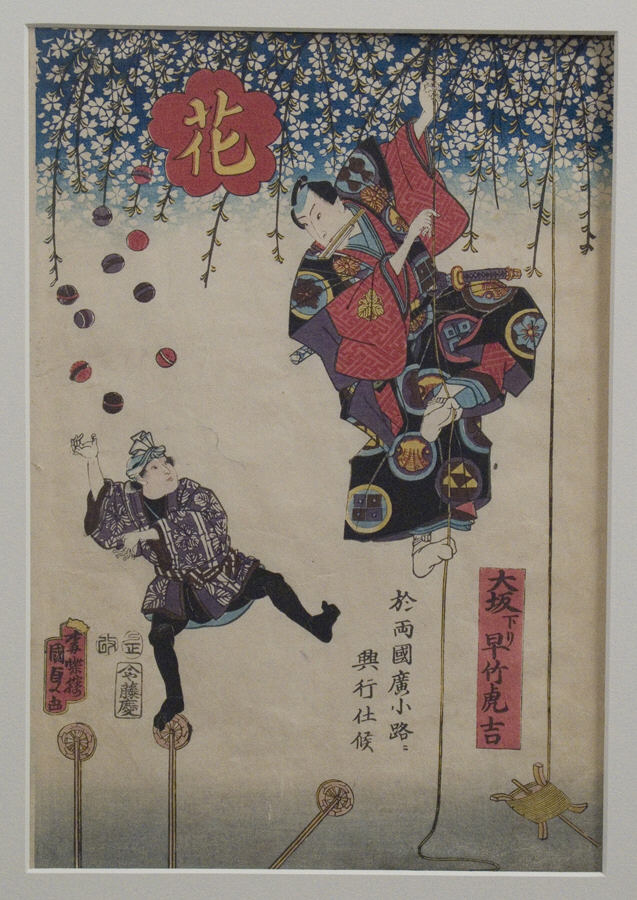
Hayatake Torakichi from Osaka: Performance in Ryōgoku
1857
Woodblock print; ink and color on paper
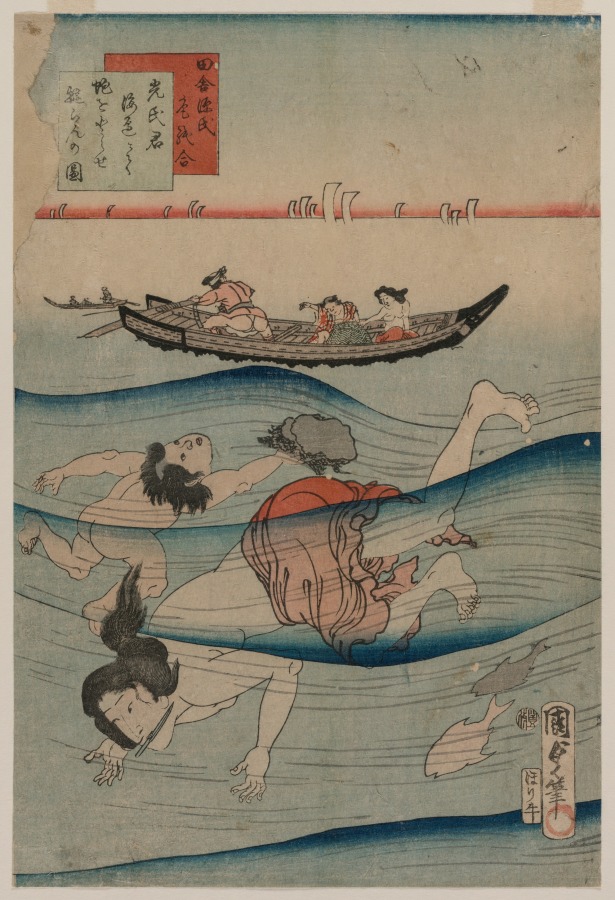
Rustic Genji's Poetry Contest: Mitsuuji's Excursion to the Seaside to See Abalone Diving
1865
One of a triptych of color woodblock prints