Biography
Utagawa Sadahide (歌川貞秀, 1807-1873), also known by the studio names Gountei Sadahide (五雲亭貞秀) and Hashimoto Sadahide, was the most prolific designer of Yokohama-e — the genre of woodblock prints depicting the newly opened treaty port of Yokohama and the encounter between Japan and the West during the 1860s. He produced a body of work that ranged from traditional warrior prints, historical narratives, and beauty subjects in his early decades to the panoramic Yokohama harbor scenes, foreigner portraits, bird's-eye view maps, and depictions of Western commerce for which he is principally remembered.
Sadahide was born in 1807 in Shimōsa Province and entered the Edo studio of Utagawa Kunisada (1786-1865, later Toyokuni III), becoming one of his most prominent pupils. Kunisada was then becoming the most commercially successful print designer of nineteenth-century Japan, and the Utagawa school under him and his peers Kuniyoshi and Hiroshige dominated the ukiyo-e market for the entire century. From the late 1820s onward Sadahide produced prints across the full range of ukiyo-e subjects: warrior prints from medieval chronicles, kabuki and popular fiction, beauty prints, and historical landscapes. He frequently signed with the studio name Gountei (五雲亭, 'Five Clouds Studio'), which became his most recognized brush name during the Yokohama-e years.
The pivotal event of Sadahide's career was the opening of Yokohama as a treaty port in July 1859, following the Harris Treaty of 1858 that ended Japan's two-century policy of national seclusion. Yokohama, a previously inconsequential fishing village on Edo Bay, was rapidly transformed into a bustling enclave where American, British, Dutch, French, Russian, and Chinese merchants established trading houses and a foreign settlement. The visible presence of Western ships, technology, and customs created enormous popular curiosity in Edo, and from 1859 through the mid-1860s a distinct genre of woodblock prints — Yokohama-e — flourished to satisfy it. Sadahide was the dominant designer of the genre, producing dozens of multi-sheet compositions depicting the harbor, the foreign settlement, individual nationalities of foreigners going about their business, trading houses, banquet scenes, pleasure quarters, and bird's-eye views of the entire port. His Yokohama-e are characterized by ethnographic detail — distinct features and costumes for Americans, English, Dutch, Chinese, and Russians — combined with spectacular panoramic compositions and bright pigments, often the newly imported synthetic aniline reds and purples.
Among Sadahide's most ambitious Yokohama works are the great triptychs and pentaptychs of 1860-1861, including 'The Newly Opened Port of Yokohama,' 'Yokohama Trade: Picture of Westerners Shipping Cargo' (a five-sheet pentaptych), 'A True View of a Trading House of a Yokohama Merchant,' 'View of the Yokohama Pleasure Quarters at Cherry Blossom Time,' 'Curio Shop in Yokohama,' and the densely populated interiors 'Foreign Business Establishment in Yokohama' and 'Foreigners in the Drawing Room of Foreign Merchant's House in Yokohama.' These combined the ukiyo-e tradition of multi-sheet panoramic composition with a documentary urge to record the unprecedented spectacle of the Western trading port. Yokohama-e flowed back to Edo as souvenirs of the new port, shaping the popular image of foreigners in late Tokugawa Japan.
Sadahide was also a pioneer of the bird's-eye view (chōkanzu) tradition in print form, designing panoramic maps and elevated perspectives of Edo, Yokohama, and other Japanese cities that combined topographical accuracy with the decorative conventions of woodblock printing. His work in this idiom anticipated the great cartographic prints of the Meiji period and reflects his interest in synthesizing Western perspective and ethnographic specificity with the Japanese print idiom. In the later 1860s he turned increasingly to book illustration; his multi-volume 'Yokohama kaikō kenbunshi' (Record of Observations of the Opening of Yokohama, 1862–66) is one of the most important printed sources for the visual history of the early treaty port. Sadahide died in 1873, just as the woodblock tradition was beginning its decline before photography and lithography.
Sadahide's prints are held by major museum collections worldwide. The Metropolitan Museum of Art has an outstanding holding of his Yokohama-e, including the pentaptych 'Yokohama Trade: Picture of Westerners Shipping Cargo' (JP3389). Other significant holdings exist at the Museum of Fine Arts, Boston, the Cleveland Museum of Art, the Smithsonian's Freer and Sackler Galleries, the Yokohama Museum of Art and Kanagawa Prefectural Museum, and the British Museum and Victoria and Albert Museum in London. Sadahide stands as the visual chronicler of the opening of Japan to the West, and his prints remain primary documents for how Japanese audiences first imagined the foreigners on their shores.
Key Facts
Frequently Asked Questions
Utagawa Sadahide (歌川貞秀, 1807-1873), also known by the studio names Gountei Sadahide (五雲亭貞秀) and Hashimoto Sadahide, was the most prolific designer of Yokohama-e — the genre of woodblock prints depicting the newly opened treaty port of Yokohama and the encounter between Japan and the West during the 1860s. He produced a body of work that ranged from traditional warrior prints, historical narratives, and beauty subjects in his early decades to the panoramic Yokohama harbor scenes, foreigner portraits, bird's-eye view maps, and depictions of Western commerce for which he is principally remembered.
Utagawa Sadahide was active from 1807 to 1873. They were associated with the Ukiyo-e movement.
Utagawa Sadahide's work was shaped by the Ukiyo-e tradition in Japanese woodblock printmaking. Ukiyo-e: ## What is ukiyo-e? Ukiyo-e ([浮世絵](/glossary/ukiyo-e)) — literally "pictures of the floating world" — is the Edo-period Japanese print and painting tradition that flourished from roughly 1660 to 1868, depicting the pleasures of urban life in Edo (modern Tokyo): courtesans, kabuki actors, sumo wrestlers, famous landscapes, and seasonal beauties.
Utagawa Sadahide's prints frequently feature spring.
Original prints by Utagawa Sadahide can be found in collections including Metropolitan Museum of Art, Cleveland Museum of Art.
Woodblock Prints by Utagawa Sadahide (7)
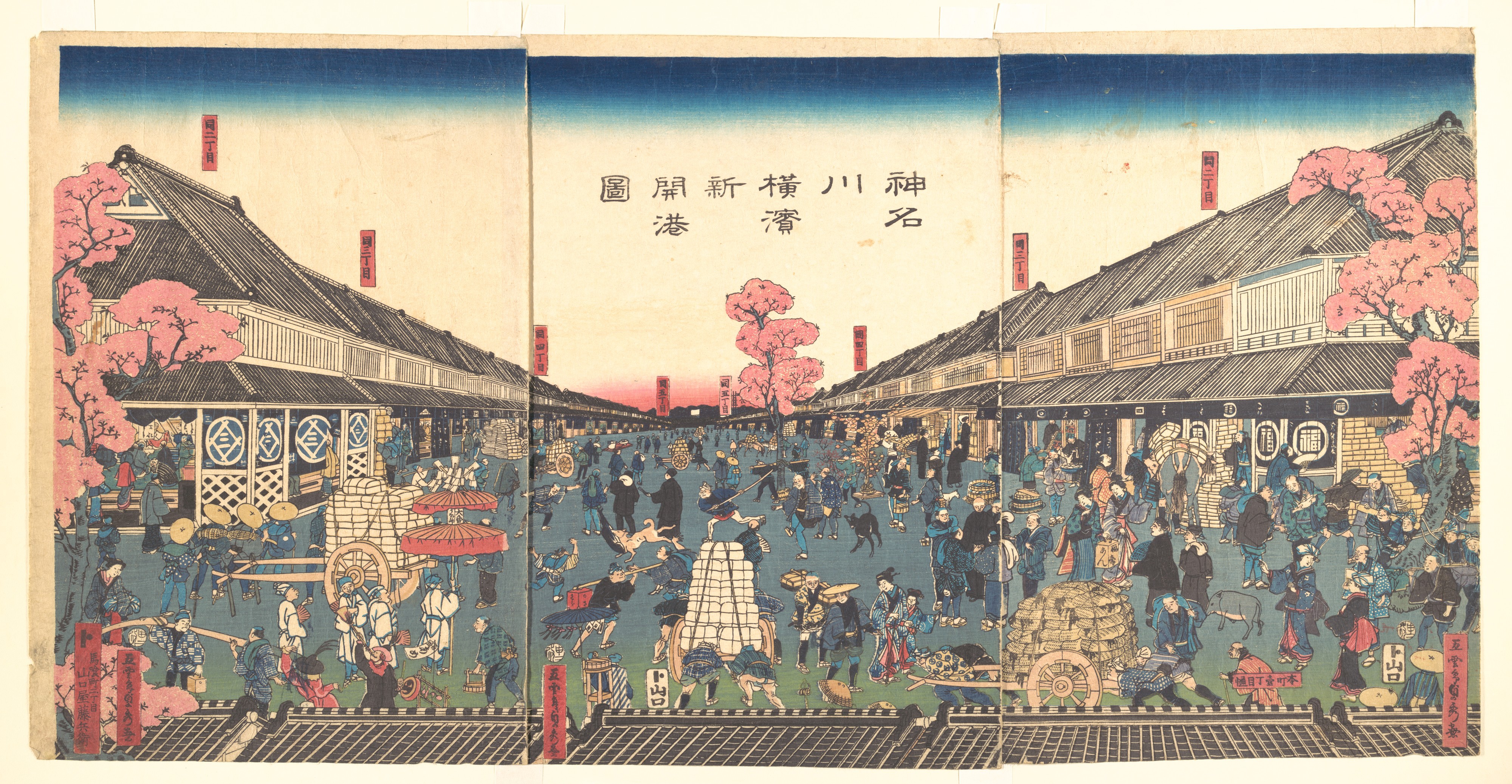
The Newly Opened Port of Yokohama in Kanagawa Prefecture (Kanagawa Yokohama shinkaikōzu)
神奈川横浜新開港図
2nd month, 1860
Triptych of woodblock prints (nishiki-e); ink and color on paper
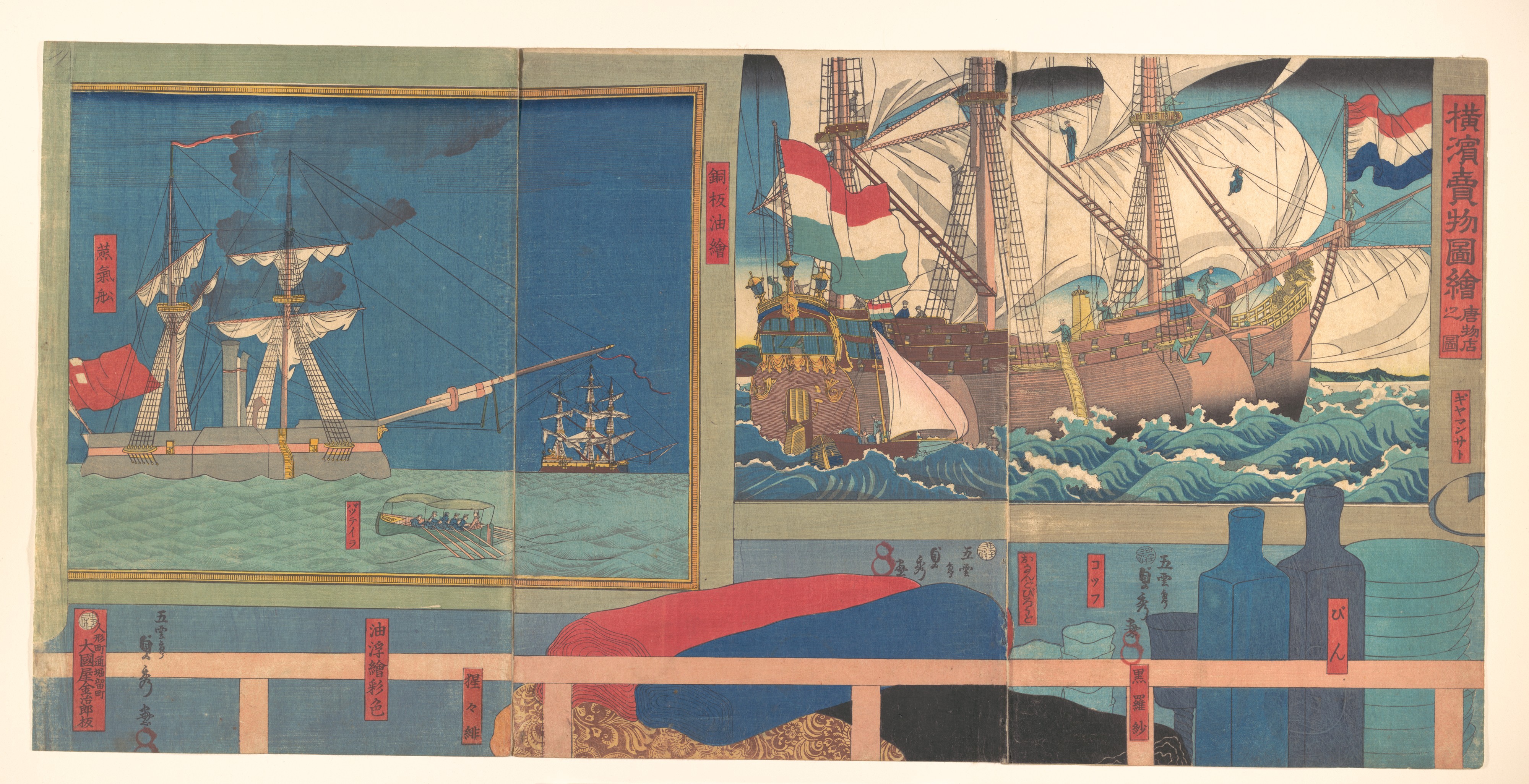
Curio Shop in Yokohama
3rd month, 1860
Triptych of woodblock prints; ink and color on paper
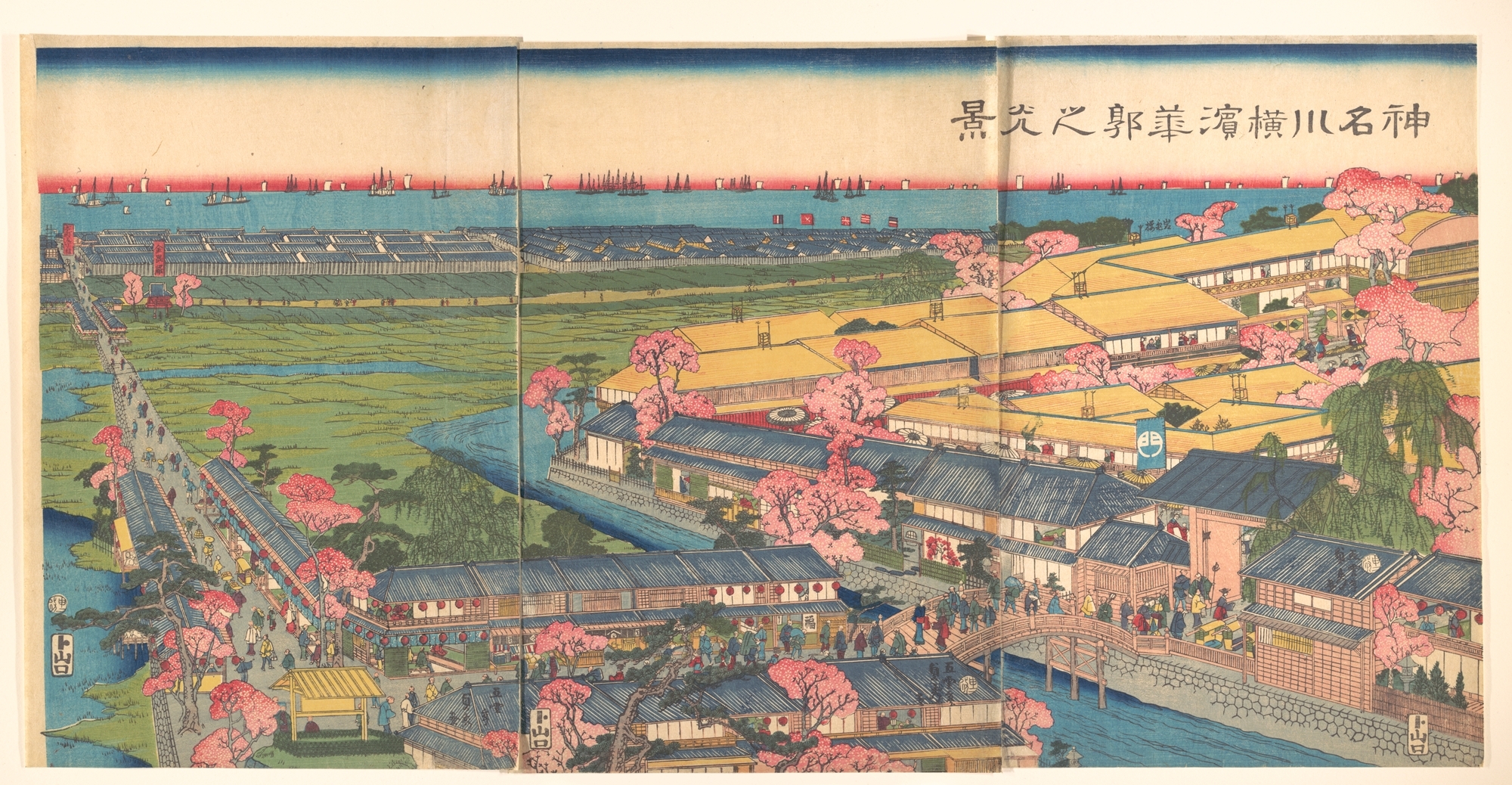
View of the Yokohama Pleasure Quarters of Kanagawa at Cherry Blossom Time
2nd month, 1860
Triptych of woodblock prints; ink and color on paper
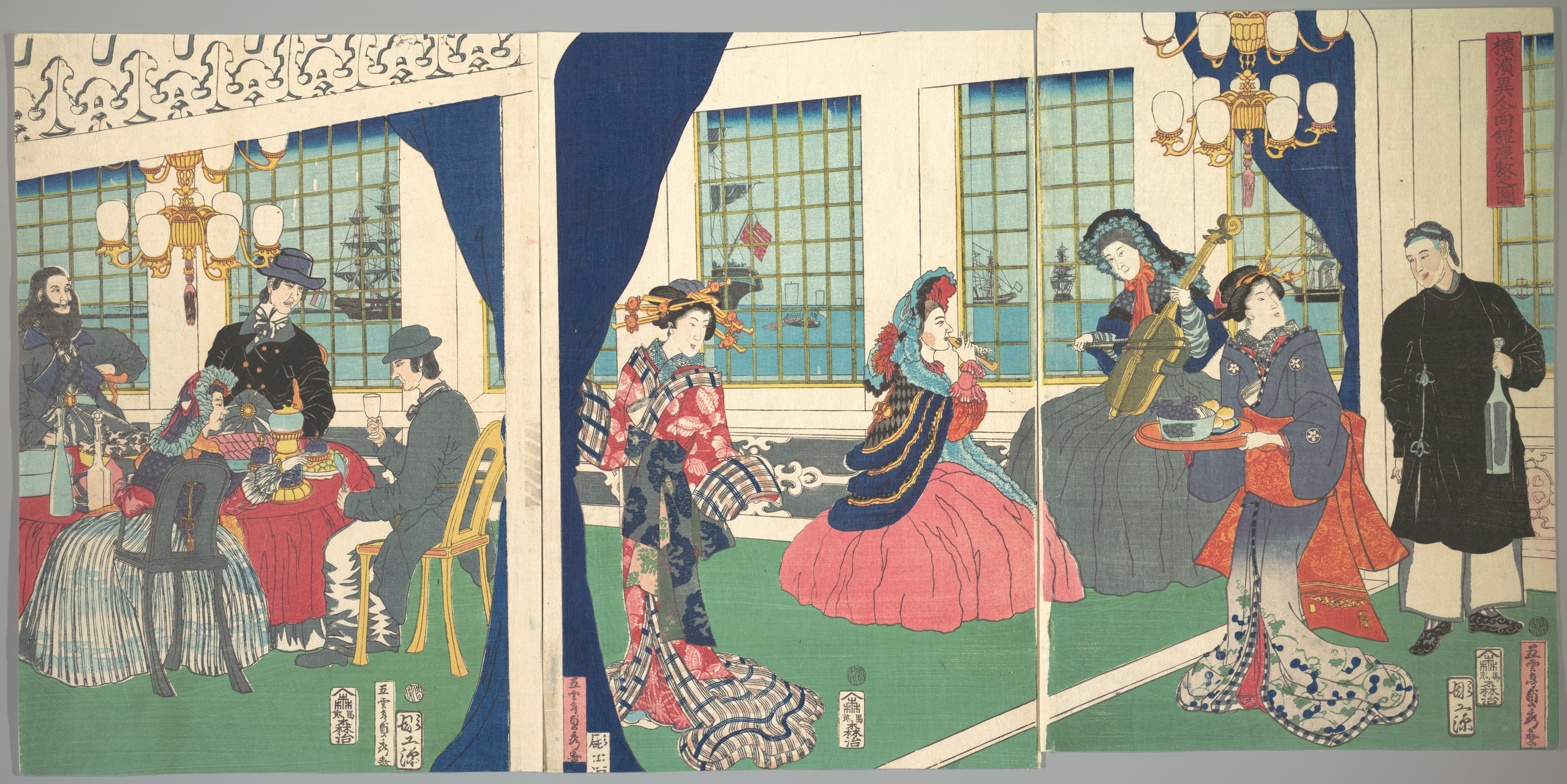
Foreigners in the Drawing Room of Foreign Merchant's House in Yokohama
9th month, 1861
Triptych of woodblock prints; ink and color on paper
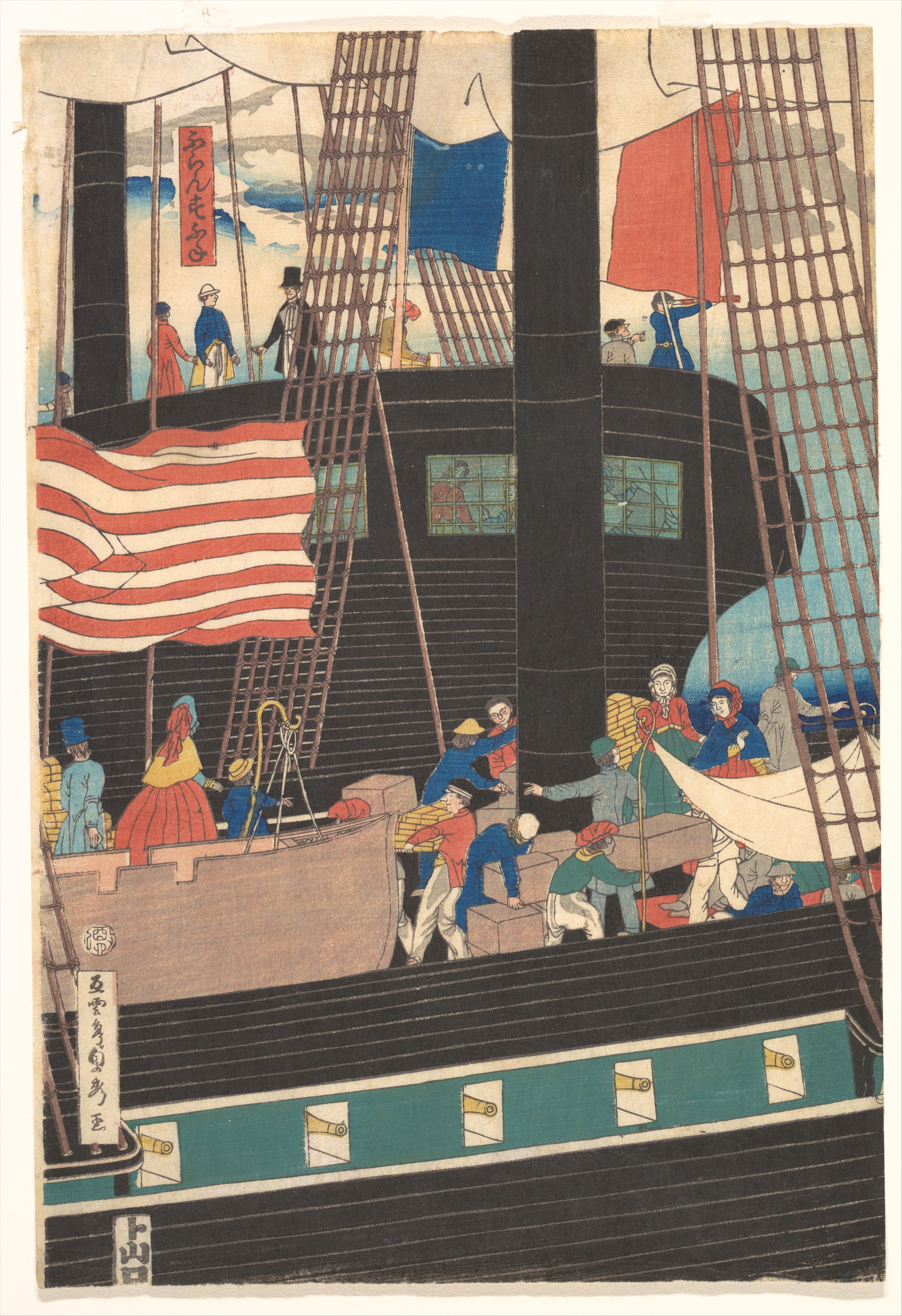
Yokohama Trade: Picture of Westerners Shipping Cargo
April 1861
Ōban pentaptych of woodblock prints; ink and color on paper
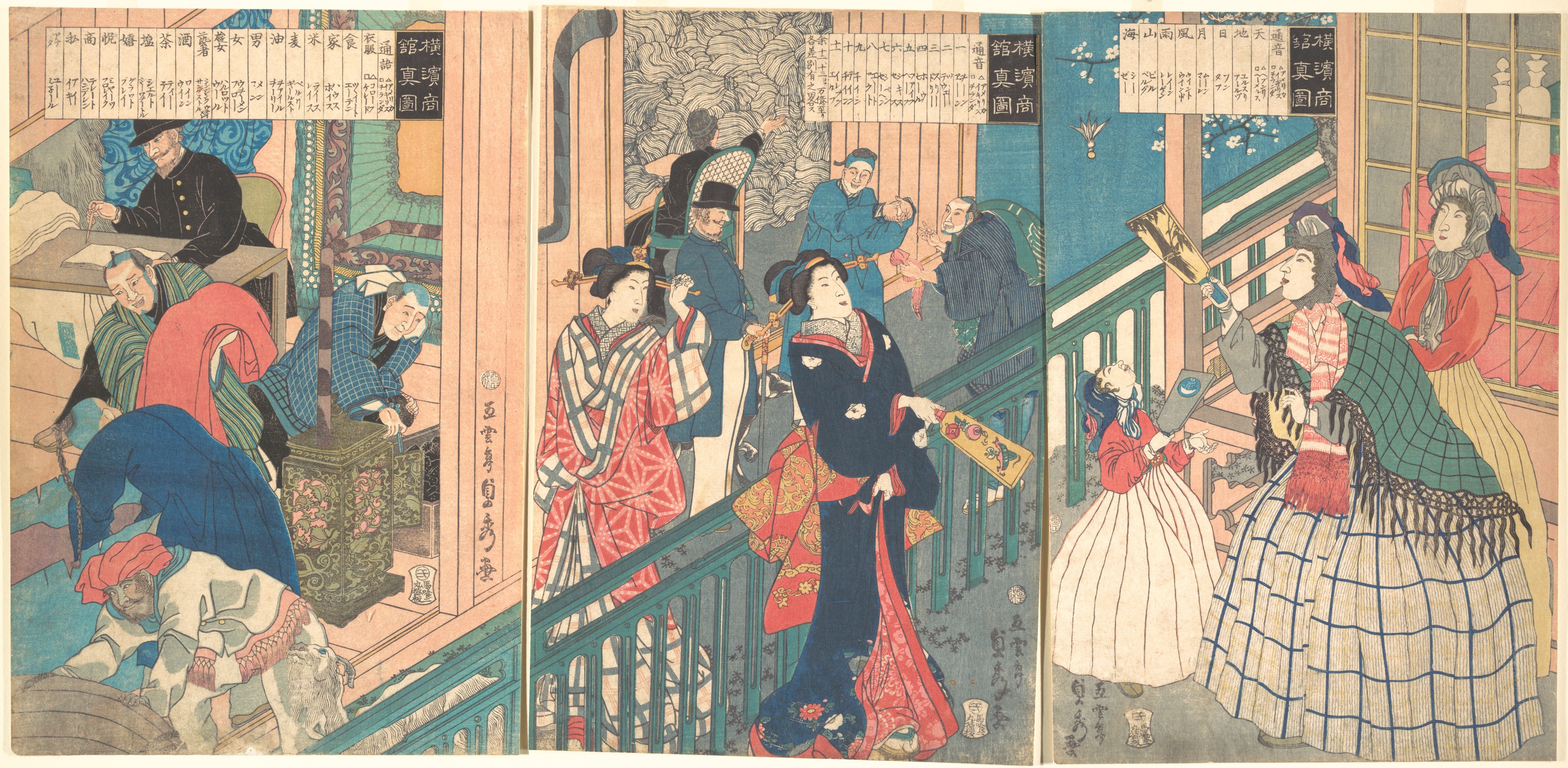
A True View of a Trading House of a Yokohama Merchant
1861
Triptych of woodblock prints (nishiki-e); ink and color on paper; vertical ōban
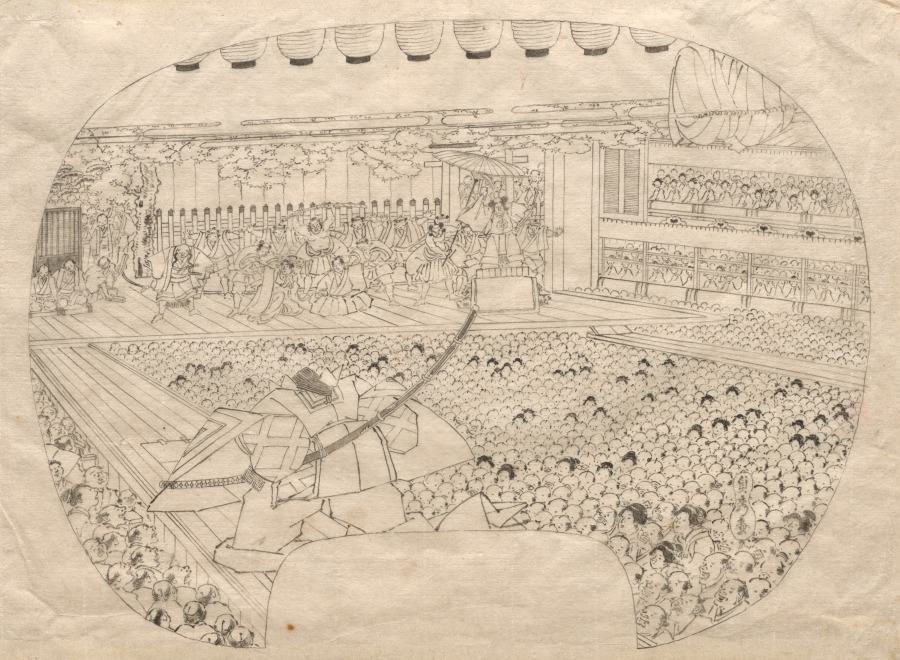
Design for Fan-shaped Print of Kabuki Theater
c. 1830s-60s
Ink on paper