Biography
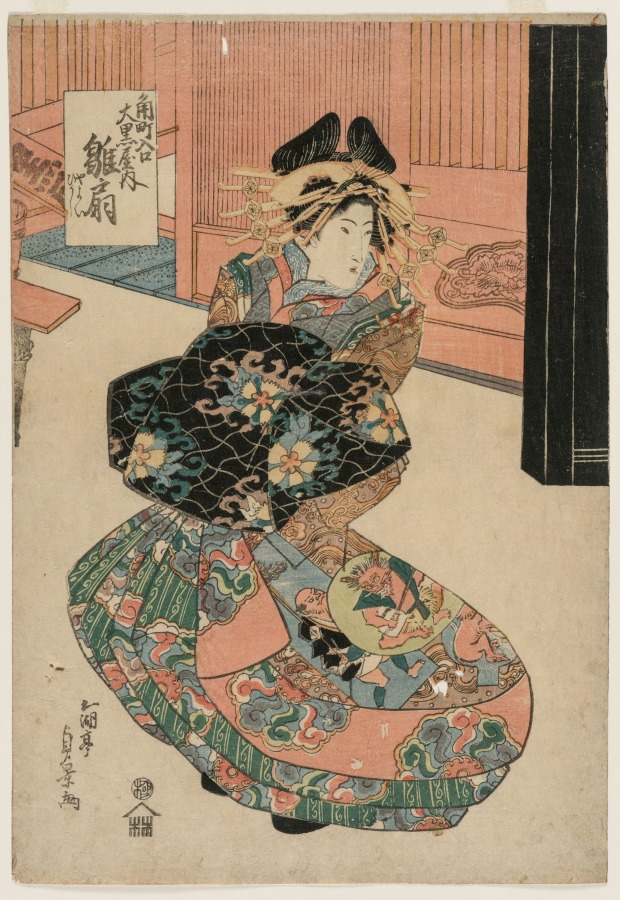
Utagawa Sadakage (歌川貞景, active c. 1818–1844), who also signed his work as Gokōtei Sadakage (五湖亭貞景), was a Japanese ukiyo-e print designer and book illustrator of the late Edo period who worked as a pupil of Utagawa Kunisada (1786–1865) within the prolific Utagawa school. His original family name was Kojima (小島) and his common name Shōgorō (庄五郎); nothing certain is recorded of his birth or death dates. His signed prints and illustrated books cluster across the Bunsei (1818–1830) and Tenpō (1830–1844) eras, placing his active career almost entirely within the final generation of Edo ukiyo-e before the upheavals of the Bakumatsu period. He worked first in Edo and later in Osaka.
Sadakage trained in the studio of Kunisada, who by the second decade of the nineteenth century had become the most commercially successful actor-print and beauty-print designer in Edo and was building one of the largest pupil networks in the history of ukiyo-e. Following the standard convention by which Utagawa students received a single character from the master's art name, Sadakage took the character "Sada" (貞) from Kunisada (国貞). This placed him securely within the Kunisada lineage that produced dozens of designers whose surviving prints are now collectively known as the "Kunisada school" of Edo ukiyo-e.
Sadakage's surviving output is comparatively modest by the standards of his master and his more famous contemporaries Kuniyoshi and Hiroshige, but it is consistent in subject and quality. He specialized in bijin-ga (pictures of beautiful women), depicting fashionable courtesans of the Yoshiwara and contemporary urban women in the elaborately patterned, decoratively rich style that the Utagawa school had codified in the 1810s and 1820s. A single-sheet work such as "Beauty Looking at Her Image in a Mirror" (Metropolitan Museum of Art) typifies his idiom: tall, elegant female figures rendered with patterned kimono, elaborate hairstyles, and the close attention to dress and toilette that defined the late-Edo beauty print.
Alongside his single-sheet prints, Sadakage worked extensively as an illustrator of woodblock-printed books, contributing designs to the many popular illustrated volumes that flowed from the late-Edo publishing trade. He also produced work in other genres — including actor prints (yakusha-e) and hand-painted pictures (nikuhitsu-ga) — though beauty prints and book illustration remained the center of his practice.
The Gokōtei art name (五湖亭) under which he signed many of his prints was a gō (artistic studio name) of the kind that Edo ukiyo-e designers commonly adopted alongside their primary signature. The signature "Gokōtei Sadakage ga" (五湖亭貞景画) appears on a number of his prints and identifies a consistent signing practice.
Sadakage belongs to the substantial group of Kunisada pupils who supplied the steady late-Edo market for bijin-ga and printed books alongside the more spectacular series productions of designers such as Kunisada, Kuniyoshi, and Hiroshige. His work is preserved today in the Metropolitan Museum of Art, the Art Institute of Chicago, and other international collections of Japanese woodblock prints. For collectors and scholars of the late-Edo Utagawa school, Sadakage represents the kind of accomplished but second-tier designer whose output documents the texture of the broader ukiyo-e print industry in the decades before the Meiji Restoration began to dismantle the woodblock tradition.
Key Facts
- Nationality
- 🇯🇵Japan
- Movement
- Ukiyo-e
Frequently Asked Questions
Utagawa Sadakage (歌川貞景, active c. 1818–1844), who also signed his work as Gokōtei Sadakage (五湖亭貞景), was a Japanese ukiyo-e print designer and book illustrator of the late Edo period who worked as a pupil of Utagawa Kunisada (1786–1865) within the prolific Utagawa school. His original family name was Kojima (小島) and his common name Shōgorō (庄五郎); nothing certain is recorded of his birth or death dates. His signed prints and illustrated books cluster across the Bunsei (1818–1830) and Tenpō (1830–1844) eras, placing his active career almost entirely within the final generation of Edo ukiyo-e before the upheavals of the Bakumatsu period. He worked first in Edo and later in Osaka.
Utagawa Sadakage's work was shaped by the Ukiyo-e tradition in Japanese woodblock printmaking. Ukiyo-e: ## What is ukiyo-e? Ukiyo-e ([浮世絵](/glossary/ukiyo-e)) — literally "pictures of the floating world" — is the Edo-period Japanese print and painting tradition that flourished from roughly 1660 to 1868, depicting the pleasures of urban life in Edo (modern Tokyo): courtesans, kabuki actors, sumo wrestlers, famous landscapes, and seasonal beauties.