Biography
Utagawa Toyokuni II (二代目歌川豊国, 1777–1835), known until 1826 by the art name Toyoshige (豊重) and afterwards signing with the gō Gosotei (後素亭), is one of the quietly consequential — and posthumously contested — figures in the Utagawa school of Edo print designers. The principal pupil, adopted son, and son-in-law of Utagawa Toyokuni I (1769–1825), he carried the Utagawa headship through the decade between his teacher's death and his own, only to be overshadowed by his rival and fellow Toyokuni I pupil Utagawa Kunisada (1786–1865), who from 1844 claimed the Toyokuni name in a way that effectively wrote Toyoshige out of the lineage. The modern restoration of his identity as the legitimate Toyokuni II — reflected in the British Museum's authority record (BIOG6956) and in the holdings of the Art Institute of Chicago — has returned a distinctive body of yakusha-e (actor prints), bijin-ga (beautiful women), and landscapes to a designer who in his own lifetime was the recognized successor to the Utagawa workshop.
Born in 1777, Toyoshige entered Toyokuni I's studio in the first decades of the nineteenth century, when the workshop was already the dominant force in commercial ukiyo-e publishing in Edo. Toyokuni I had inherited the Utagawa lineage from its founder Utagawa Toyoharu (1735–1814) and reshaped its output around yakusha-e and bijin-ga for the booming market of the late Kansei and Bunka eras. Toyoshige's earliest signed prints, signed 'Toyoshige ga,' show him working in his teacher's hand on actor portraits, paired bijin compositions, and book illustrations for the same Edo publishers who handled Toyokuni I. He married Toyokuni I's daughter and was formally adopted as his son and heir, a relationship that under Edo atelier conventions made him the successor to the workshop and to the master's name.
Following Toyokuni I's death in Bunsei 8 (1825), Toyoshige took up the Toyokuni signature the next year, in 1826, signing his prints as 'Toyokuni' or 'Gosotei Toyokuni' — the Gosotei studio name distinguishing him from his teacher in informed eyes. Because he lived in the Hongō district of Edo, he is also known as Hongō Toyokuni. It is under these signatures that he produced his best-known landscape work, the series Eight Views of Famous Places (Meisho hakkei), which applies the Chinese 'eight views' (hakkei) convention to famous sites in and around Edo and includes the celebrated design 'Night Rain at Ōyama.' Like the Utagawa school's other answers to the landscape revolution driven by Hokusai's Thirty-six Views of Mount Fuji and by Hiroshige's contemporary work, Toyoshige's landscapes owe much to Hokusai and are more atmospheric than topographical. He also continued to produce yakusha-e and surimono through the late Bunsei and early Tenpō years.
The complication in Toyoshige's posthumous reputation begins with Kunisada. Kunisada, who had not been adopted into the master's family and had no formal claim to the Toyokuni name during Toyoshige's lifetime, waited until after Toyoshige's death in 1835 before publicly assuming the signature 'Toyokuni' in 1844, using it for the rest of his career. Because Kunisada's output flooded the market for the next two decades, and because Western collectors tended to treat any 'Toyokuni'-signed print as being by a single artist, Toyoshige's contribution was often absorbed into and confused with Kunisada's enormous production. Kunisada himself styled his Toyokuni signature as a second-generation claim, implicitly denying Toyoshige's — the source of persistent confusion in older catalogues, where 'Toyokuni II' may refer to either Toyoshige or Kunisada depending on the writer.
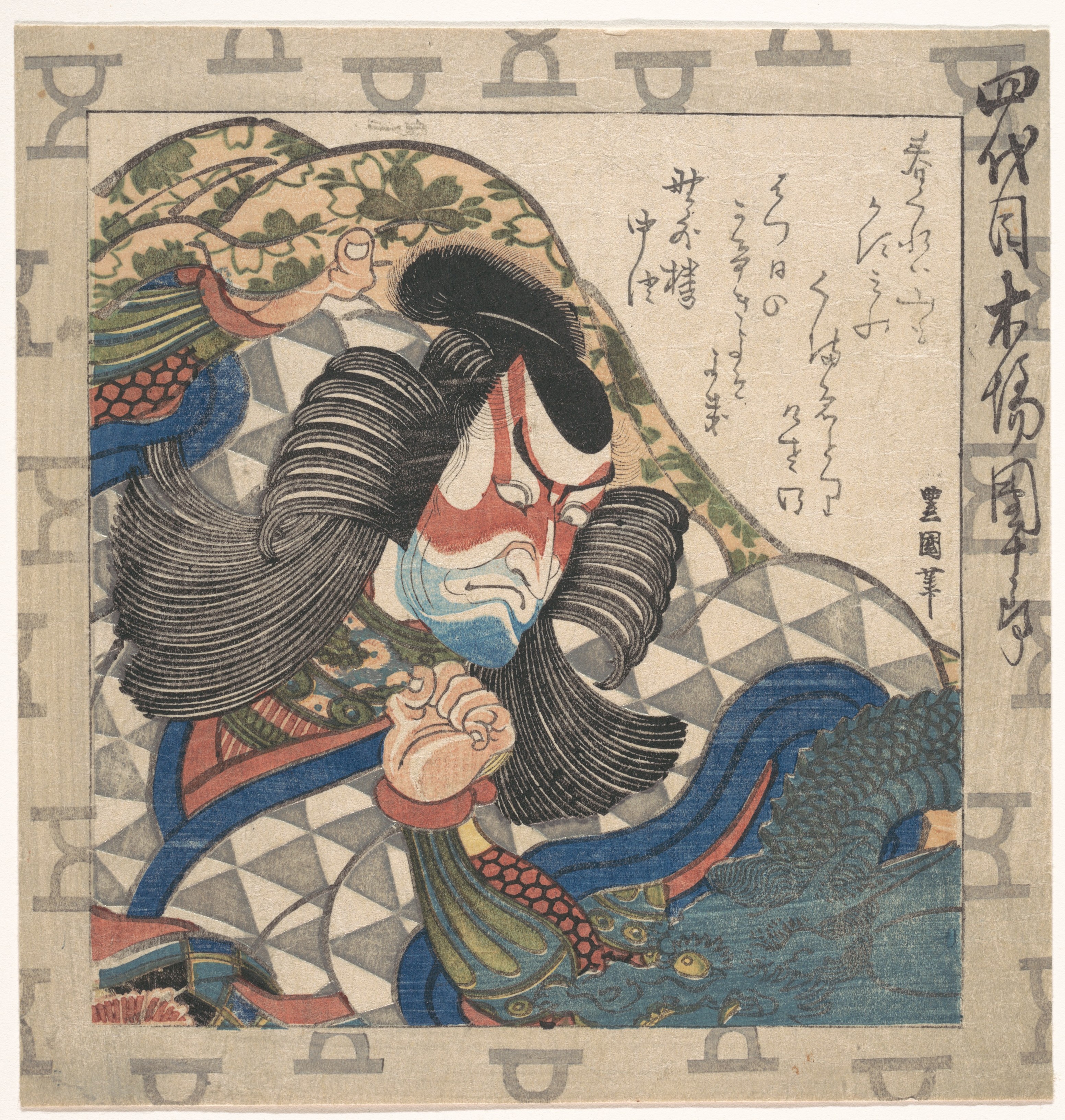
Toyoshige's surviving work is smaller than his teacher's or Kunisada's but distinctive. His actor prints, preserved in the British Museum and other public collections, concentrate on the leading kabuki actors of the Bunka and Bunsei stage — drawn close to his teacher's hand but with a rounder facial type and softer costume pattern. His landscapes are organized around weather and literary association in the Chinese hakkei tradition rather than around a single celebrity site. His work is today held in major public collections, including the British Museum, the Art Institute of Chicago, and the Library of Congress, among others. Having taken up the Toyokuni name in 1826, he retained it until his death in Tenpō 6 (1835).
Key Facts
- Active Period
- 1777–1835
- Nationality
- 🇯🇵Japan
- Movement
- Ukiyo-e
- Works Indexed
- 2
Frequently Asked Questions
Utagawa Toyokuni II (二代目歌川豊国, 1777–1835), known until 1826 by the art name Toyoshige (豊重) and afterwards signing with the gō Gosotei (後素亭), is one of the quietly consequential — and posthumously contested — figures in the Utagawa school of Edo print designers. The principal pupil, adopted son, and son-in-law of Utagawa Toyokuni I (1769–1825), he carried the Utagawa headship through the decade between his teacher's death and his own, only to be overshadowed by his rival and fellow Toyokuni I pupil Utagawa Kunisada (1786–1865), who from 1844 claimed the Toyokuni name in a way that effectively wrote Toyoshige out of the lineage. The modern restoration of his identity as the legitimate Toyokuni II — reflected in the British Museum's authority record (BIOG6956) and in the holdings of the Art Institute of Chicago — has returned a distinctive body of yakusha-e (actor prints), bijin-ga (beautiful women), and landscapes to a designer who in his own lifetime was the recognized successor to the Utagawa workshop.
Utagawa Toyokuni II was active from 1777 to 1835. They were associated with the Ukiyo-e movement.
Utagawa Toyokuni II's work was shaped by the Ukiyo-e tradition in Japanese woodblock printmaking. Ukiyo-e: ## What is ukiyo-e? Ukiyo-e ([浮世絵](/glossary/ukiyo-e)) — literally "pictures of the floating world" — is the Edo-period Japanese print and painting tradition that flourished from roughly 1660 to 1868, depicting the pleasures of urban life in Edo (modern Tokyo): courtesans, kabuki actors, sumo wrestlers, famous landscapes, and seasonal beauties.
Original prints by Utagawa Toyokuni II can be found in collections including Metropolitan Museum of Art.