Biography
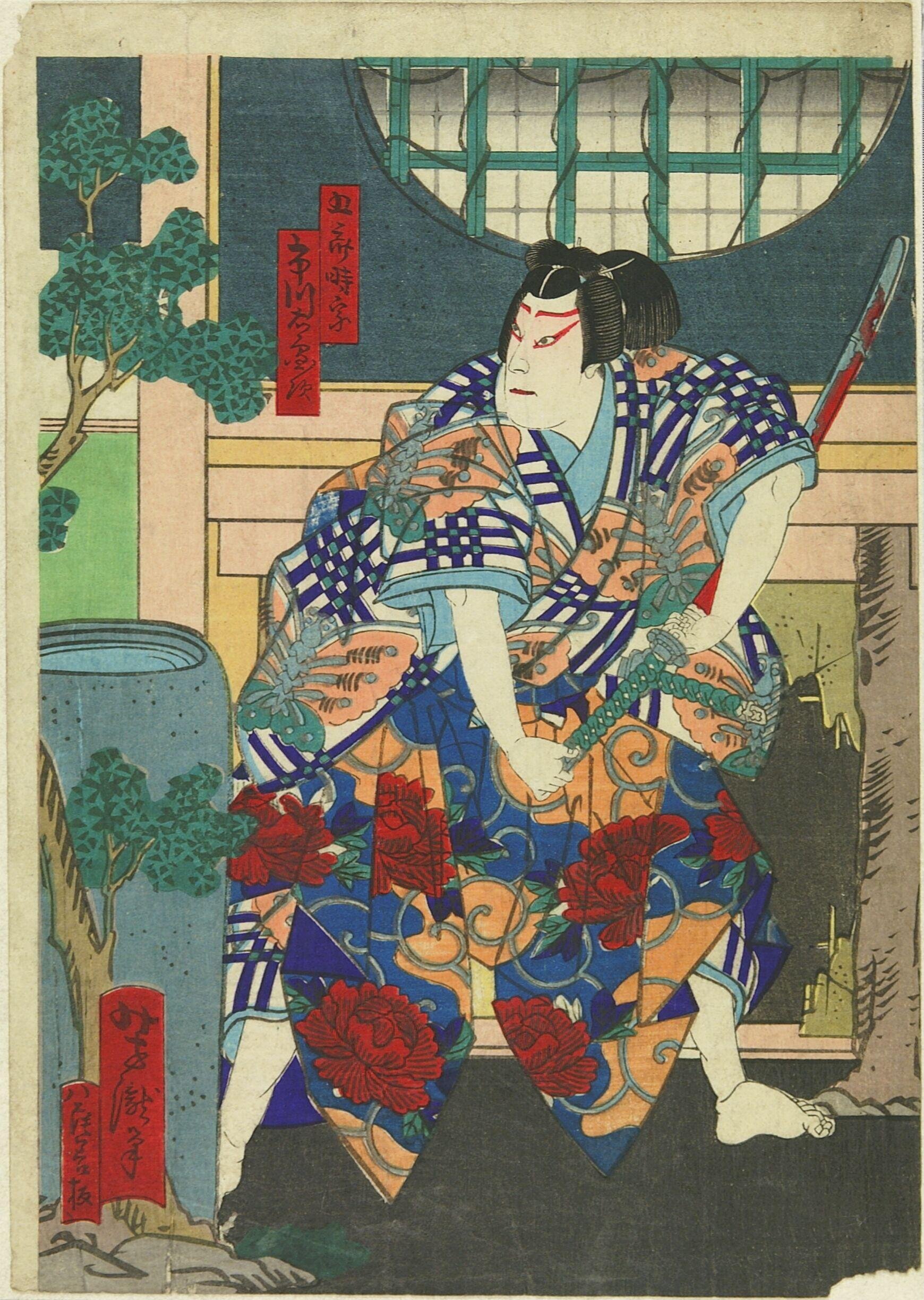
Utagawa Yoshitaki (歌川芳滝, 1841-1899), also known by the art name Ichiyōsai Yoshitaki (一養齋芳滝), was the preeminent woodblock print designer of late nineteenth-century Osaka and one of the most prolific figures in the Osaka kamigata-e tradition. Working through the transition from the Bakumatsu (late Edo) period into the early Meiji era, Yoshitaki produced what scholars estimate to be more than 1,000 separate print designs — by some counts over 1,200 — the overwhelming majority of them yakusha-e (actor prints) depicting performers on the Osaka kabuki stage. He was the dominant kamigata-e designer of his generation and a key figure in the survival of the Osaka woodblock tradition into the modern era.
Yoshitaki was born Nakai Tsunejirō in Osaka in 1841. As a boy he trained under the Osaka print designer Nakajima Yoshiume, who had himself studied with the great Edo master Utagawa Kuniyoshi; it was through this lineage that Yoshitaki entered the Utagawa school, the dominant lineage of Japanese print designers by the mid-nineteenth century. He set out as an independent artist in the mid-1850s, and from his earliest works he focused almost exclusively on yakusha-e: bust portraits, full-length actor studies, mitate (visual parodies), and multi-sheet compositions depicting scenes from current kabuki productions. Alongside actor prints he also produced landscapes (fūkeiga) and warrior prints (musha-e), and in later years he designed nishiki-e shinbun — illustrated newspaper prints — for several Osaka papers.
Osaka prints, known collectively as kamigata-e or Ōsaka-e, differ in important ways from the more famous Edo school of ukiyo-e. They were produced in smaller editions, often by amateur or semi-professional designers connected to specific theatres or theatre clubs, and they were aimed at an audience of devoted kabuki fans rather than the mass tourist market of Edo. The kamigata-e idiom favoured close attention to the physical likeness and signature mannerisms of individual actors, lavish use of decorative techniques such as mica, burnishing, embossing, and metallic pigments, and a more restrained palette compared with Edo brashness. Yoshitaki worked fluently within all these conventions and is often credited with bringing them to their most refined late expression.
From roughly 1860 through the 1880s, Yoshitaki was the leading kamigata-e designer in Osaka. He depicted the major kabuki actors of the Bakumatsu and Meiji stage — including members of the celebrated Jitsukawa acting line — and worked with the city's theatre publishers. His prints functioned as part of the commercial ecosystem of the Osaka theatres: commemorative sheets for special performances, single-sheet portraits sold to fans, and multi-panel compositions depicting kabuki scenes that had been particularly successful that season.
The Meiji Restoration of 1868 brought severe pressure on Osaka's traditional theatre and print industries. Yoshitaki nonetheless continued to produce prints into the 1870s and 1880s, adapting popular kabuki melodramas into richly decorated kamigata compositions incorporating mica and burnishing. By the 1880s the kamigata-e tradition was in steep decline, displaced by photography, lithography, and the centralization of Japanese visual culture in Tokyo, yet Yoshitaki went on designing prints until his death in 1899, standing as one of the last major figures of the Osaka school. His work is held today by major institutions including the Minneapolis Institute of Art, the British Museum, and the Museum of Fine Arts, Boston. For collectors and scholars of kamigata-e and Osaka yakusha-e, Utagawa Yoshitaki is the indispensable late-period master whose work documents the closing chapter of a regional print tradition that had flourished for more than a century in Japan's second great urban centre.
Key Facts
- Active Period
- 1841–1899
- Nationality
- 🇯🇵Japan
- Movement
- Ukiyo-e
- Works Indexed
- 2
Frequently Asked Questions
Utagawa Yoshitaki (歌川芳滝, 1841-1899), also known by the art name Ichiyōsai Yoshitaki (一養齋芳滝), was the preeminent woodblock print designer of late nineteenth-century Osaka and one of the most prolific figures in the Osaka kamigata-e tradition. Working through the transition from the Bakumatsu (late Edo) period into the early Meiji era, Yoshitaki produced what scholars estimate to be more than 1,000 separate print designs — by some counts over 1,200 — the overwhelming majority of them yakusha-e (actor prints) depicting performers on the Osaka kabuki stage. He was the dominant kamigata-e designer of his generation and a key figure in the survival of the Osaka woodblock tradition into the modern era.
Utagawa Yoshitaki was active from 1841 to 1899. They were associated with the Ukiyo-e movement.
Utagawa Yoshitaki's work was shaped by the Ukiyo-e tradition in Japanese woodblock printmaking. Ukiyo-e: ## What is ukiyo-e? Ukiyo-e ([浮世絵](/glossary/ukiyo-e)) — literally "pictures of the floating world" — is the Edo-period Japanese print and painting tradition that flourished from roughly 1660 to 1868, depicting the pleasures of urban life in Edo (modern Tokyo): courtesans, kabuki actors, sumo wrestlers, famous landscapes, and seasonal beauties.
Original prints by Utagawa Yoshitaki can be found in collections including Minneapolis Institute of Art, Victoria and Albert Museum.