
Biography
Utagawa Yoshitsuya (歌川芳艶, 22 February 1822 - 1866), best known by the art name Ichieisai Yoshitsuya (一英斎芳艶) and also signing as Kōko Yoshitsuya, was a designer of late-Edo ukiyo-e woodblock prints who specialized in warrior subjects (musha-e) and historical narrative compositions. He was a pupil of Utagawa Kuniyoshi (1797-1861), the most celebrated warrior-print designer of the nineteenth century, and his career represents one of the most direct extensions of Kuniyoshi's idiom into the late Edo and Bakumatsu periods.
Yoshitsuya was born in Edo in 1822 and entered Kuniyoshi's studio while his master was at the peak of his powers as a musha-e designer, producing the great Suikoden warrior series and the heroic triptych compositions that defined the Utagawa school's mid-century engagement with martial legend. Kuniyoshi's was one of the largest workshops in late-Edo Japan, and Yoshitsuya joined a cohort of pupils that eventually included Yoshitoshi, Yoshiiku, Yoshitora, and Yoshikazu, all of whom signed with the master's distinctive 芳 ("yoshi") character as the first element of their art names. Within this group Yoshitsuya occupied a clearly defined niche as a specialist in warrior and historical-narrative subjects rather than in the actor, beauty, or comic genres other pupils took up.
The musha-e (warrior print) tradition Yoshitsuya inherited drew its subject matter from the great martial epics of medieval Japan and pre-modern China: the Heike monogatari, the Soga monogatari, the legends of Minamoto no Yorimitsu (Raikō) and the Four Heavenly Kings, the Taiheiki, the Suikoden cycle of Chinese outlaw heroes, and the history of the Sengoku-period warlords. Mid-nineteenth century musha-e were closely intertwined with the contemporary kabuki stage, which drew heavily on the same epic narratives, and prints frequently functioned as visual amplifications of celebrated theatrical productions. They were typically issued as ōban triptychs - three full-sized sheets joined to form a single panoramic scene - or as single-sheet portraits in ōban or chūban format. The Tokugawa shogunate's Tenpō Reforms of 1842 had restricted explicit actor portraiture for a period, and warrior prints in this period absorbed some of the energy that would otherwise have gone into yakusha-e, becoming a preferred vehicle for dramatic, colorful, and politically permissible imagery.
Yoshitsuya was active as an independent designer from approximately the early 1840s through his death in 1866. His most ambitious works are dramatic ōban triptychs depicting moments of legendary combat or supernatural encounter, including scenes drawn from the exploits of Minamoto no Yorimitsu (Raikō) and his warriors. He also designed the unusual 1861 series Bankoku jinbutsu zue ("People of Barbarian Nations"), a set of single-sheet portraits of representative foreigners issued just after the opening of Japanese ports to Western trade. The Library of Congress holds the King of Italy and the American sheets, and the King of Italy is also at the Art Institute of Chicago. These "Yokohama-e" prints document the curiosity and anxiety with which the Japanese public received the sudden expansion of foreign contact after the Perry expedition of 1853-1854, and they sit at the intersection of musha-e (which constructed exotic warrior identities) and topical journalism. Yoshitsuya's foreign portraits, executed in his characteristic Utagawa idiom of bold contour and full-bodied color, are among the most striking single sheets of the genre. In parallel with this work he also designed Tōkaidō-station landscape series.
Yoshitsuya died in 1866, two years before the Meiji Restoration, as the political order in which late-Edo musha-e had flourished began to collapse. His pupils, such as Utagawa Kazutoyo and Utagawa Yoshitoyo II, continued the tradition into Meiji, but the dense Bakumatsu warrior-print publishing world largely ended with the Restoration. His prints are held today by major institutions including the Art Institute of Chicago and the Library of Congress, among other major collections of Japanese prints. For collectors of late-Edo Utagawa-school musha-e and Yokohama-e, Yoshitsuya is an indispensable mid-century figure: a direct heir to Kuniyoshi who carried the warrior-print tradition through the Ansei and Bunkyū years into the eve of Meiji.
Key Facts
- Active Period
- 1822–1866
- Nationality
- 🇯🇵Japan
- Movement
- Ukiyo-e
- Works Indexed
- 4
Frequently Asked Questions
Utagawa Yoshitsuya (歌川芳艶, 22 February 1822 - 1866), best known by the art name Ichieisai Yoshitsuya (一英斎芳艶) and also signing as Kōko Yoshitsuya, was a designer of late-Edo ukiyo-e woodblock prints who specialized in warrior subjects (musha-e) and historical narrative compositions. He was a pupil of Utagawa Kuniyoshi (1797-1861), the most celebrated warrior-print designer of the nineteenth century, and his career represents one of the most direct extensions of Kuniyoshi's idiom into the late Edo and Bakumatsu periods.
Utagawa Yoshitsuya was active from 1822 to 1866. They were associated with the Ukiyo-e movement.
Utagawa Yoshitsuya's work was shaped by the Ukiyo-e tradition in Japanese woodblock printmaking. Ukiyo-e: ## What is ukiyo-e? Ukiyo-e ([浮世絵](/glossary/ukiyo-e)) — literally "pictures of the floating world" — is the Edo-period Japanese print and painting tradition that flourished from roughly 1660 to 1868, depicting the pleasures of urban life in Edo (modern Tokyo): courtesans, kabuki actors, sumo wrestlers, famous landscapes, and seasonal beauties.
Original prints by Utagawa Yoshitsuya can be found in collections including Minneapolis Institute of Art, Library of Congress, Art Institute of Chicago.
Woodblock Prints by Utagawa Yoshitsuya (4)
Nakamura Shikan, Ichimura Uzaemon
c. 1840
Color woodcut
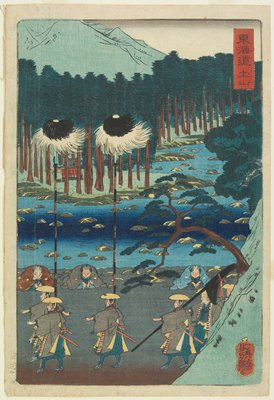
Tsuchiyama
1859, 4th month
Woodblock print (nishiki-e), ink and color on paper
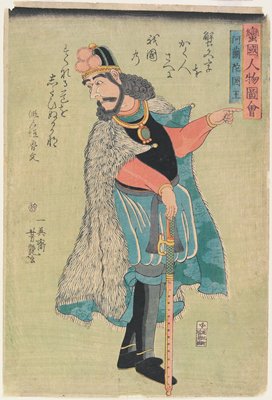
King of Holland
1861, 1st lunar month
Woodblock print (nishiki-e), ink and color on paper

Minamoto Yorimitsu in Mount Ashigara (Minomoto Yorimitsu Ashigarayama iri no zu)
1861
Color woodblock print; oban triptych