Biography
Yamamoto Eishun (山本英春, born 1879) was a Japanese woodblock print designer of the late Meiji period whose career was concentrated almost entirely in the highly specialised field of kuchi-e — the polychrome frontispiece illustrations that were folded into popular novels and literary magazines during the boom years of mass-market Japanese publishing. He belongs to the small group of late-Meiji artists who worked at the seam where the older ukiyo-e workshop tradition met the new world of illustrated periodical literature, and his prints survive today almost exclusively as the inserts of period publications and as loose impressions held in specialist collections and print databases.
Biographical details for Eishun are sparse, as is common for kuchi-e specialists, who were often treated by publishers and the early collecting literature as anonymous illustrators rather than independent print artists. The most consistent biographical thread recorded in reference databases identifies him as a pupil of Migita Toshihide (右田年英, 1863–1925), one of the leading historical, war, and bijin print designers of the late Meiji period and himself a teacher of a circle of younger illustrators. Through Migita's studio Eishun would have absorbed the late-Utagawa-derived figure style that defines so much Meiji-period popular print: long-lined bijin figures rendered with a controlled outline, modest gradated colour, and the legible narrative composition appropriate to a book illustration. Several sources note an alternate reading of his name as Hideharu — not an unusual situation for an artist whose go (art name) was rarely fully documented by the publishers who used him.
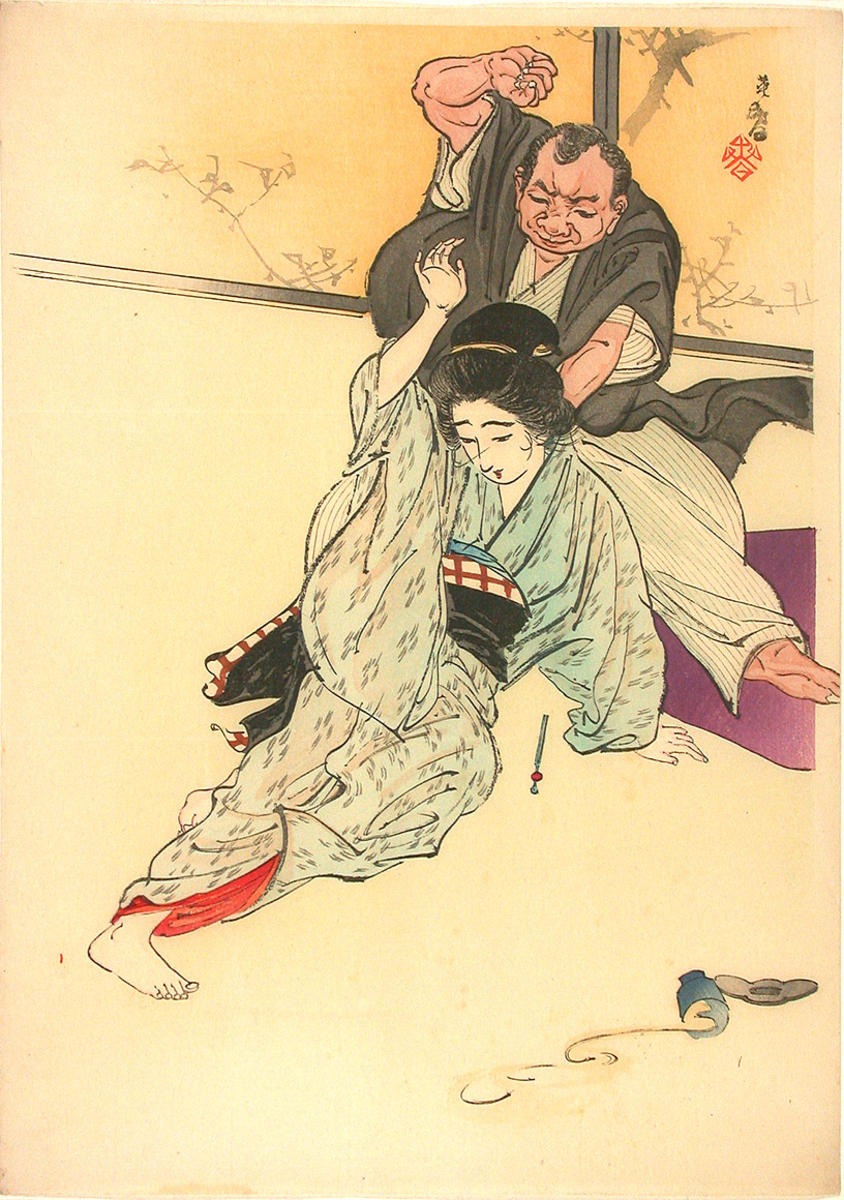
Eishun's professional life unfolded chiefly within the Osaka publishing world, where he produced kuchi-e prints intended for novels and serialised fiction issued by Kansai literary houses. In this he worked in a somewhat distinct stylistic and commercial register from the better-known Tokyo kuchi-e illustrators of the period — designers such as Kajita Hankō, Mishima Shōsō, Takeuchi Keishū, and Tomioka Eisen — whose frontispieces set the fashionable standard for the genre. Among the few of Eishun's designs that have been documented is a domestic-drama scene recorded under the title "Husband Beats Wife," the kind of tense narrative moment that the genre favoured. His datable kuchi-e cluster in the first decade of the twentieth century, roughly 1900–1910, the peak years of the genre before lithographic and photographic frontispieces displaced woodblock kuchi-e from mass-market publishing in the early Taishō period.
The technical features of Eishun's kuchi-e are characteristic of the genre at its mature phase. The sheets were printed in the tall, narrow format typical of kuchi-e, sized to be folded and inserted into the front of a magazine or novel; their compositions are narrative — a moment of domestic drama, a courtesan by the shore, a tense confrontation between a man and a beautiful woman — and the colour tends toward the muted, atmospheric mode of late-Meiji kuchi-e, with delicate gradations (bokashi) in the background and a restrained use of opaque pigment in the figures' robes.
Within the larger picture of Meiji print history, Yamamoto Eishun belongs to the second tier of kuchi-e specialists: a working illustrator whose documented output is very small — current research has turned up only a handful of distinct designs in dealer and database records since the early 2000s — but whose work nonetheless contributes to one of the most important visual cultures of late-Meiji Japan. Kuchi-e was the form through which a mass urban readership encountered colour woodblock images at the moment when ukiyo-e had largely receded from daily life, and artists like Eishun — working at the Osaka end of a Tokyo-centred industry — helped carry the figural and atmospheric vocabulary of nineteenth-century printmaking into the twentieth. For collectors, his prints surface principally through specialist dealers and print databases rather than through the major Western museum print rooms, where Meiji-period kuchi-e remain underrepresented relative to their historical importance.
Key Facts
- Active Period
- 1879
- Nationality
- 🇯🇵Japan
- Movement
- Meiji/Taishō Prints
- Works Indexed
- 6
Frequently Asked Questions
Yamamoto Eishun (山本英春, born 1879) was a Japanese woodblock print designer of the late Meiji period whose career was concentrated almost entirely in the highly specialised field of kuchi-e — the polychrome frontispiece illustrations that were folded into popular novels and literary magazines during the boom years of mass-market Japanese publishing. He belongs to the small group of late-Meiji artists who worked at the seam where the older ukiyo-e workshop tradition met the new world of illustrated periodical literature, and his prints survive today almost exclusively as the inserts of period publications and as loose impressions held in specialist collections and print databases.
Yamamoto Eishun was active born in 1879. They were associated with the Meiji/Taishō Prints movement.
Yamamoto Eishun's work was shaped by the Meiji/Taishō Prints tradition in Japanese woodblock printmaking. Meiji/Taishō Prints: Meiji and Taishō era prints (1868–1926) bridge the transition from traditional ukiyo-e to the modern shin-hanga and sosaku-hanga movements.
Original prints by Yamamoto Eishun can be found in collections including Japanese Art Open Database (JAODB), Robyn Buntin of Honolulu.
Woodblock Prints by Yamamoto Eishun (6)
Husband Beats Wife
c. 1905
Polychrome woodblock kuchi-e print on paper; frontispiece for Bungei Kurabu magazine
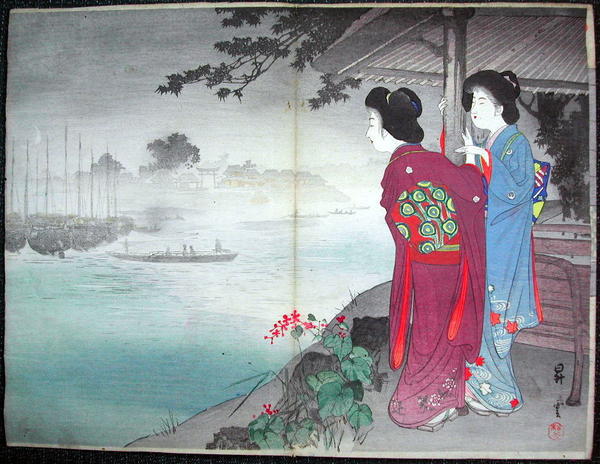
Seashore Landscape and Two Bijin
海辺の景色と二美人
c. 1905
Polychrome woodblock kuchi-e print on paper
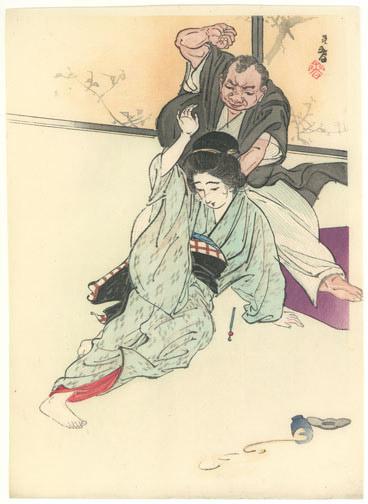
Kuchi-e Story Illustration (II)
c. 1910
Polychrome woodblock kuchi-e print on paper
Kuchi-e Story Illustration (III)
c. 1910
Polychrome woodblock kuchi-e print on paper
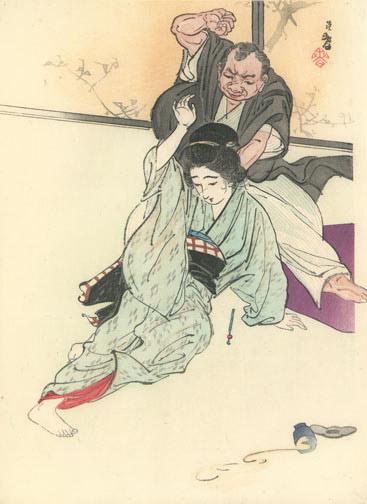
Kuchi-e Story Illustration (I)
c. 1910
Polychrome woodblock kuchi-e print on paper

Kuchi-e Story Illustration (IV)
c. 1910
Polychrome woodblock kuchi-e print on paper