
Biography
Yamamoto Shunkyo (1871-1933) was one of the central figures of Meiji- and Taisho-period Kyoto painting: a Maruyama-Shijo school landscapist by training, an Imperial Household Artist (Teishitsu Gigeiin) from 1917, a founding juror of the government's Bunten exhibition, and the painter most closely identified with the landscape of Lake Biwa and the mountains of central Japan. Working at the moment when the Kyoto painting world was redefining itself in dialogue with the new institutions of Meiji Tokyo, with Western yoga, and with the modern habits of plein-air sketching, Shunkyo produced a body of work that married the Maruyama-Shijo tradition of close observation with a personal feeling for atmosphere, weather, and the experience of walking in mountains. His set of seasonal silk paintings Recesses of Shiobara (Shiobara no oku, 1909, National Museum of Modern Art, Tokyo) is one of the canonical landscape works of late-Meiji nihonga.
Shunkyo was born in 1871 in Zeze-cho, on the shore of Lake Biwa in Shiga Prefecture, in an area now part of the city of Otsu. The lake and its surrounding mountains would remain at the center of his imagination throughout his career, and he returned to Lake Biwa subjects in screens, scrolls, and exhibition pieces from his earliest student work into his last years. Sent to Kyoto as a boy in the early 1880s to train as a painter, he studied first under Nomura Bunkyo (1854-1911); when Bunkyo moved to Tokyo, Shunkyo remained in Kyoto and from 1885 continued his training under Mori Kansai (1814-1894), a leading representative of the late Maruyama-Shijo school. It was in this lineage that he took the art name Shunkyo and absorbed the Shijo repertoire of waterfalls, pines, mountain rivers, and mist-bound valleys, together with the school's characteristic discipline—inherited from Maruyama Okyo's eighteenth-century shasei (sketching from life) practice—of beginning a landscape from sustained outdoor observation rather than from copies of older masters alone.
By the turn of the century Shunkyo had emerged as one of the leading painters of the senior Kyoto generation, his name frequently mentioned together with that of Takeuchi Seiho (1864-1942), a leading figure of Kyoto's modern painting circle. Within that circle Shunkyo was known above all as a landscape specialist. He exhibited at the national venues of the day, including the government's Domestic Industrial Expositions (Naikoku Kangyo Hakurankai), and won recognition for his landscapes. When the Ministry of Education's Bunten exhibition (Monbusho Bijutsu Tenrankai) was inaugurated in 1907—modeled on the French Salon as a national framework for recognizing contemporary Japanese painting—Shunkyo was appointed to its founding jury alongside Takeuchi Seiho and other senior Kyoto and Tokyo painters. He continued to serve on the Bunten and its successor Teiten juries, and to show new work at them, through most of the rest of his life. Recesses of Shiobara, painted in 1909, secured his standing at the highest level and eventually entered the collection of the National Museum of Modern Art, Tokyo, where it remains a touchstone of late-Meiji landscape nihonga.
Lake Biwa and the mountains continued to organize Shunkyo's work throughout his career. He remained closely tied to the Lake Biwa region and traveled to sketch mountain and river landscapes, producing screens and scrolls that range more widely in geography than those of his Shijo predecessors. His late manner—represented by works such as Zuisho (Good Omen, 1931)—combines a drier, more architectural handling of foreground rocks and trees with extensive atmospheric haze in the middle distance. Rather than holding the Shijo landscape apart from foreign influence, Shunkyo absorbed elements of Western realist technique and of photography into it, pushing the tradition toward a heightened attention to light, weather, and depth while keeping its underlying formal language.
Shunkyo's institutional honors followed the Bunten years. In 1917 he was appointed an Imperial Household Artist (Teishitsu Gigeiin), the highest official recognition then available to a Japanese painter, and in 1919 he became a member of the newly established Imperial Academy of Fine Arts (Teikoku Bijutsuin). For many years he taught at the Kyoto municipal art schools, and he also ran his own private painting school in Kyoto, training a younger generation of Kyoto landscape painters. He died in 1933.
With respect to woodblock prints proper, Shunkyo belongs to a category of senior Kyoto nihonga painters—like Takeuchi Seiho and Imao Keinen—whose work circulated primarily through paintings and through the late-Meiji and Taisho reproduction trade rather than through original print designs. Woodblock reproductions after his landscapes were issued in the Kyoto book-and-print trade that also published prints after Seiho and other Shijo painters, and these, alongside the screens and scrolls in major Japanese collections, form a principal Western access point to his work today and place him among the artists central to any account of Kyoto Shijo landscape between the close of the Edo period and the early Showa years.
Key Facts
- Active Period
- 1871–1933
- Nationality
- 🇯🇵Japan
- Movement
- Meiji/Taishō Prints
- Works Indexed
- 12
Frequently Asked Questions
Yamamoto Shunkyo (1871-1933) was one of the central figures of Meiji- and Taisho-period Kyoto painting: a Maruyama-Shijo school landscapist by training, an Imperial Household Artist (Teishitsu Gigeiin) from 1917, a founding juror of the government's Bunten exhibition, and the painter most closely identified with the landscape of Lake Biwa and the mountains of central Japan. Working at the moment when the Kyoto painting world was redefining itself in dialogue with the new institutions of Meiji Tokyo, with Western yoga, and with the modern habits of plein-air sketching, Shunkyo produced a body of work that married the Maruyama-Shijo tradition of close observation with a personal feeling for atmosphere, weather, and the experience of walking in mountains. His set of seasonal silk paintings Recesses of Shiobara (Shiobara no oku, 1909, National Museum of Modern Art, Tokyo) is one of the canonical landscape works of late-Meiji nihonga.
Yamamoto Shunkyo was active from 1871 to 1933. They were associated with the Meiji/Taishō Prints movement.
Yamamoto Shunkyo's work was shaped by the Meiji/Taishō Prints tradition in Japanese woodblock printmaking. Meiji/Taishō Prints: Meiji and Taishō era prints (1868–1926) bridge the transition from traditional ukiyo-e to the modern shin-hanga and sosaku-hanga movements.
Yamamoto Shunkyo's prints frequently feature autumn foliage, spring, waterfalls, winter.
Original prints by Yamamoto Shunkyo can be found in collections including National Museum of Modern Art, Tokyo (via Wikimedia Commons), Honolulu Museum of Art, Richard Lane Collection (via Wikimedia Commons), Daimai Bijutsu no. 163 (1935) (via Wikimedia Commons), Adachi Museum of Art (via Google Arts & Culture / Wikimedia Commons).
Woodblock Prints by Yamamoto Shunkyo (12)
Kiyomizu Temple in Autumn
秋の清水寺
1891
Ink and color on silk

Waterfall
瀧図
circa 1900
Color woodblock print

Beauty and the Thunder God
美人と雷神
1904
Pair of hanging scrolls; ink and color on paper

Spring Landscape
春景山水図
circa 1900–1910
Color woodblock print

Recesses of Shiobara (Autumn), panel 2
塩原の奥(秋)・第二扇
1909
Pair of six-panel screens (one of four panels shown); color on silk

Recesses of Shiobara (Autumn), panel 3
塩原の奥(秋)・第三扇
1909
Pair of six-panel screens (one of four panels shown); color on silk

Recesses of Shiobara (Autumn), panel 1
塩原の奥(秋)・第一扇
1909
Pair of six-panel screens (one of four panels shown); color on silk

Recesses of Shiobara (Autumn), panel 4
塩原の奥(秋)・第四扇
1909
Pair of six-panel screens (one of four panels shown); color on silk
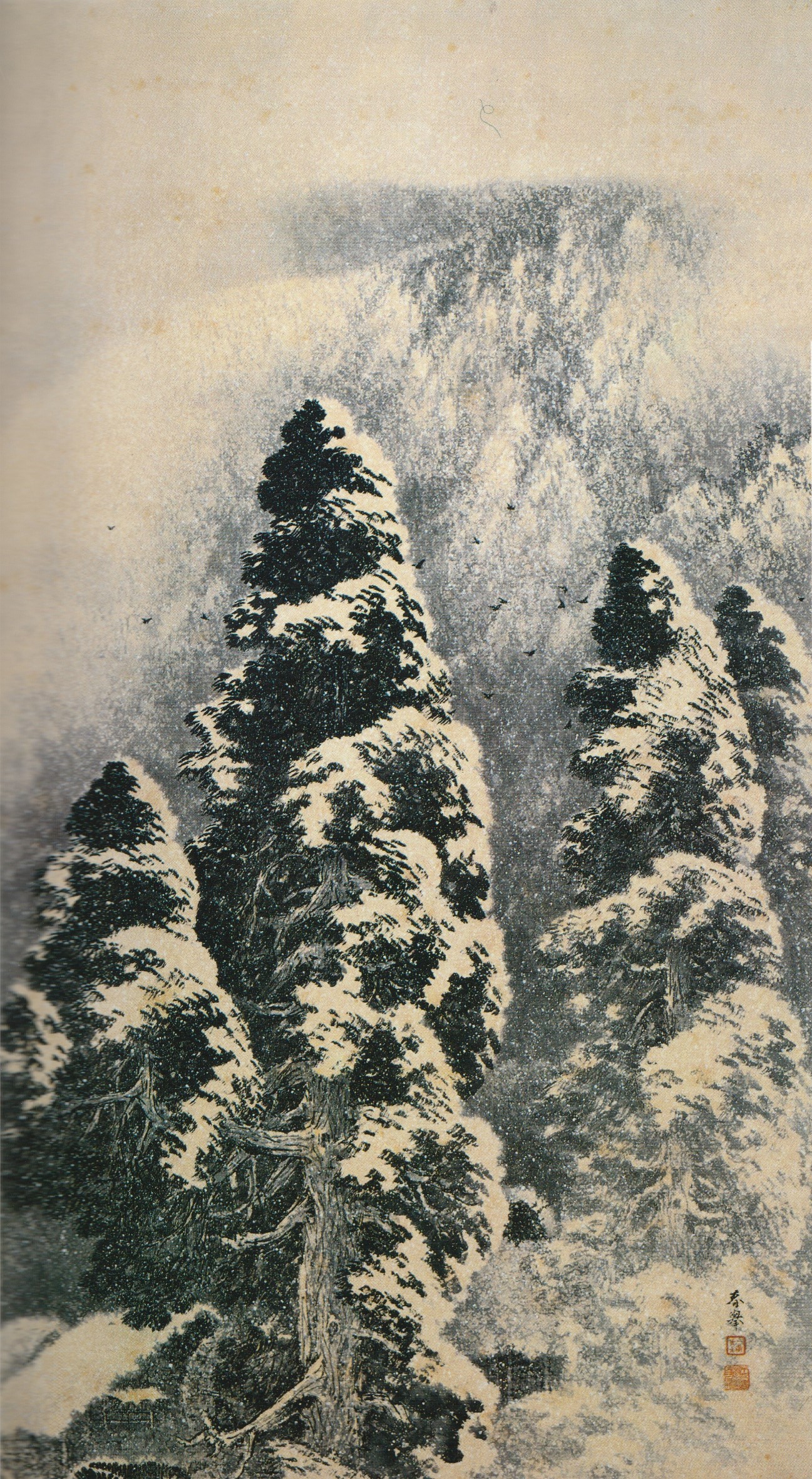
Pines in Snow (Yukimatsu)
雪松図
circa 1922
Hanging scroll; ink and color on silk

Kyōsha fūshu (Sketches in the Narrow Lanes)
水墨 狭斜風趣
before 1933
Ink and wash on paper

Good Omen (Zuishō)
瑞祥
1931
Pair of two-panel folding screens; color on silk

Spring of Mountain (Okuyama no Haru)
奥山の春図
1933
Hanging scroll; color on silk