Biography
Yamamura Kōka (山村耕花, 1885–1942), also active as Yamamura Toyonari (山村豊成) on his woodblock prints, was one of the most original kabuki actor portraitists of the Taishō and early Shōwa periods, an artist who brought a thoroughly modern visual intelligence to the most heavily patterned subject in Japanese popular printmaking. Born in the Shinagawa district of Tokyo in 1885, he trained within the Tokyo painting world that ran from the late-Edo studios into the new state art schools of the Meiji period. From 1896 he studied under the Meiji painter and printmaker Ogata Gekkō (1859–1920), an independent master known for his book illustration and prints.
Kōka went on to study at the Tokyo School of Fine Arts (Tōkyō Bijutsu Gakkō), graduating from the Japanese-painting (nihonga) course in 1907. The curriculum gave him a firm grounding in orthodox nihonga, but the surrounding cultural moment was pulling toward Western pictorial values, and Kōka became fluent in the chiaroscuro and atmospheric perspective of European painting as well as the Japanese tradition. In 1907 he exhibited at the first government-sponsored Bunten salon, and he continued to show there in the years that followed while also working as an illustrator.
The decisive turn came in 1916, when the publisher Watanabe Shōzaburō (1885–1962), impressed by one of his paintings, recruited him to design woodblock prints in the new shin-hanga manner. Watanabe's program was to revive the traditional Edo print workshop, with its division of labor between artist, carver, and printer, but to attach it to artists trained in modern academic painting rather than to the Utagawa-school print specialists of the late Edo period. In the years that followed, Kōka designed a series of actor portraits for Watanabe, developing the half-length actor portrait that would become his signature subject.
Beginning in 1920, again working with Watanabe, Kōka produced the canonical series of twelve kabuki actor portraits generally known as Flowers of the Theatrical World (Rien no hana). Signed with his print name Toyonari, these prints are among the masterpieces of shin-hanga: actors are shown in role as bust- or half-length figures against plain or mica grounds, in deliberate reference to the mica-ground large-head actor portraits (ōkubi-e) of Tōshūsai Sharaku (active 1794–95) and Utagawa Toyokuni I (1769–1825). The emphasis on close psychological scrutiny of a single actor in a specific role draws on the early twentieth-century revival of interest in Sharaku that critics and collectors had pursued for years.
Stylistically, however, Kōka's actors are unmistakably products of the early Shōwa modern. He drew with precision on textile pattern, hairline edges, and facial musculature, but he modeled flesh and fabric with a soft Western chiaroscuro that ukiyo-e of the eighteenth century never used; he assigned costume colors in modulated harmonies that betray a debt to European academic painting and to the poster artists then circulating widely in Tokyo's design culture; and he composed his portraits with an eye to the new psychological intimacy that the modern stage, the cinema, and the studio photograph had introduced into Japanese visual culture by 1920. The result is a body of actor prints that simultaneously revive the most exalted traditions of Edo-period ukiyo-e and stand as some of the first genuinely modernist Japanese portraits.
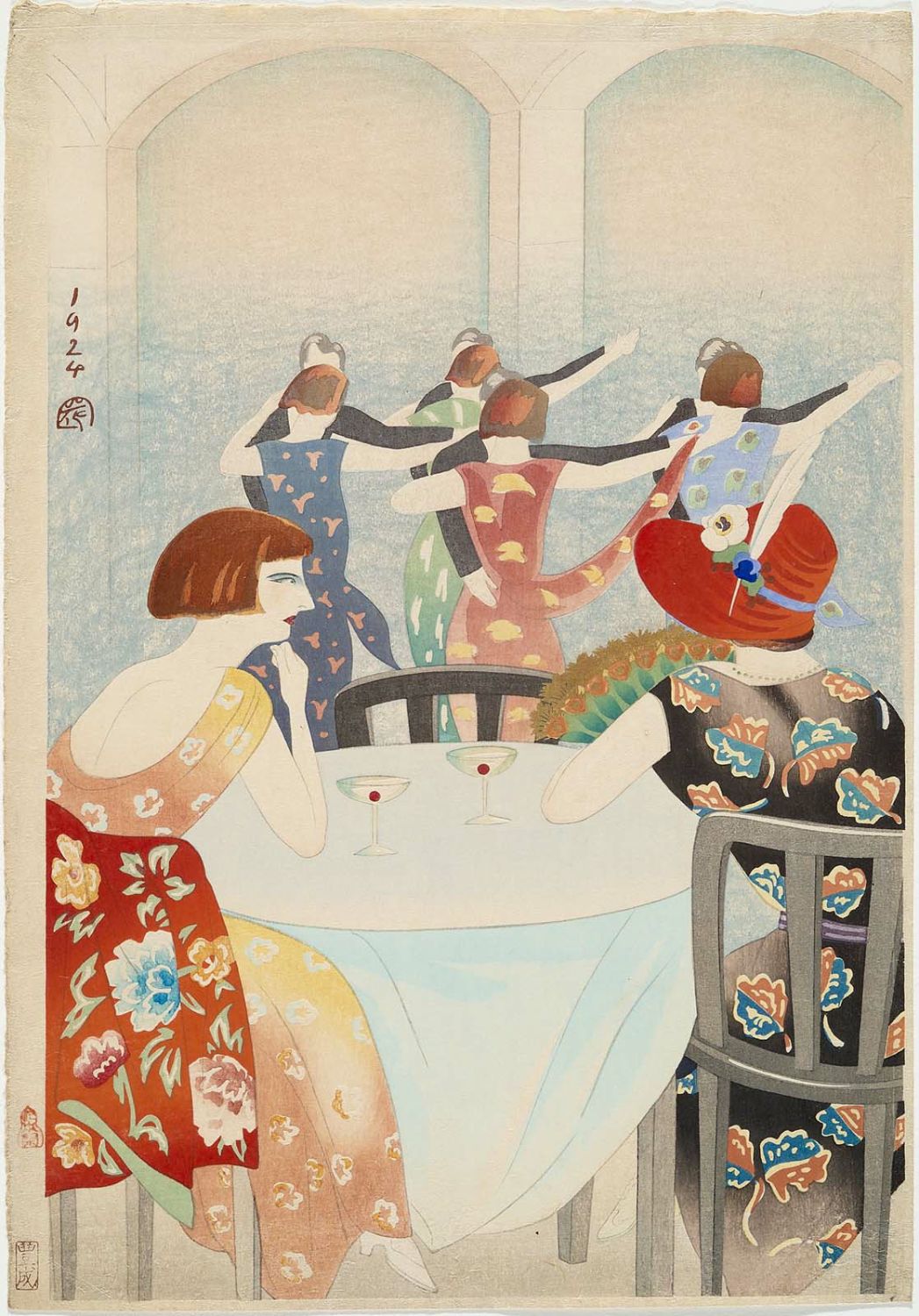
Kōka continued to design woodblock prints through the 1920s and into the 1930s, including occasional bijin-ga (pictures of beautiful women), maiko subjects, and contemporary genre prints such as Dancing at the New Carlton Hotel, Shanghai (1924), one of the earliest Japanese woodblock prints to address the cosmopolitan modern leisure culture of the Asian treaty-port city. He also continued to paint in nihonga, with hanging-scroll works such as The Heron Maiden, now in the Metropolitan Museum of Art. He died in 1942. Major public collections holding his work include the Metropolitan Museum of Art, the Art Institute of Chicago, the Minneapolis Institute of Art, and the British Museum.
Key Facts
- Active Period
- 1885–1942
- Nationality
- 🇯🇵Japan
- Movement
- Shin-hanga
- Subjects
- Children
- Works Indexed
- 3
Frequently Asked Questions
Yamamura Kōka (山村耕花, 1885–1942), also active as Yamamura Toyonari (山村豊成) on his woodblock prints, was one of the most original kabuki actor portraitists of the Taishō and early Shōwa periods, an artist who brought a thoroughly modern visual intelligence to the most heavily patterned subject in Japanese popular printmaking. Born in the Shinagawa district of Tokyo in 1885, he trained within the Tokyo painting world that ran from the late-Edo studios into the new state art schools of the Meiji period. From 1896 he studied under the Meiji painter and printmaker Ogata Gekkō (1859–1920), an independent master known for his book illustration and prints.
Yamamura Kōka was active from 1885 to 1942. They were associated with the Shin-hanga movement.
Yamamura Kōka's work was shaped by the Shin-hanga tradition in Japanese woodblock printmaking. Shin-hanga: ## What is Shin-hanga? Shin-hanga (新版画), literally "new prints," is the early twentieth-century revival of the collaborative Japanese woodblock workshop, organized between roughly 1915 and 1960 by the Tokyo publisher Watanabe Shōzaburō (1885–1962) and a handful of competing houses.
Yamamura Kōka's prints frequently feature children.
Original prints by Yamamura Kōka can be found in collections including Minneapolis Institute of Art, Harvard Art Museums, Museum of Fine Arts, Boston.