Biography
Yashima Gakutei (c. 1786-1868) stands among the most refined and intellectually accomplished designers of surimono and kyoka-e in late-Edo ukiyo-e, a quiet virtuoso whose lavishly printed poetry-circle commissions distill the technical apex of Japanese woodblock printing into intimate, jewel-like compositions. Working in the orbit of Katsushika Hokusai and his foremost surimono pupil Totoya Hokkei, Gakutei produced prints that were never intended for the commercial marketplace but rather for circulation among small literary societies of kyoka poets, where each impression served simultaneously as a New Year's greeting, a poetic anthology, and a connoisseur's object of contemplation. His career spans the entire surimono boom of the 1810s and 1820s, and his designs for the Honchoren, Katsushikaren, and Yomogawa poetry circles define the era's most ambitious privately-commissioned print culture.
The artist's origins are unusually well documented for a surimono specialist. Born around 1786, Gakutei was active in both Osaka and Edo, a dual-city career that gave his work a cosmopolitan sophistication and brought him into contact with the leading kyoka poets of both centers. He used numerous artist names across his career, including Gogaku, Sadaoka, Harunobu, and the studio name Yashima, while signing surimono variously as Gakutei, Gakutei Harunobu, and Gogaku. His training is generally traced to the Hokusai school, with strong stylistic evidence pointing to direct study with Totoya Hokkei, the master who effectively codified the surimono format in the 1810s. Some scholars argue for direct apprenticeship under Hokusai himself; what is certain is that Gakutei absorbed the Hokusai school's rigorous draftsmanship, its taste for Chinese literary subjects, and its willingness to push woodblock printing toward maximal technical complexity.
Gakutei's chosen specialty, the surimono, was the most demanding format in ukiyo-e. These privately-commissioned prints, typically in the small square shikishiban format roughly twenty centimeters on a side, were funded by poetry circles to circulate kyoka verses among their members. Because no commercial publisher needed to recoup costs, surimono could use the most expensive materials available: thick hosho paper, dozens of color blocks, hand-applied metallic pigments in gold, silver, copper, and brass, embossed blind-printing called karazuri, and burnishing effects that produced lacquer-like surfaces. Gakutei mastered every one of these techniques and pushed them further than nearly any contemporary. His prints from the 1810s and 1820s, designed primarily for the Honchoren and Katsushikaren poetry groups, are saturated with metallic ground washes, micaceous shimmers, and crisp linear precision that survives in the finest impressions held by museums today.
His subject matter ranges across the full encyclopedic interests of the kyoka world. Series such as the Twenty-four Japanese Paragons of Filial Piety for the Honcho Circle (Honchoren Honcho nijushiko) translate the venerable Chinese moral tradition into Japanese historical exemplars, drawing from sources like the Nihongi, the Taiheiki, and the Sandai jitsuroku. The Cherry Blossoms of Katsushika (Katsushika sakura zukushi) and Cherry Trees for the Katsushika Circle (Katsushika sakuratsukushi) link famous cherry varieties to legendary women and classical poems. The Framed Pictures of Women for the Katsushika Circle (Katsushikaren gakumen fujin awase) presents legendary beauties such as Ono no Komachi, Kogo no Tsubone, Usugumo, and Lady Tomoe in trompe-l'oeil framed cartouches. Other series mine Chinese vernacular fiction, including the Five Tiger Generals of the Tales of the Water Margin (Suikoden Goko Shogun) and the Three Heroes of Shu (Shoku sanketsu), as well as Japanese courtly tales like the Honchoren monogatari juban. He also produced quiet still-life surimono of bowls, scissors, plum branches, sake bottles, and morning glories, and the celebrated illustrated book One Hundred Humorous Poems by One Hundred Poets (Kyoka hyakunin isshu), which adapts the classical Hyakunin Isshu anthology to comic verse.
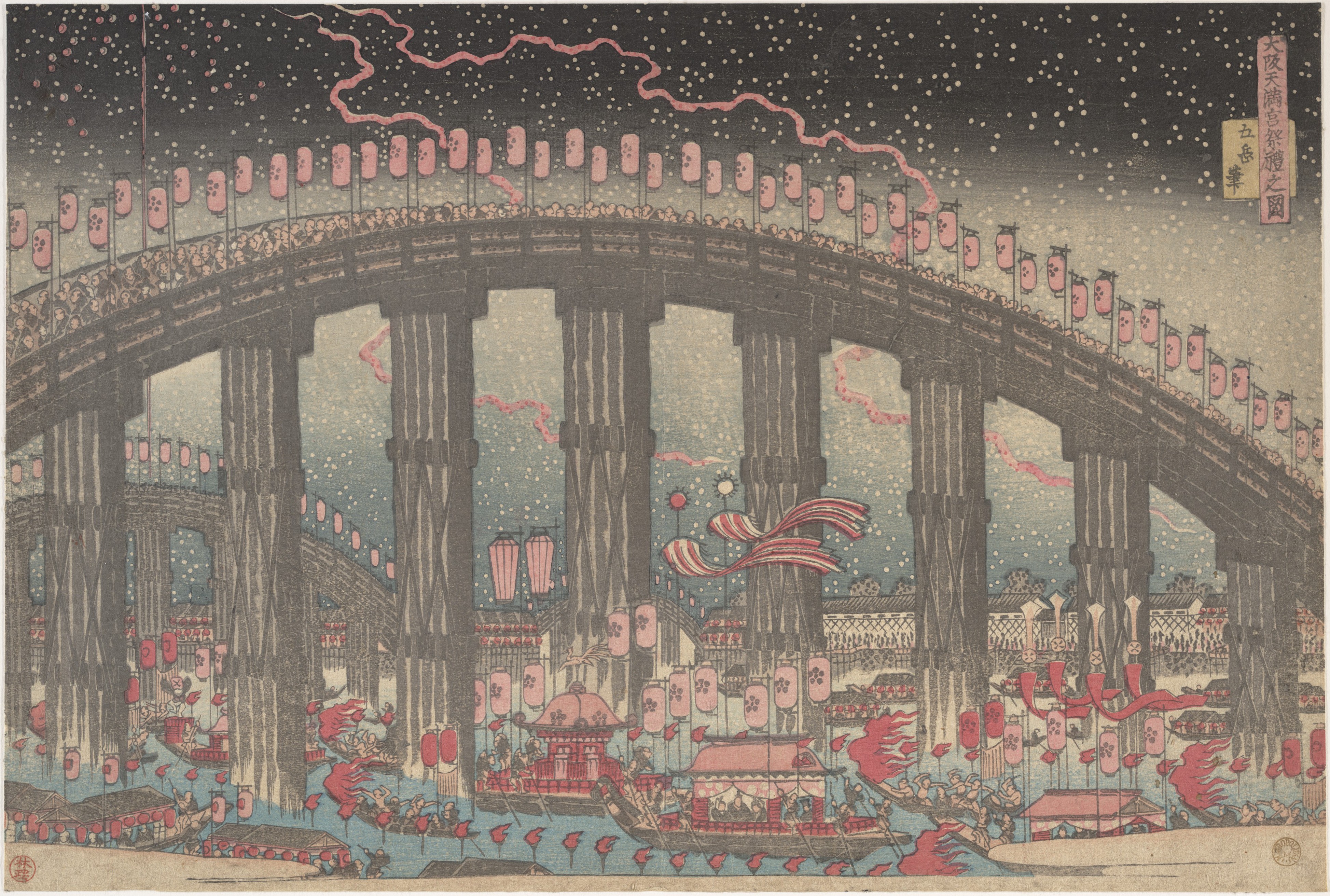
Gakutei is best remembered today for two landscape series that mark a late shift in his practice from intimate surimono to slightly larger horizontal views with topographic ambitions: the Yodogawa Hakkei, eight views along the Yodo River between Osaka and Kyoto, and the Tenpozan Eight Views, depicting the artificial Tenpozan hill at Osaka harbor. Both series demonstrate his complete fluency in Hokusai-school landscape conventions while showing the unmistakable refinement of color and tone that distinguishes a surimono master at work in a more public format. These landscape sets, produced in the early 1830s, position Gakutei alongside Hokusai and Hiroshige in the canon of late-Edo topographic printmaking, even though his overall output remains far smaller and more specialized than either.
In the kyoka world, Gakutei was not merely an illustrator but a participating poet, contributing verses under his own poetic names and circulating in the same literary salons whose commissions sustained him. This dual identity as artist and poet gave his designs an unusual integration of image and inscription; the calligraphic placement, the visual rhyme between motif and metaphor, and the layered allusions to classical poetry all reflect a designer working inside the literary culture rather than simply illustrating it. His later years saw the gradual decline of the great surimono boom as the Tenpo Reforms of the late 1830s restricted luxury printing and the kyoka circles themselves contracted. Gakutei lived through the long twilight of Edo print culture and died in 1868, the year the Tokugawa shogunate fell and the Meiji era began, closing one of the longest careers in ukiyo-e history.
For collectors of Japanese woodblock prints, Yashima Gakutei represents the pinnacle of surimono connoisseurship. His prints reward close looking with extraordinary technical detail, dense literary allusion, and a chromatic restraint that holds its own against the more famous landscape designers of his era. Major holdings exist at the Art Institute of Chicago, the Museum of Fine Arts Boston, the British Museum, and the Metropolitan Museum of Art, and his work remains central to any serious study of late-Edo ukiyo-e, surimono, kyoka-e, and the Hokusai school's broader influence on Japanese printmaking.
Key Facts
- Active Period
- 1786–1868
- Nationality
- 🇯🇵Japan
- Movement
- Ukiyo-e
- Works Indexed
- 125
Frequently Asked Questions
Yashima Gakutei (c. 1786-1868) stands among the most refined and intellectually accomplished designers of surimono and kyoka-e in late-Edo ukiyo-e, a quiet virtuoso whose lavishly printed poetry-circle commissions distill the technical apex of Japanese woodblock printing into intimate, jewel-like compositions. Working in the orbit of Katsushika Hokusai and his foremost surimono pupil Totoya Hokkei, Gakutei produced prints that were never intended for the commercial marketplace but rather for circulation among small literary societies of kyoka poets, where each impression served simultaneously as a New Year's greeting, a poetic anthology, and a connoisseur's object of contemplation. His career spans the entire surimono boom of the 1810s and 1820s, and his designs for the Honchoren, Katsushikaren, and Yomogawa poetry circles define the era's most ambitious privately-commissioned print culture.
Yashima Gakutei was active from 1786 to 1868. They were associated with the Ukiyo-e movement.
Yashima Gakutei's work was shaped by the Ukiyo-e tradition in Japanese woodblock printmaking. Ukiyo-e: ## What is ukiyo-e? Ukiyo-e ([浮世絵](/glossary/ukiyo-e)) — literally "pictures of the floating world" — is the Edo-period Japanese print and painting tradition that flourished from roughly 1660 to 1868, depicting the pleasures of urban life in Edo (modern Tokyo): courtesans, kabuki actors, sumo wrestlers, famous landscapes, and seasonal beauties.
Yashima Gakutei's prints frequently feature mount fuji, spring, birds & flowers, rain, autumn foliage, fish.
Original prints by Yashima Gakutei can be found in collections including Victoria and Albert Museum, Art Institute of Chicago, Metropolitan Museum of Art.