Biography
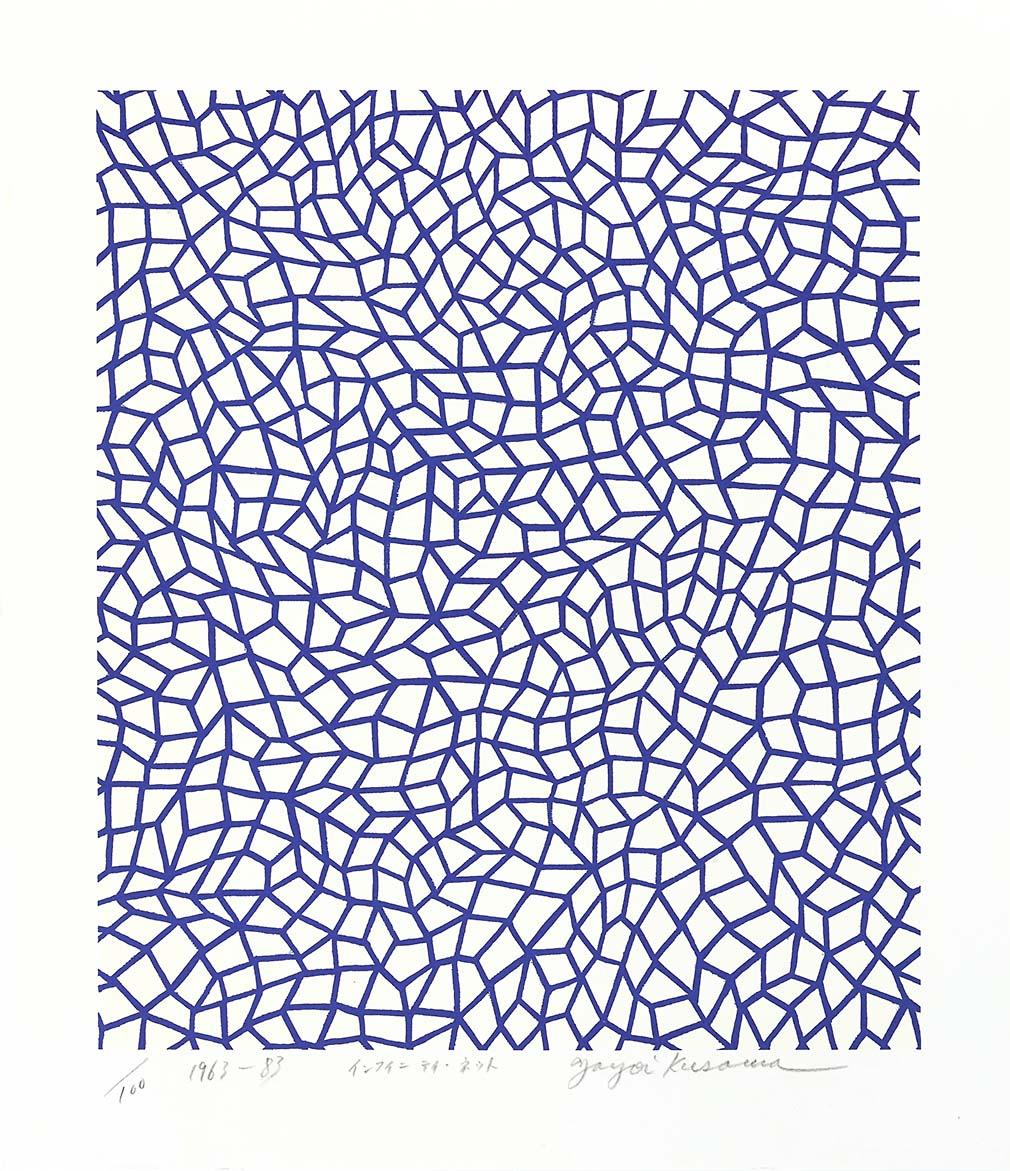
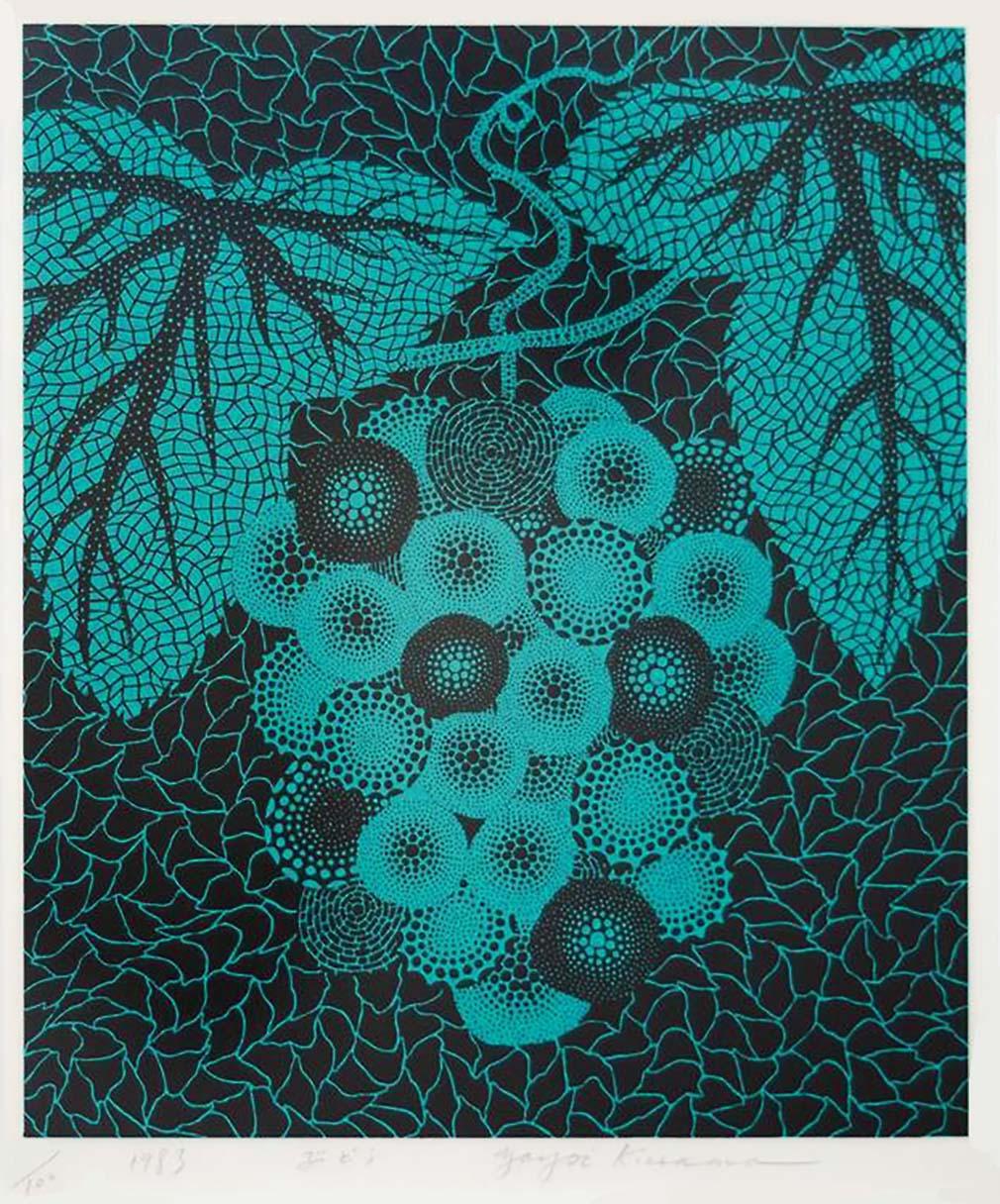
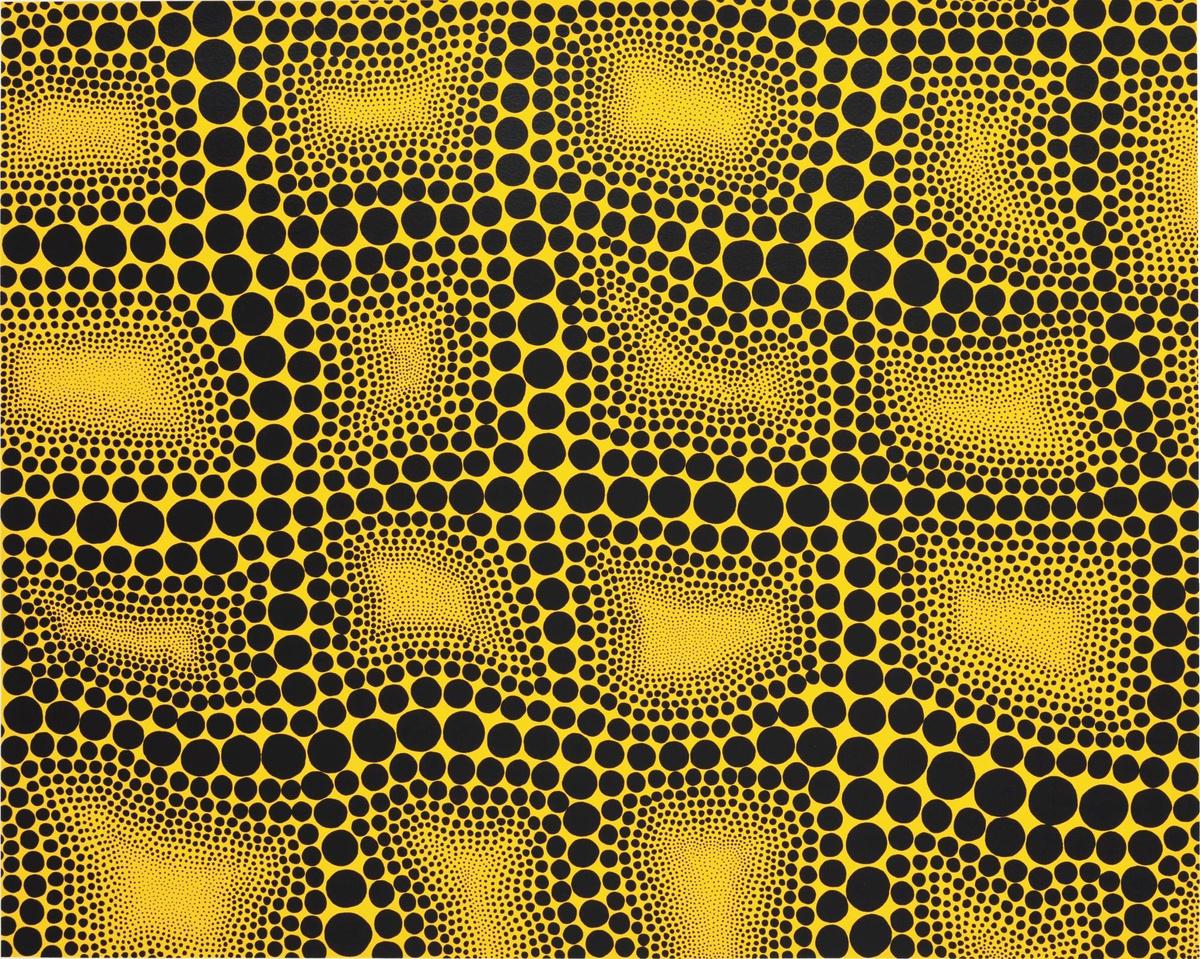
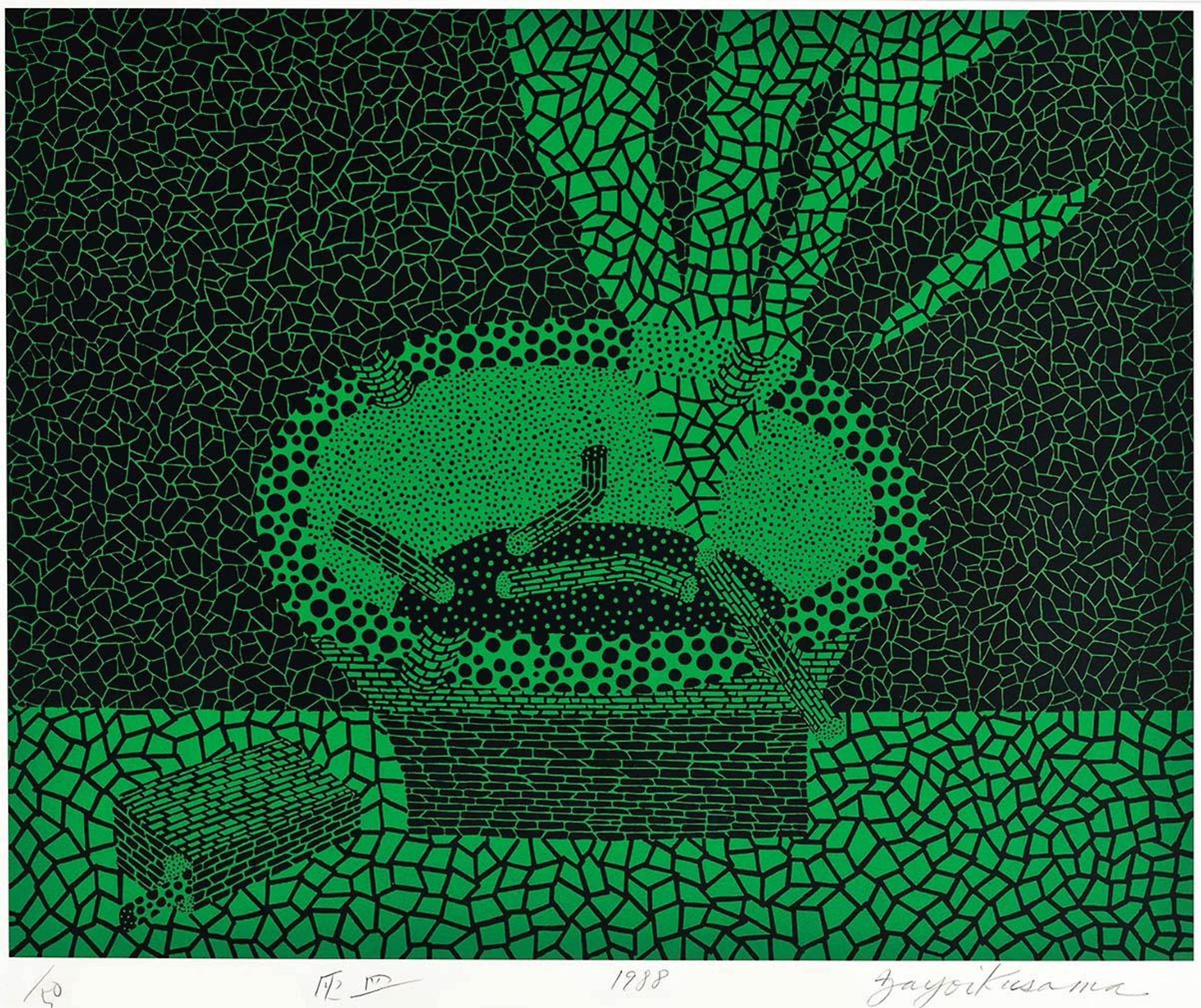
Yayoi Kusama (草間彌生, b. 22 March 1929, Matsumoto, Nagano Prefecture) is one of the most internationally visible Japanese artists of the postwar period and among the most widely exhibited living artists in the world. Across more than seventy years of working life she has produced an enormous and continuously expanding body of work spanning painting, sculpture, environmental installation (the 'Infinity Mirror Rooms'), performance, fiction, poetry, fashion, and an extensive practice of editioned printmaking. Her signature motifs — polka dots, pumpkins, infinity nets, biomorphic figures with eyes — recur across all media, organising a unified visual vocabulary that has become one of the most-recognised graphic signatures of the late twentieth and early twenty-first century.
Kusama trained in nihonga (Japanese-style painting) at the Kyoto Municipal School of Arts and Crafts, which she entered in 1948. She corresponded in the 1950s with the American artist Georgia O'Keeffe, whose advice she sought before moving to the United States; in 1957 Kusama moved to Seattle and then in 1958 to New York City, where she lived until her return to Japan in 1973. The New York period was decisive for her wider reputation: she developed the 'Infinity Net' paintings in 1959 (large fields of obsessive small loops on coloured ground), produced the soft-sculpture 'Accumulations' (everyday objects covered in fabric phallic protrusions), staged a sequence of body-painting Happenings in the late 1960s, and engaged with the emergent New York scene alongside artists including Donald Judd, Eva Hesse, Joseph Cornell (with whom she had a close association that lasted until his death in 1972), and Andy Warhol.
In 1973 Kusama returned to Japan, and in 1977 she voluntarily entered a psychiatric hospital in Tokyo, where she has lived ever since while continuing to work daily in a nearby studio. The post-1977 phase of her career has been the most prolific by far, encompassing the parallel development of monumental polka-dotted pumpkin sculptures, immersive Infinity Mirror Room installations, the long-running 'My Eternal Soul' painting series, and an intensive print-publishing practice.
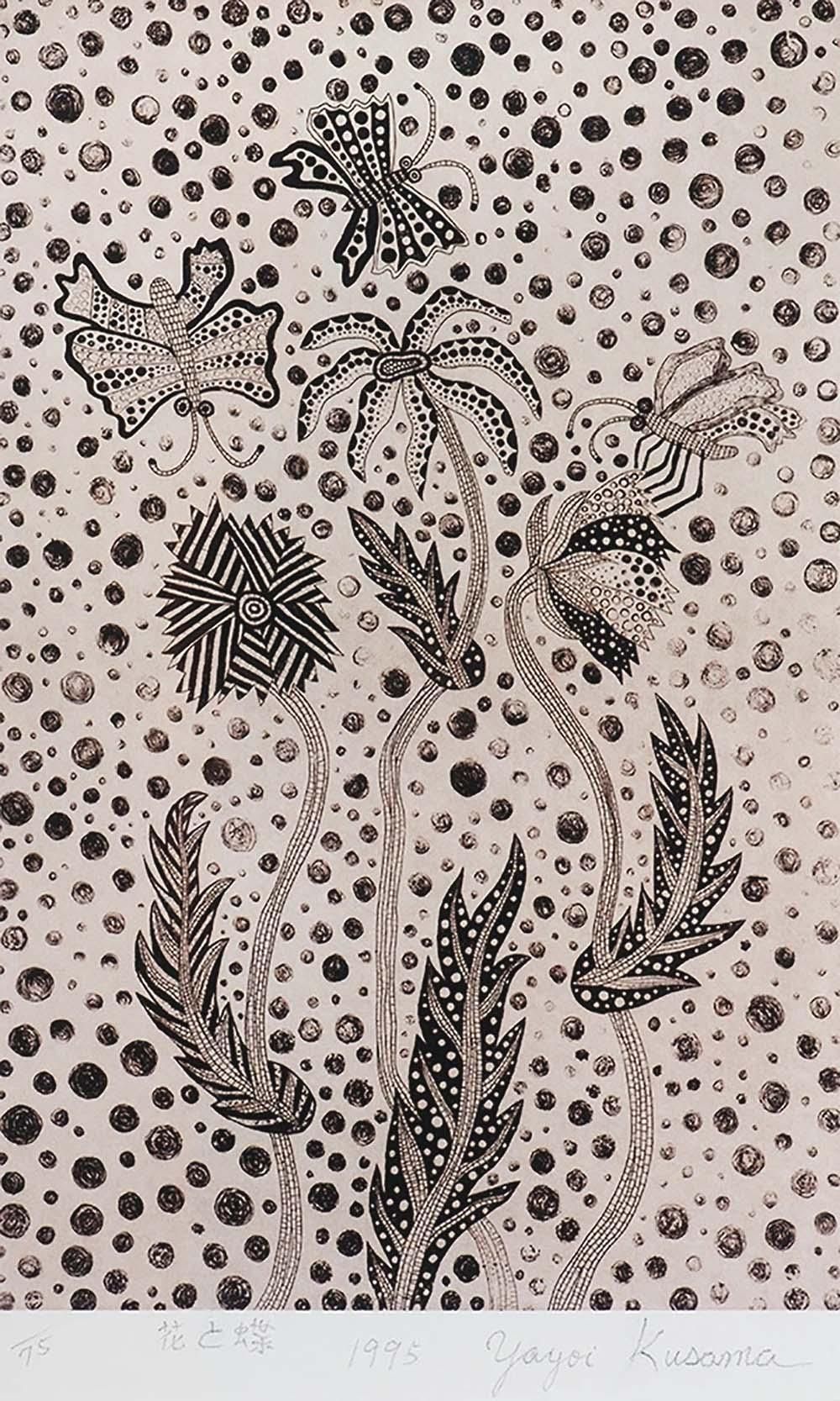
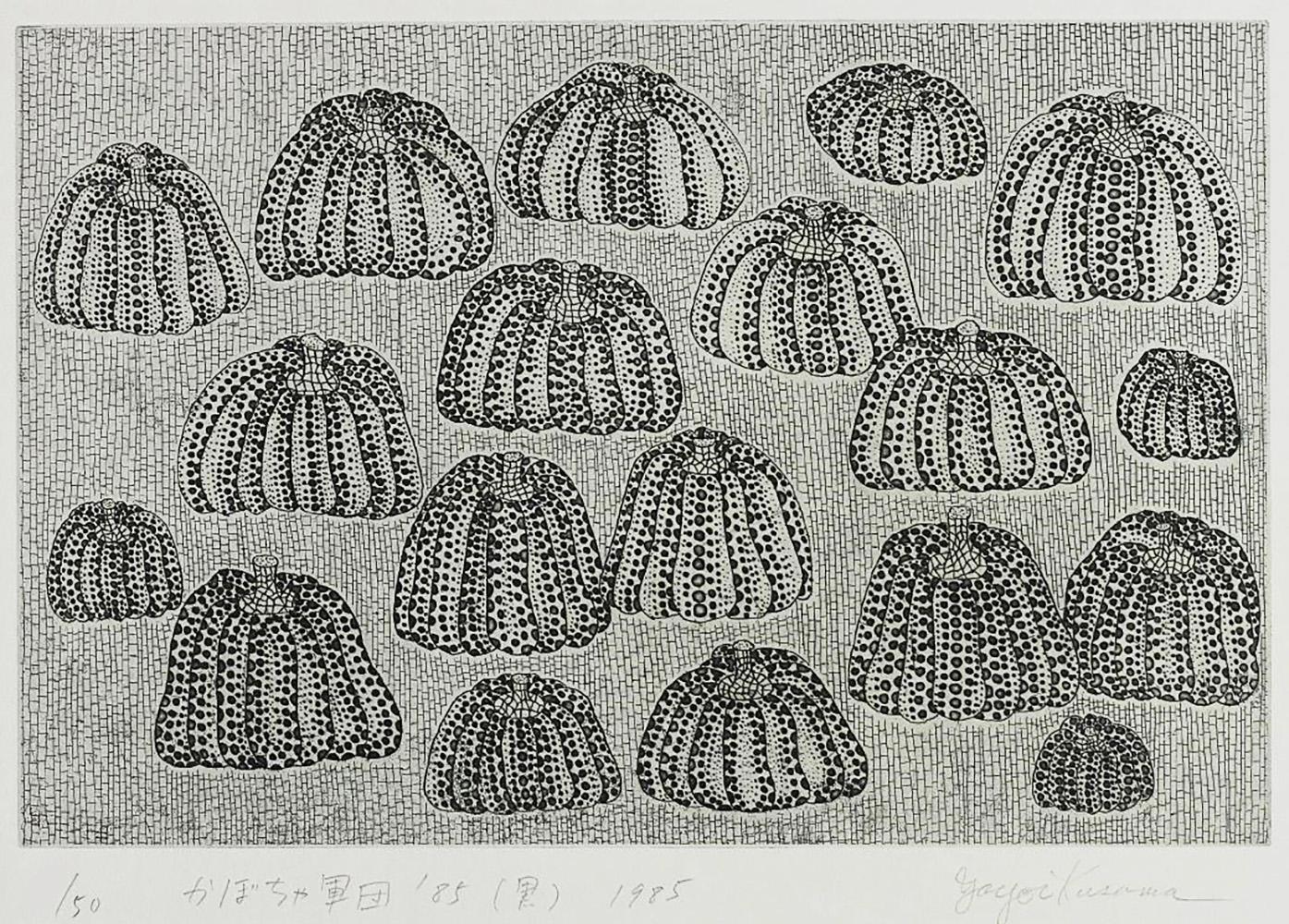
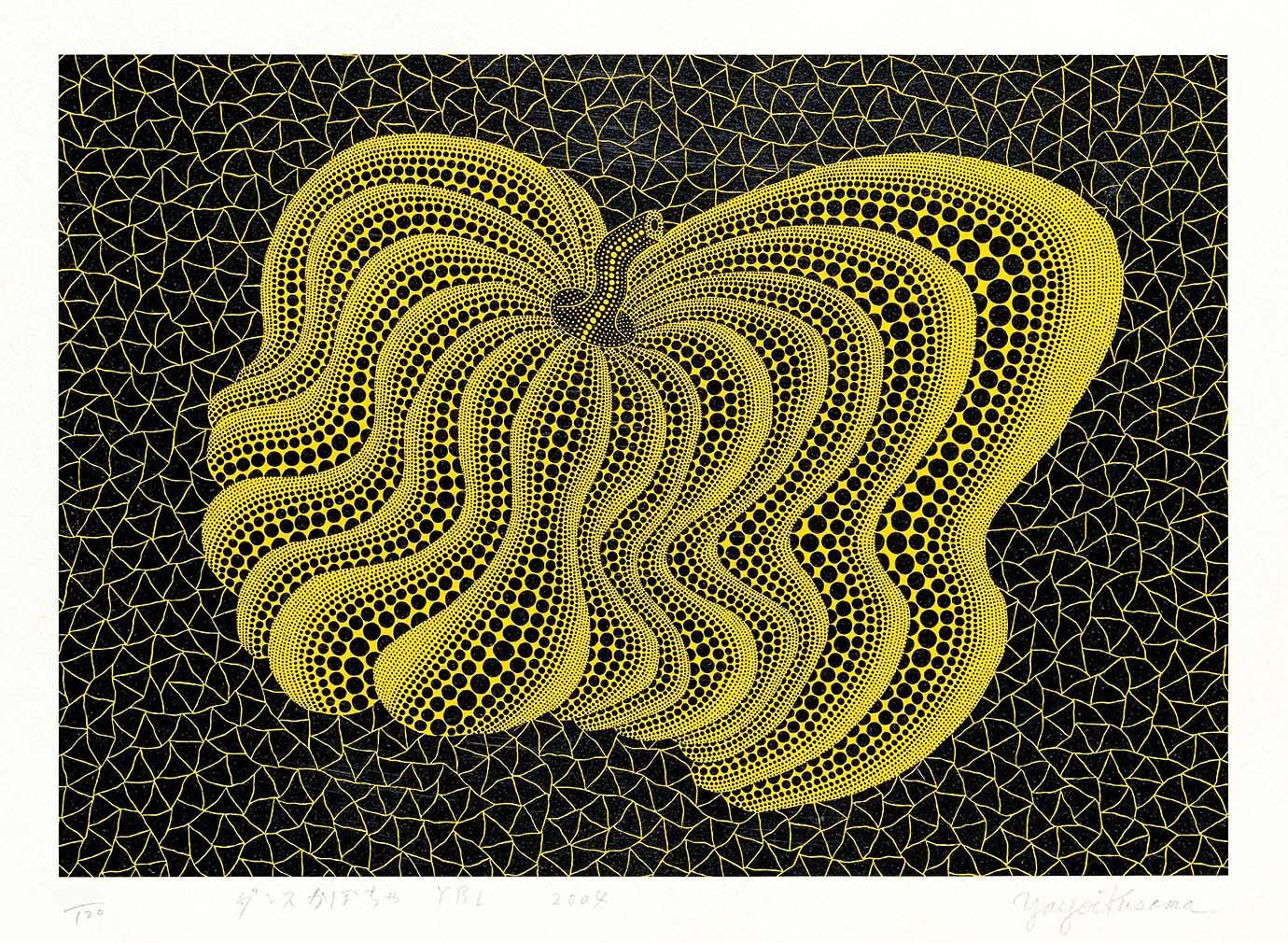
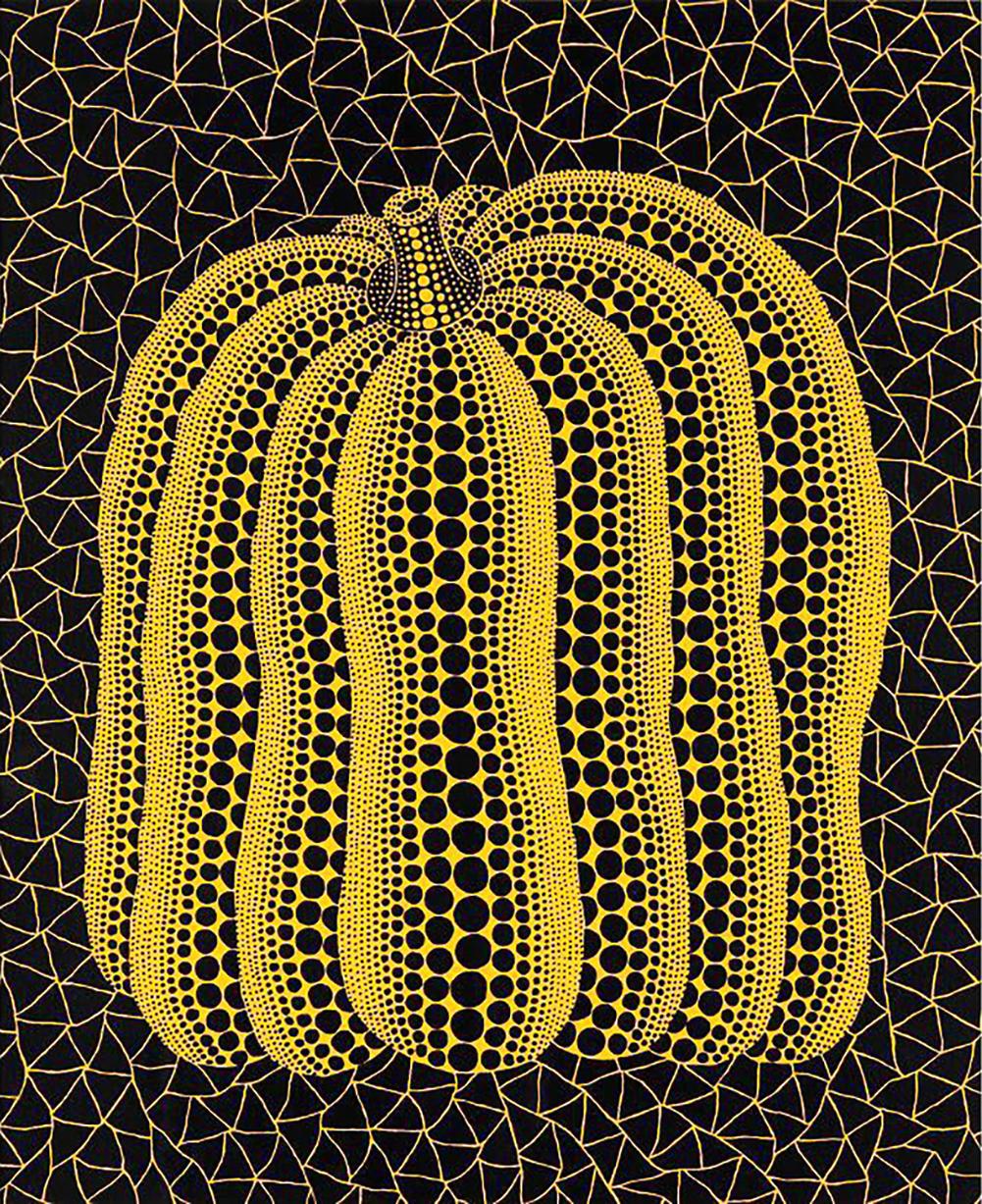
Kusama's printmaking began in 1979, six years after her return to Japan, and has continued as a central strand of her practice ever since. Screenprinting — well suited to her flat colour, sharp edges, and repeating patterns — is her most frequently used method, alongside lithography and etching, and her editioned prints have been documented in a published print catalogue. Recurring print motifs echo the vocabulary of her wider output: pumpkins, infinity nets, flowers, and fields of dots, issued in limited editions and continuing into her late career at larger scale.
Kusama's institutional recognition is comprehensive: she represented Japan at the 1993 Venice Biennale and has been the subject of major exhibitions at institutions including the Museum of Modern Art (which presented 'Love Forever' in 1998), Tate Modern, the Whitney Museum of American Art, the Hirshhorn Museum, the Centre Pompidou, the Mori Art Museum in Tokyo, and the National Art Center, Tokyo. Her work is held in major public collections of postwar art worldwide, and her life and career were the subject of the 2018 documentary 'Kusama: Infinity,' directed by Heather Lenz and released by Magnolia Pictures.
Within contemporary Japanese art Kusama occupies a singular position as one of the highest-profile living Japanese artists internationally, whose practice across all media has produced one of the most-recognisable graphic vocabularies of the postwar period, and whose printmaking — sustained since 1979 — is a significant component of her broader artistic output. Her prints continue to be issued through Yayoi Kusama Studio and circulate through galleries including Ota Fine Arts (Tokyo), David Zwirner (New York), and Victoria Miro (London).
Key Facts
- Active Period
- 1929
- Nationality
- 🇯🇵Japan
- Movement
- Contemporary Mokuhanga
- Works Indexed
- 7
Frequently Asked Questions
Yayoi Kusama (草間彌生, b. 22 March 1929, Matsumoto, Nagano Prefecture) is one of the most internationally visible Japanese artists of the postwar period and among the most widely exhibited living artists in the world. Across more than seventy years of working life she has produced an enormous and continuously expanding body of work spanning painting, sculpture, environmental installation (the 'Infinity Mirror Rooms'), performance, fiction, poetry, fashion, and an extensive practice of editioned printmaking. Her signature motifs — polka dots, pumpkins, infinity nets, biomorphic figures with eyes — recur across all media, organising a unified visual vocabulary that has become one of the most-recognised graphic signatures of the late twentieth and early twenty-first century.
Yayoi Kusama was active born in 1929. They were associated with the Contemporary Mokuhanga movement.
Yayoi Kusama's work was shaped by the Contemporary Mokuhanga tradition in Japanese woodblock printmaking. Contemporary Mokuhanga: Contemporary mokuhanga (literally "wood-block print") encompasses artists working from approximately 1970 to the present who continue or reinvent traditional Japanese woodblock printing techniques.
Yayoi Kusama's prints frequently feature silkscreen, still life, abstract, birds & flowers.