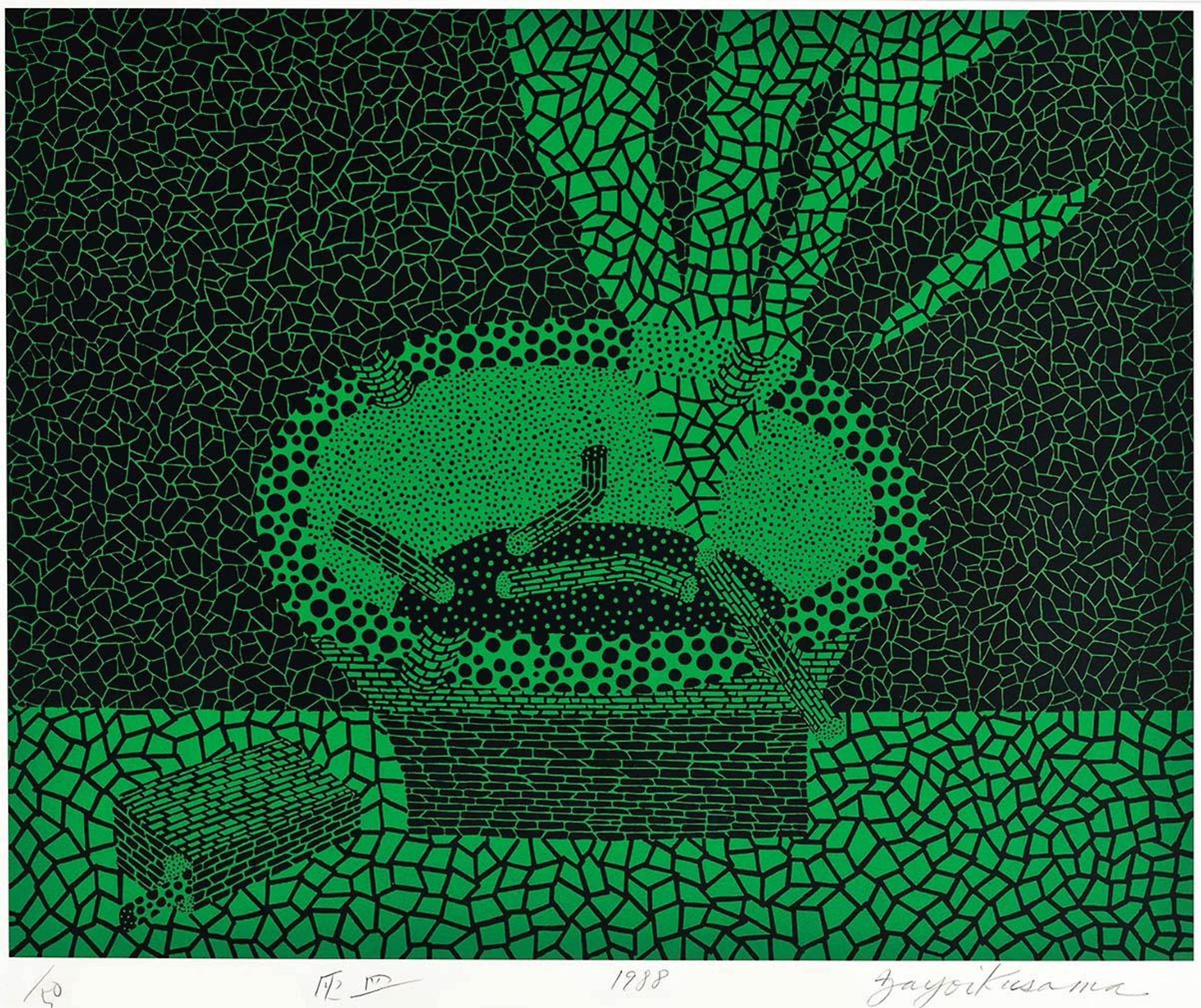
Ashtray
by Yayoi Kusama
- Medium:
- Silkscreen
- Image courtesy of
- Composition Gallery
Description
A 1990 silkscreen showing a glass or ceramic ashtray, presumably depicted from above or in three-quarter view with one or more cigarettes, Ashtray sits within Kusama's ongoing still-life practice of mundane consumer objects rendered as graphic icons. The subject extends a thread that runs through her work from the 1960s 'compulsion furniture' — chairs, ladders, and household objects covered in her signature soft protrusions — to the flat editioned still lifes of the 1980s and 1990s. Screenprint production allows the object to be translated into discrete blocks of colour with sharp outlines, the smoke or ash rendered as flat curling shapes, and dots typically scattered across the body of the object or its ground. The ashtray theme also recalls the consumer-object iconography of American Pop art, with which Kusama was associated in 1960s New York. By 1990 she had been resident at Seiwa Hospital in Tokyo for over a decade and was producing prints prolifically as part of a daily studio practice that continues to the present.
More Prints by Yayoi Kusama
More Still Life Prints


Frequently Asked Questions
Ashtray was created by Yayoi Kusama (草間 彌生).
Ashtray uses Silkscreen, on silkscreen.
Ashtray depicts still life.