Biography
Yoshimune Arai (荒井芳宗, 1873–1945) worked during the transitional decades when Japanese woodblock printmaking evolved from the commercial ukiyo-e tradition into the publisher-driven shin-hanga movement. He was active across the late Meiji, Taishō, and early Shōwa periods, an era when Western influences were rapidly transforming Japanese visual culture while traditional crafts struggled to maintain their footing against photography, lithography, and Western-style illustration.
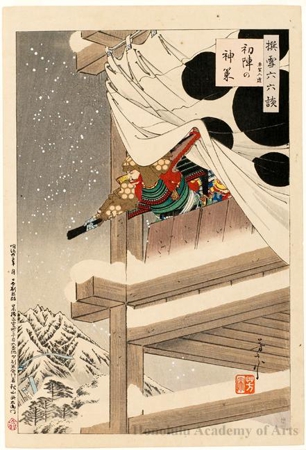
Arai is best known as a designer of atmospheric night scenes and landscapes in the shin-hanga style. He was especially noted for his skill in rendering the effects of light at night and on water, achieved through subtle color gradations and a harmonious balance of light and shadow. His designs contributed to a well-known series of night scenes issued during the Taishō and early Shōwa periods.
His prints were published by Hasegawa Takejirō and by Nishinomiya Yosaku, houses associated with atmospheric landscape prints and with woodblock-illustrated books produced in part for export markets. As was typical of shin-hanga production, Arai appears to have supplied the designs while professional carvers and printers executed the final blocks and impressions — a collaborative division of labor that distinguished the movement from the self-carved prints of the concurrent sōsaku-hanga school.
As the shin-hanga movement coalesced under publishers such as Watanabe Shōzaburō in the 1910s and 1920s, Arai's generation of designers occupied an intermediate position, trained in traditional methods but working in an industry being reshaped by new aesthetic ambitions and foreign collector demand. His prints reflect this transitional quality, combining Meiji draftsmanship with the richer color printing and atmospheric effects that became hallmarks of the shin-hanga style.
Arai died in 1945, the final year of the Second World War, a period when Japan's printmaking infrastructure had been largely suspended by wartime privation. Documentation of his life remained scarce, and his prints were little known among collectors until the dispersal of the American collector Robert O. Muller's shin-hanga holdings after 2003 brought renewed attention to his night scenes.
Key Facts
- Active Period
- 1873–1945
- Nationality
- 🇯🇵Japan
- Movement
- Shin-hanga
- Works Indexed
- 38
Frequently Asked Questions
Yoshimune Arai (荒井芳宗, 1873–1945) worked during the transitional decades when Japanese woodblock printmaking evolved from the commercial ukiyo-e tradition into the publisher-driven shin-hanga movement. He was active across the late Meiji, Taishō, and early Shōwa periods, an era when Western influences were rapidly transforming Japanese visual culture while traditional crafts struggled to maintain their footing against photography, lithography, and Western-style illustration.
Yoshimune Arai was active from 1873 to 1945. They were associated with the Shin-hanga movement.
Yoshimune Arai's work was shaped by the Shin-hanga tradition in Japanese woodblock printmaking. Shin-hanga: ## What is Shin-hanga? Shin-hanga (新版画), literally "new prints," is the early twentieth-century revival of the collaborative Japanese woodblock workshop, organized between roughly 1915 and 1960 by the Tokyo publisher Watanabe Shōzaburō (1885–1962) and a handful of competing houses.
Original prints by Yoshimune Arai can be found in collections including Japanese Art Open Database, Honolulu Museum of Art, ukiyo-e.org, Museum of Applied Arts, Vienna.