
Fabrication (Inclusion)
by Amano Kazumi
- Date:
- 1966
- Medium:
- Woodblock print, ink and color on embossed paper
- Dimensions:
- 92.6 × 54.8 cm
- Edition:
- Self-printed
- Source:
- Minneapolis Institute of Art
Description
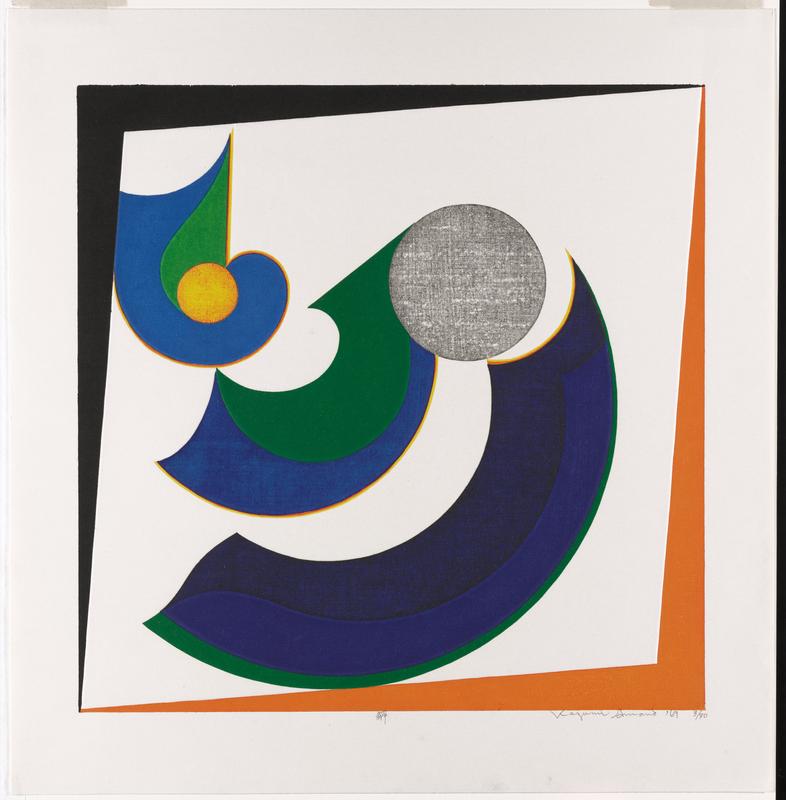
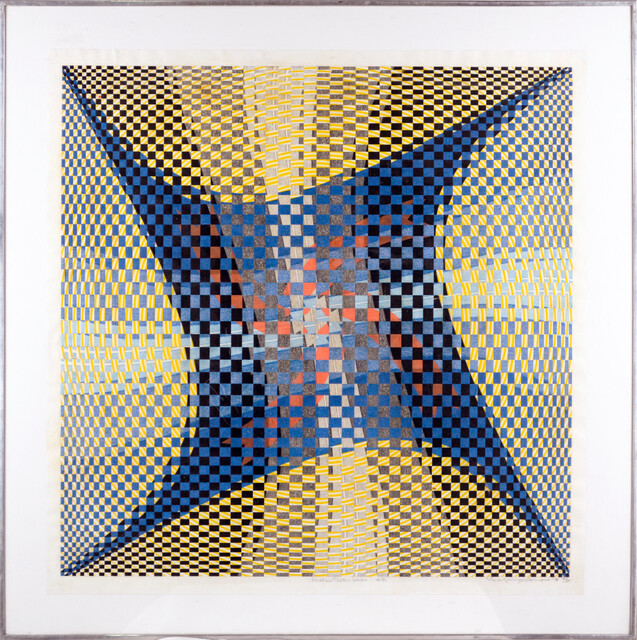
Fabrication (Inclusion), created in 1966, pairs two words that pull in opposite directions. Fabrication implies construction, making, or even deception, while Inclusion suggests the act of containing or welcoming something within a boundary. Together they describe the paradox at the heart of Amano's printmaking: the artist fabricates a world that includes real physical traces of its own making.
Executed in ink and color on embossed paper, this print uses the three-dimensional quality of karazuri embossing to literalize the concept of inclusion. Portions of the composition are pushed into the paper, creating recessed spaces that physically contain shadow and air. The embossed areas exist below the surface plane, included within the paper itself rather than merely printed upon it. Amano's color choices interact with these topographic variations, as ink settles differently on raised and recessed surfaces, producing tonal effects that are impossible to achieve on flat paper.
More Prints by Amano Kazumi
![Untitled [musicians performing Owara-bushi] by Amano Kazumi](https://1.api.artsmia.org/800/135476.jpg)
![Untitled [two roosters] by Amano Kazumi](https://1.api.artsmia.org/800/135977.jpg)
More Animals Prints

Snake Charmers (Hebizukai)
Hebizukai
1932
Color woodblock print; oban

Hoshifuri Pine at Zen'yoji Temple in Edogawa (Edogawa-ku Zen'yoji Hoshifuri matsu), from the series "One Hundred Views of Great Tokyo in the Showa Era (Showa dai Tokyo fukei hyaku zue hanga)"
1935
Color woodblock print; oban

Drawing for Rabbit and Boy
1964
Acrylic paint and oil pastel with oiled charcoal and ink over an ink and graphite underdrawing on paper

Rabbit and Boy
1964
Color lithograph with relief block and hand coloring; edition 35/36
Frequently Asked Questions
Fabrication (Inclusion) was created by Amano Kazumi (天野和美) in 1966.
Fabrication (Inclusion) uses Embossing, on woodblock print, ink and color on embossed paper.
Fabrication (Inclusion) depicts animals and abstract.
Fabrication (Inclusion) measures 92.6 × 54.8 cm.