
Snake Charmers (Hebizukai)
Hebizukai
- Date:
- 1932
- Medium:
- Color woodblock print; oban
- Format:
- Oban
- Dimensions:
- 40.3 × 28.6 cm
- Publisher:
- Yoshida Studio
- Source:
- Art Institute of Chicago
Description
In this striking 1932 oban print, Hiroshi Yoshida turns his traveler's eye to North Africa or South Asia, capturing street performers who coax cobras to sway before a rapt crowd. The composition balances tension and theater — the snakes rising sinuously while turbaned charmers command the scene with pipes and gestures. Yoshida's command of atmospheric color, honed through decades of plein-air oil painting and jizuri self-carving, brings the dusty heat and showmanship of this ancient street spectacle to life in exquisite woodblock detail.
More Prints by Hiroshi Yoshida
More Animals Prints

Hoshifuri Pine at Zen'yoji Temple in Edogawa (Edogawa-ku Zen'yoji Hoshifuri matsu), from the series "One Hundred Views of Great Tokyo in the Showa Era (Showa dai Tokyo fukei hyaku zue hanga)"
1935
Color woodblock print; oban

Drawing for Rabbit and Boy
1964
Acrylic paint and oil pastel with oiled charcoal and ink over an ink and graphite underdrawing on paper

Rabbit and Boy
1964
Color lithograph with relief block and hand coloring; edition 35/36
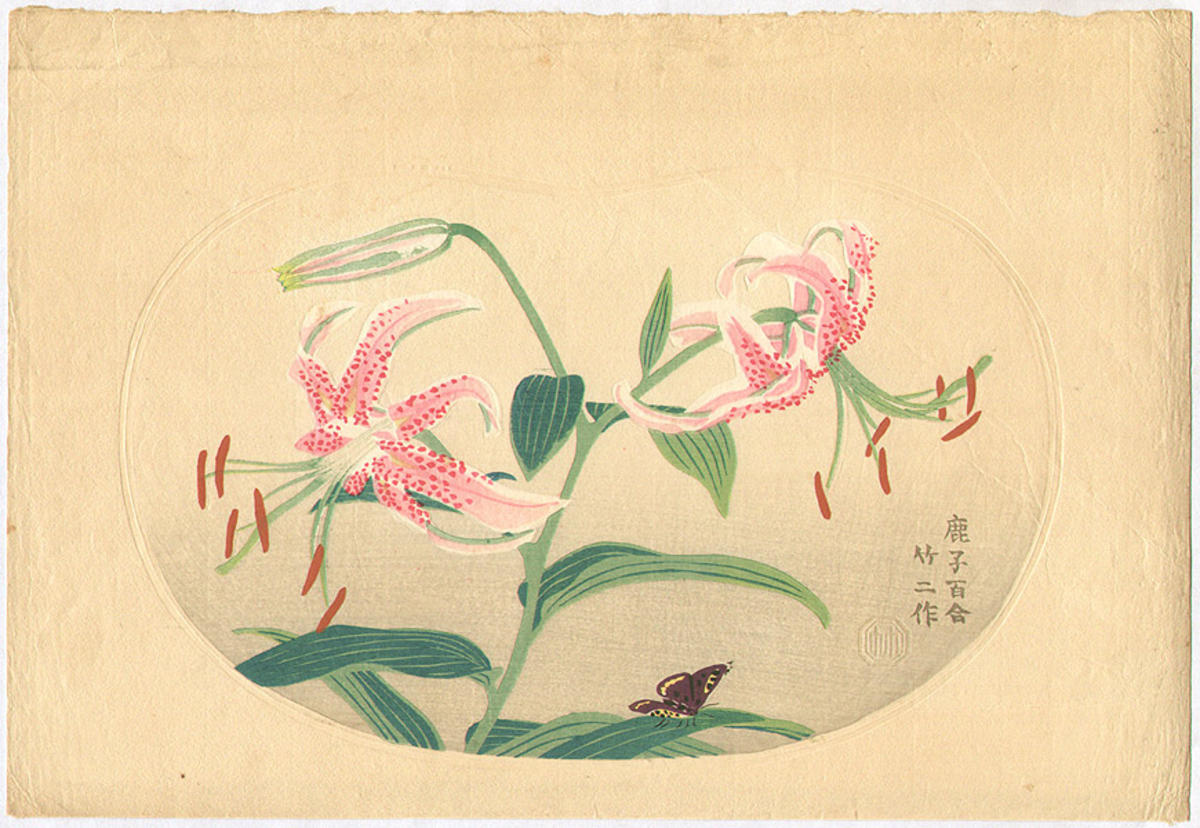
Tiger Lily
Woodblock print
Featured in Collections
Curated cross-cuts that include this print.
Frequently Asked Questions
Snake Charmers (Hebizukai) (Hebizukai) was created by Hiroshi Yoshida (吉田博) in 1932.
Snake Charmers (Hebizukai) uses Moku-hanga, Nishiki-e, and Bokashi, on color woodblock print; oban.
Snake Charmers (Hebizukai) was published by Yoshida Studio (1932).
Snake Charmers (Hebizukai) depicts animals.
Snake Charmers (Hebizukai) measures 40.3 × 28.6 cm (Oban format).