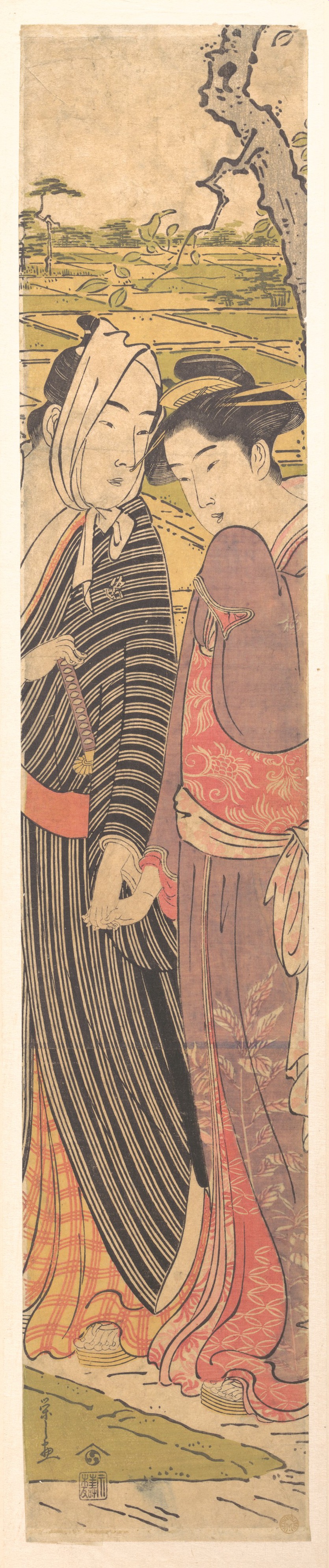
A Man and a Girl Walking in the Rice Fields
- Date:
- ca. 1780
- Medium:
- Woodblock print; ink and color on paper
- Source:
- Metropolitan Museum of Art
Description
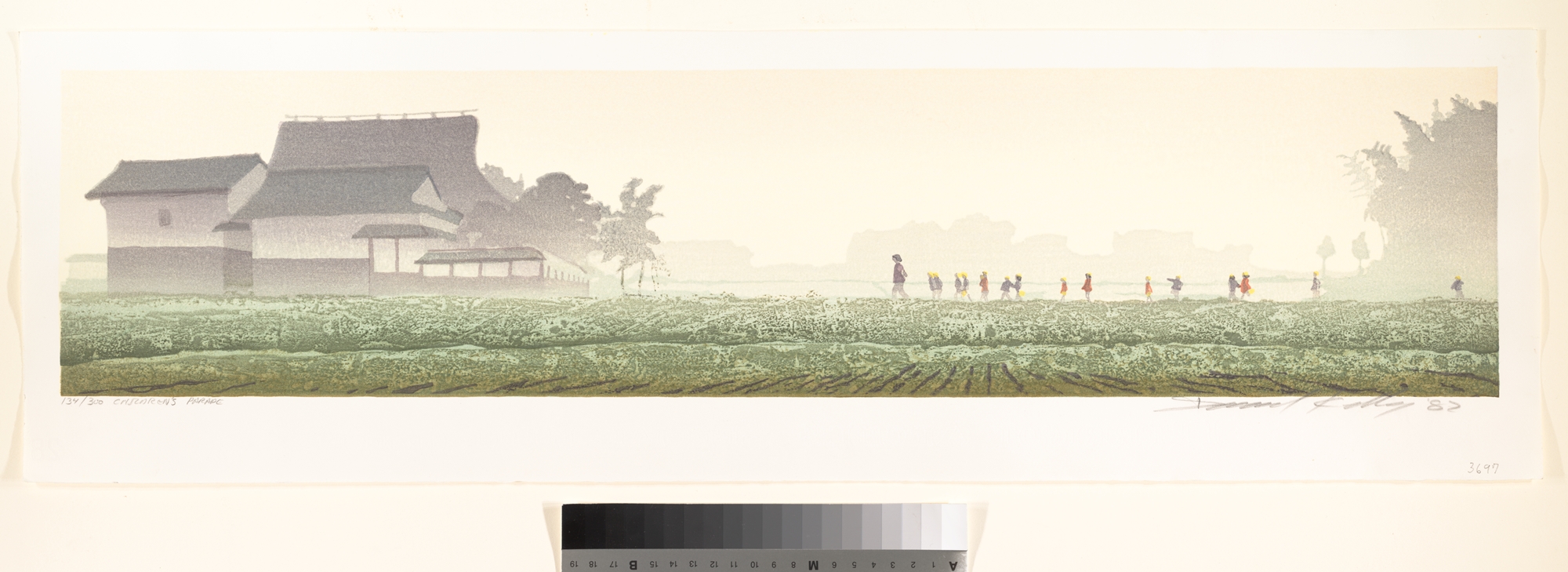
A Man and a Girl Walking in the Rice Fields, recorded in the Metropolitan Museum of Art with a date of 1770, departs from the Yoshiwara setting that dominates Chōbunsai Eishi's best-known work to follow two figures across an open agricultural landscape. The motif of beauties traversing the rice fields outside Edo allowed designers to combine the codes of bijin-ga with the seasonal cues of the countryside: paths, terraces, distant hills, and the soft horizontals of cultivated ground. Eishi treats the subject in the Chobunsai school idiom, with elongated proportions, long sustained contour lines, and a restrained palette that places weight on patterned textile and the careful placement of figures in the open setting. His training under the Kano master Eisen'in Michinobu in the shogun's studio is visible in the careful measure of space, in the calm intervals between the figures and the surrounding landscape, and in the discipline of pictorial design that distinguishes his work from more theatrical contemporary print idioms. The Metropolitan Museum of Art preserves the sheet under Eishi's name and provides the documentary basis for studying his treatment of subjects beyond the licensed quarters. Such suburban or rural pastoral subjects functioned as elegant counterpoints to the more familiar urban interiors of his Yoshiwara prints, demonstrating the breadth of Eishi's Edo bijin-ga and his willingness to bring his refined idiom to subjects drawn from the wider rhythms of life in and around the city.
More Prints by Chōbunsai Eishi

Komurasaki of the Kadotamaya with Attendants Hatsune and Utano
c. 1790
Color woodblock print; oban

A Parody of the Tales of Ise
c. 1789/95
Color woodblock print; right sheet of oban triptych

Kiyomizu, from the series "Seven Komachi (Nana Komachi)"
c. 1791/92
Color woodblock print; chuban

A Woman's Poetry Party
c. 1793
Color woodblock print; oban triptych
More Children Prints
Frequently Asked Questions
A Man and a Girl Walking in the Rice Fields was created by Chōbunsai Eishi (鳥文斎栄之) in ca. 1780.
A Man and a Girl Walking in the Rice Fields depicts children.