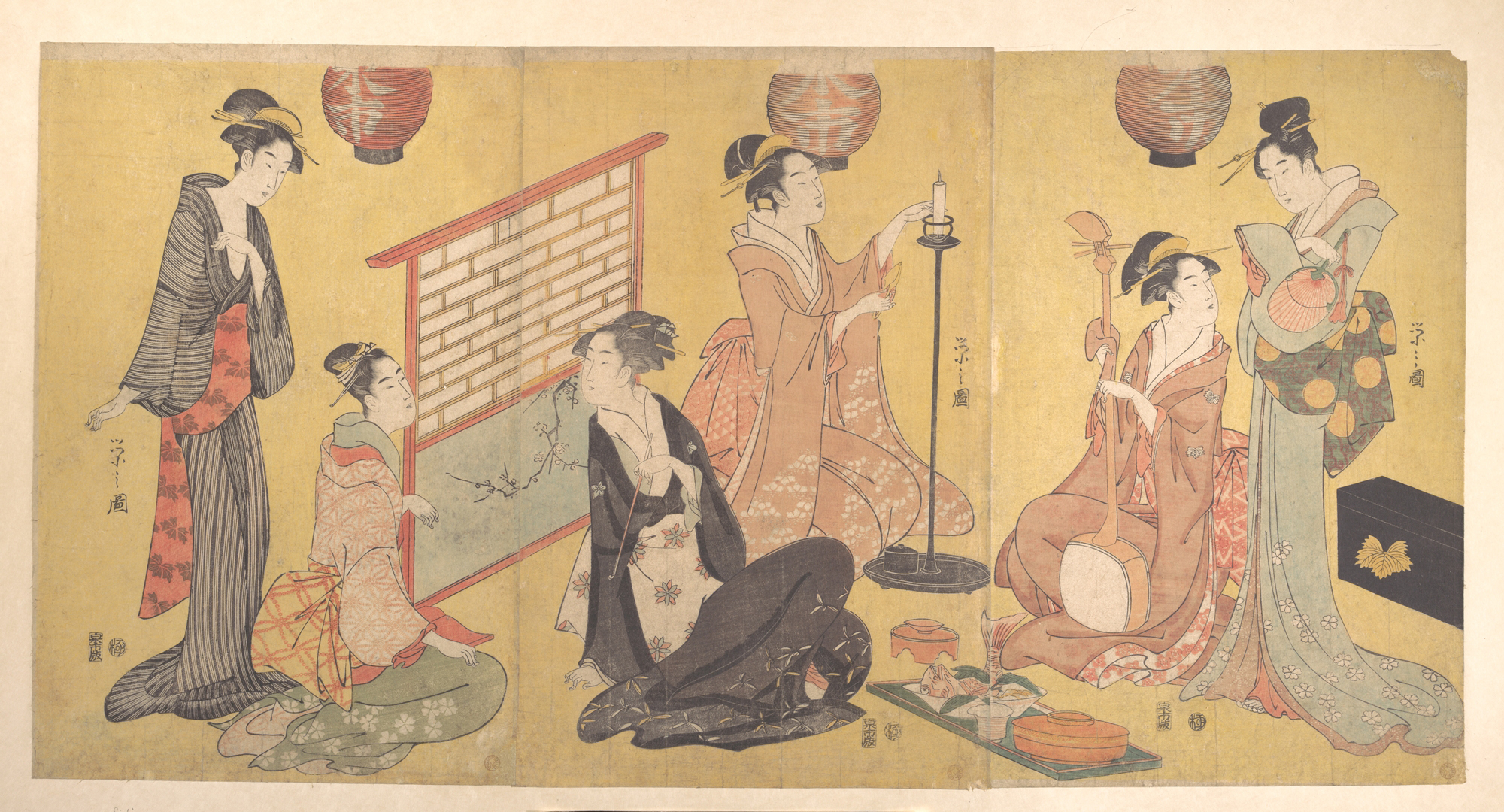
Geisha Preparing for an Entertainment
- Date:
- ca. 1794
- Medium:
- Triptych of woodblock prints; ink and color on paper
- Source:
- Metropolitan Museum of Art
Description
Geisha Preparing for an Entertainment turns Chobunsai Eishi's attention from the dramatic processions of courtesans to a quieter but no less revealing moment: the preparation that precedes a banquet performance. The Metropolitan Museum of Art preserves this impression, in which one or more geisha attend to their hair, instruments, and robes before going out to entertain. Geisha, distinct from the courtesans of the Yoshiwara, were trained primarily in music, dance, and conversation, and the visual codes of their dress and grooming carried specific professional meaning. Eishi's careful attention to the slight rearrangement of a sleeve, the placement of a hairpin, or the tuning of a shamisen positions the figures as serious professionals at work rather than as decorative ornaments. As Edo bijin-ga, the print participates in a broader fashion among late eighteenth-century artists for depicting the off-stage life of pleasure-district women, a humanizing approach that contrasted with the formal display of dōchū processions. His Kano-trained ukiyo-e background, traceable to his apprenticeship under Kano Eisen-in, gives the design its refined contour lines and restrained palette, lending dignity to a seemingly intimate moment. The composition isolates the figures against a quiet background that helps focus attention on gesture and gaze rather than on incidental detail. Chobunsai Eishi here suggests that the polished entertainments of an Edo evening rested on disciplined preparation, and his portrait of that preparation honors both the women and the larger cultural institution of the geisha tradition in which they trained.
More Prints by Chōbunsai Eishi

Komurasaki of the Kadotamaya with Attendants Hatsune and Utano
c. 1790
Color woodblock print; oban

A Parody of the Tales of Ise
c. 1789/95
Color woodblock print; right sheet of oban triptych

Kiyomizu, from the series "Seven Komachi (Nana Komachi)"
c. 1791/92
Color woodblock print; chuban

A Woman's Poetry Party
c. 1793
Color woodblock print; oban triptych
Frequently Asked Questions
Geisha Preparing for an Entertainment was created by Chōbunsai Eishi (鳥文斎栄之) in ca. 1794.