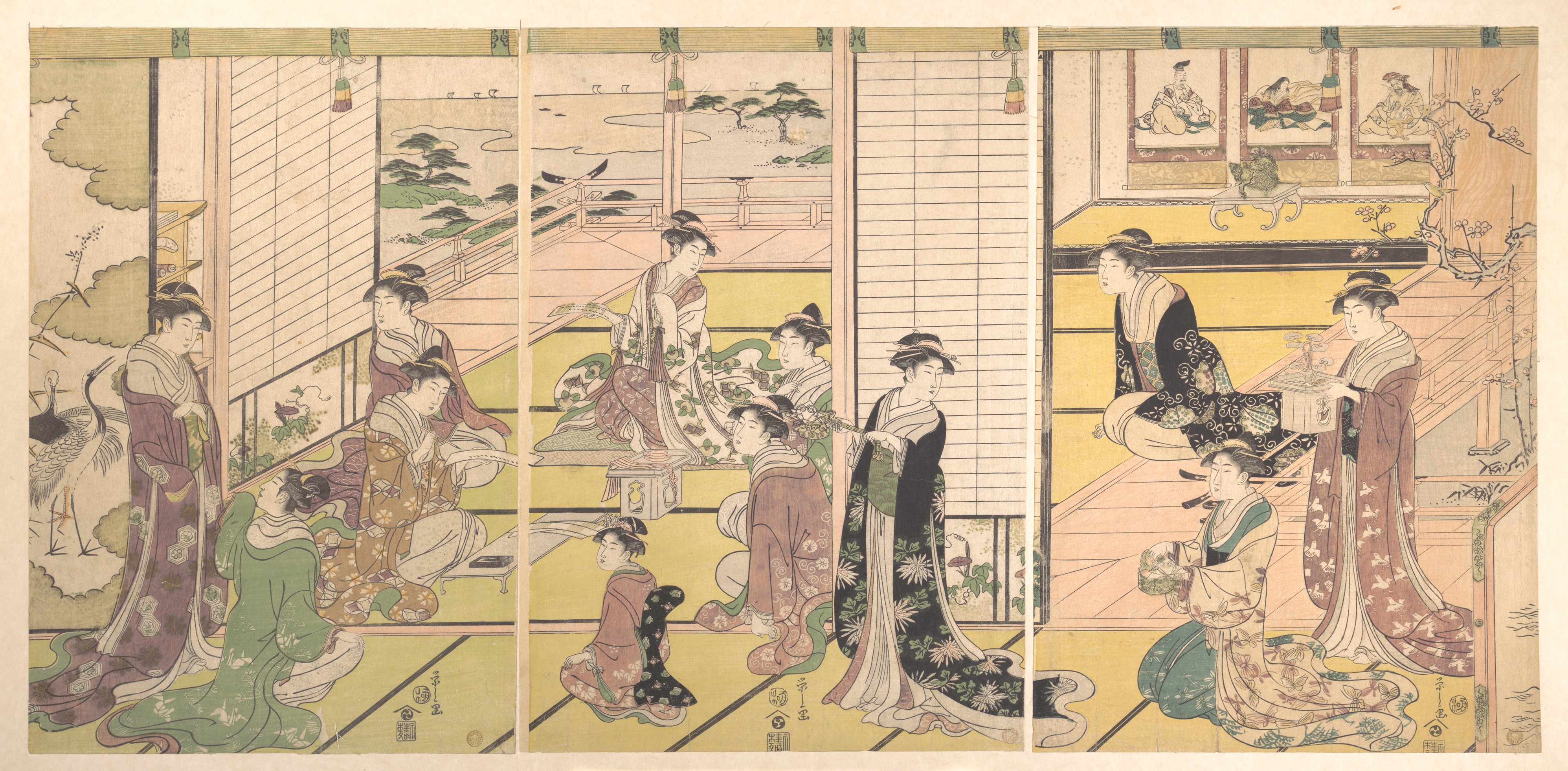
Honoring the Three Gods of Poetry: Women Composing Poems
- Date:
- ca. 1792
- Medium:
- Triptych of woodblock prints; ink and color on paper
- Source:
- Metropolitan Museum of Art
Description
Honoring the Three Gods of Poetry: Women Composing Poems shows Chobunsai Eishi at his most directly literary. The print refers to a long-standing tradition in which the three deified poets, often associated with Sumiyoshi, Tamatsushima, and Hitomaro, were invoked at gatherings devoted to waka composition. Eishi recasts the conceit in contemporary Edo bijin-ga terms by depicting modern women engaged in the same act of poetic creation, complete with brushes, paper, and the small props of a formal poetry party. The Metropolitan Museum of Art preserves this impression. The composition arranges several figures in a balanced group, their bodies turned toward one another as if exchanging verses in real time. Inscribed cartouches or poem slips integrated into the design invite the viewer to read the verses alongside the figures, transforming the print into a kind of literary portrait. As Edo bijin-ga, the work treats poetic accomplishment as a defining mark of female cultivation, an idea Eishi returned to repeatedly across his career. His Kano-trained ukiyo-e draftsmanship anchors the composition, giving the disciplined linework and balanced spacing of his apprenticeship under Kano Eisen-in to a subject that draws on classical literature. The combination of refined draftsmanship, contemporary fashion, and classical reference is precisely the kind of synthesis his audience valued. Chobunsai Eishi here joins the world of urban Edo to the venerable lineage of court poetry, presenting his contemporary women as worthy continuators of that long, immortal tradition.
More Prints by Chōbunsai Eishi

Komurasaki of the Kadotamaya with Attendants Hatsune and Utano
c. 1790
Color woodblock print; oban

A Parody of the Tales of Ise
c. 1789/95
Color woodblock print; right sheet of oban triptych

Kiyomizu, from the series "Seven Komachi (Nana Komachi)"
c. 1791/92
Color woodblock print; chuban

A Woman's Poetry Party
c. 1793
Color woodblock print; oban triptych
Frequently Asked Questions
Honoring the Three Gods of Poetry: Women Composing Poems was created by Chōbunsai Eishi (鳥文斎栄之) in ca. 1792.