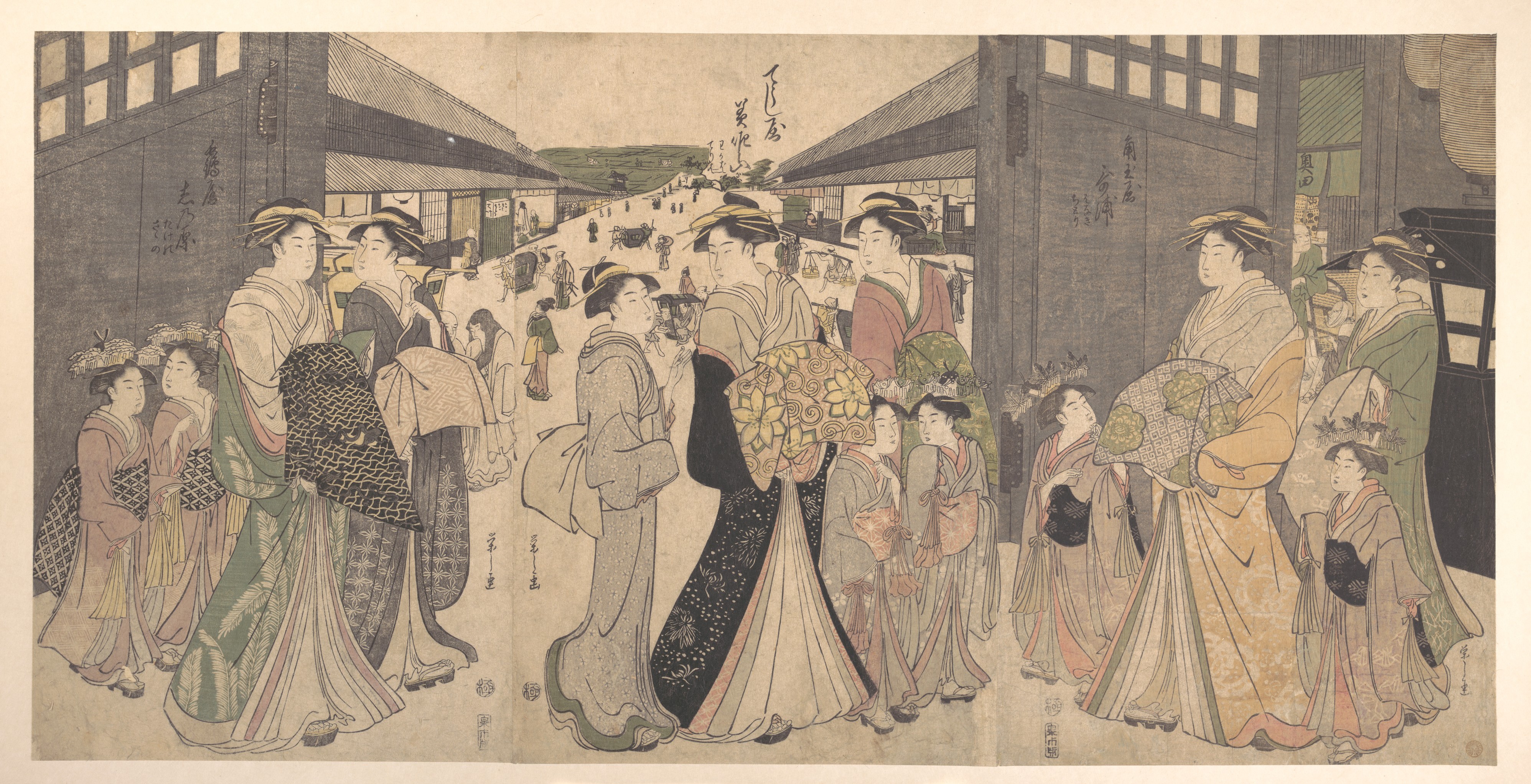
Oiran and Attendants at the Ō Mon or Great Gate of the Yoshiwara
- Date:
- ca. 1794
- Medium:
- Triptych of woodblock prints (trimmed); ink and color on paper
- Source:
- Metropolitan Museum of Art
Description
Oiran and Attendants at the Ō Mon or Great Gate of the Yoshiwara takes up the very threshold of Edo's licensed quarter. The Ō Mon was the single official entrance to the walled district, the gate through which every visitor passed and where the most splendid processions of high-ranking courtesans began. Chobunsai Eishi places an oiran and her attendants near this iconic point, choreographing the figures into a vertical arrangement that allows him to display both the leading courtesan's full robes and the deferential roles of the kamuro and shinzō around her. The Metropolitan Museum of Art preserves this impression. As Edo bijin-ga, the print serves both as fashion plate and as documentary of Yoshiwara ritual, capturing the sense of public ceremony that defined the dōchū processions. Eishi's Kano-trained ukiyo-e draftsmanship is everywhere in evidence: the clean contour of the oiran's outer robe, the carefully measured gaps between figures, and the restrained palette all derive from the disciplined painting tradition of his apprenticeship under Kano Eisen-in. He resists the temptation to overload the scene with crowd detail, focusing instead on the small group of women whose appearance constituted the spectacle. The result is a composition that feels grand without being noisy, and dignified without becoming abstract. Chobunsai Eishi uses the Ō Mon setting to remind viewers that the Yoshiwara, for all its sensual reputation, was also an institution with thresholds, hierarchies, and elaborate forms of display whose performance required both training and architecture.
More Prints by Chōbunsai Eishi

Komurasaki of the Kadotamaya with Attendants Hatsune and Utano
c. 1790
Color woodblock print; oban

A Parody of the Tales of Ise
c. 1789/95
Color woodblock print; right sheet of oban triptych

Kiyomizu, from the series "Seven Komachi (Nana Komachi)"
c. 1791/92
Color woodblock print; chuban

A Woman's Poetry Party
c. 1793
Color woodblock print; oban triptych
Frequently Asked Questions
Oiran and Attendants at the Ō Mon or Great Gate of the Yoshiwara was created by Chōbunsai Eishi (鳥文斎栄之) in ca. 1794.