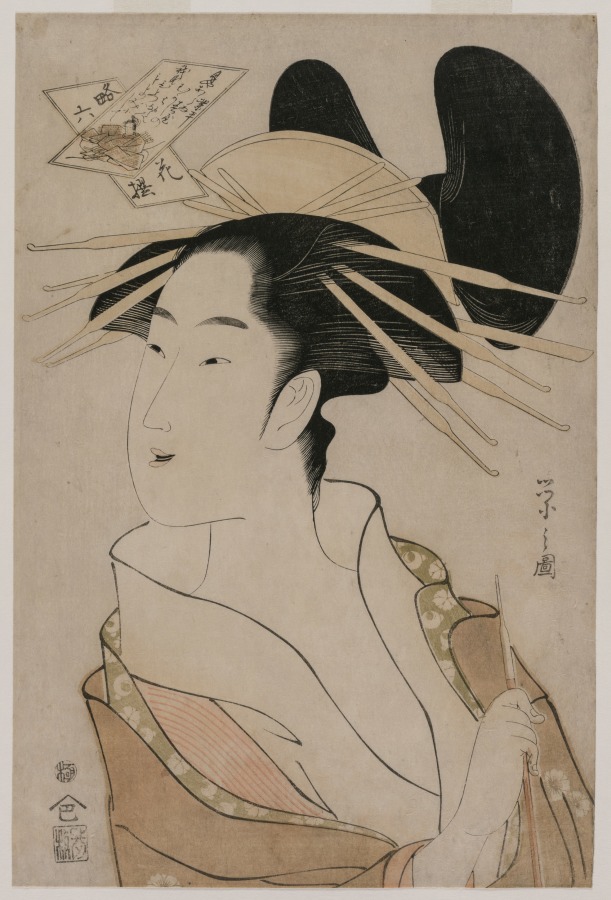
Portrait of a Courtesan Holding a Pipe (from the series The Six Immortal Poets in Modern Dress)
- Date:
- mid 1790s
- Medium:
- color woodblock print
- Source:
- Cleveland Museum of Art
Description
This sheet by Chobunsai Eishi, dated about 1790, belongs to his series The Six Immortal Poets in Modern Dress, in which the canonical rokkasen are mitate'd as elegant figures in contemporary Edo costume. The print depicts a Yoshiwara courtesan holding a long kiseru pipe, an attribute that identifies the specific poet being parodied within the series. Eishi's treatment exemplifies his Edo bijin-ga at its most distilled. As a Kano-trained ukiyo-e designer who had studied under Kano Eisen'in before entering the print market, he gives the courtesan the measured bearing of an academy figure, with sloping shoulders, narrow waist, and tapered hands. The long pipe extends across the composition as a slow horizontal counter to the vertical of the figure, and the kimono falls in long, evenly described parallel folds rather than the busier patterns favored by his contemporaries. The palette stays in his characteristic register of muted greys, soft indigos, and pale fleshtones. The Cleveland Museum of Art preserves an impression of the print as accession 1940.1044, where it is documented within The Six Immortal Poets in Modern Dress series. The work is one of the clearest demonstrations of Eishi's strategy of dignifying ukiyo-e by anchoring the courtesan portrait in the canon of classical waka poetry, a strategy that earned him a distinguished clientele among samurai and literary merchant collectors during the early Kansei era.
More Prints by Chōbunsai Eishi

Komurasaki of the Kadotamaya with Attendants Hatsune and Utano
c. 1790
Color woodblock print; oban

A Parody of the Tales of Ise
c. 1789/95
Color woodblock print; right sheet of oban triptych

Kiyomizu, from the series "Seven Komachi (Nana Komachi)"
c. 1791/92
Color woodblock print; chuban

A Woman's Poetry Party
c. 1793
Color woodblock print; oban triptych
Frequently Asked Questions
Portrait of a Courtesan Holding a Pipe (from the series The Six Immortal Poets in Modern Dress) was created by Chōbunsai Eishi (鳥文斎栄之) in mid 1790s.