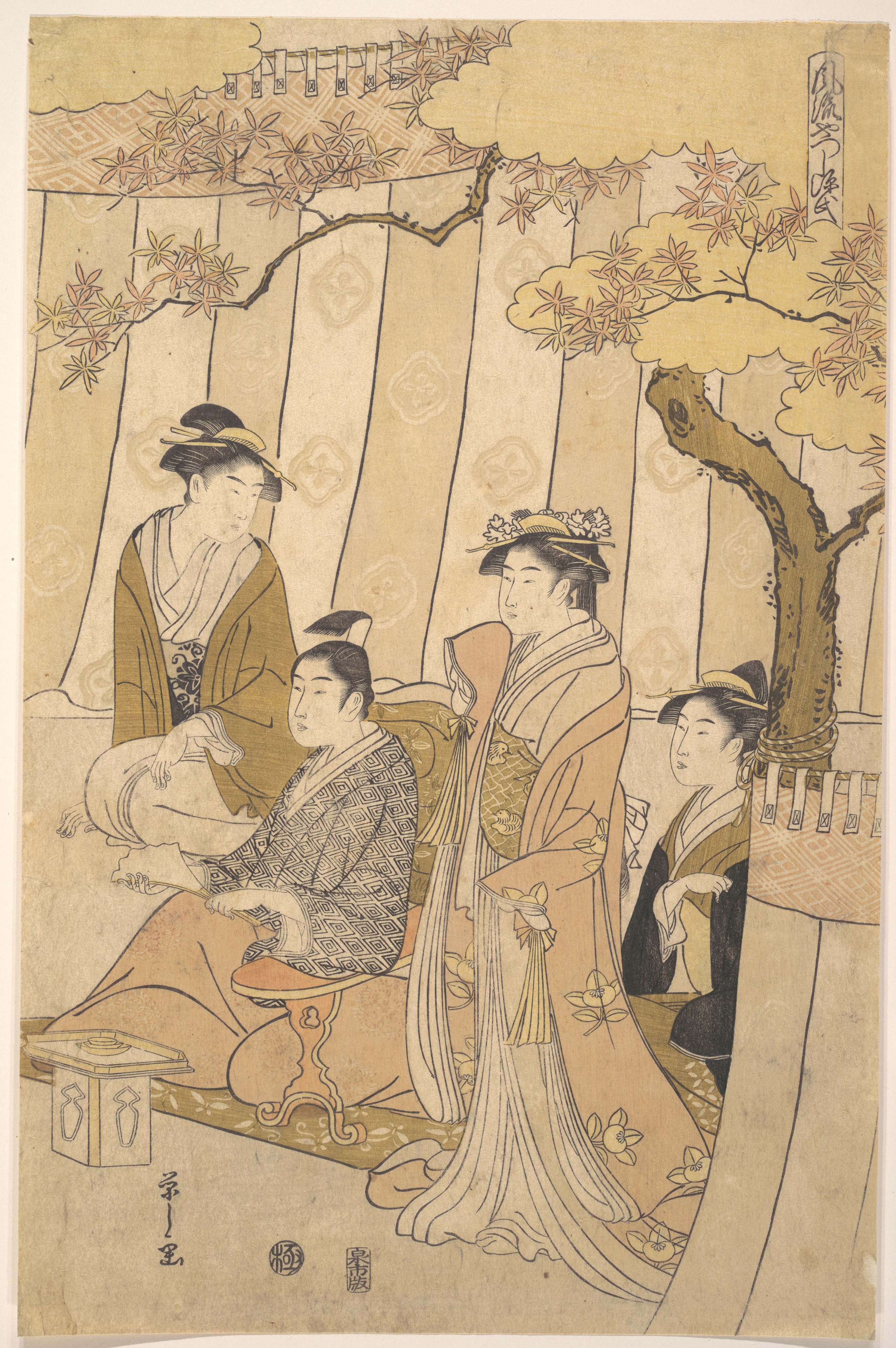
Prince Genji and Three Young Women
- Medium:
- Woodblock print; ink and color on paper
- Source:
- Metropolitan Museum of Art
Description
Prince Genji and Three Young Women is a quintessential example of Chobunsai Eishi's lifelong dialogue with The Tale of Genji, the eleventh-century novel that anchored so much of his picture making. The print belongs to the furyū yatsushi tradition, in which classical narrative figures appear as fashionable contemporary types, so the prince here is dressed and styled in the elegant manner of a late eighteenth-century young man rather than a Heian courtier. He is surrounded by three young women whose poses, fans, and trailing robes form a balanced grouping around him, an arrangement Eishi clearly built with Kano-style attention to compositional weight and rhythm. The Metropolitan Museum of Art holds this impression and credits it to Eishi's mature period, when his Edo bijin-ga had absorbed the lessons of his classical apprenticeship without losing accessibility to popular audiences. As a Kano-trained ukiyo-e artist, Eishi understood how to use clean contour lines, restrained color, and carefully spaced figures to suggest a sense of high decorum even in playful subjects. The viewer is invited to recognize Genji from his graceful demeanor and the deference of his companions rather than from explicit textual reference, a recognition game that Edo readers of the Genji enjoyed enormously. Within this game, Eishi makes sure that the women retain their own visual interest, dressed in subtly contrasting patterns that mark them as distinct personalities. Chobunsai Eishi here turns a courtly legend into a softly modern social vignette, showcasing his ability to blend literary erudition with the fashionable concerns of his Edo public.
More Prints by Chōbunsai Eishi

Komurasaki of the Kadotamaya with Attendants Hatsune and Utano
c. 1790
Color woodblock print; oban

A Parody of the Tales of Ise
c. 1789/95
Color woodblock print; right sheet of oban triptych

Kiyomizu, from the series "Seven Komachi (Nana Komachi)"
c. 1791/92
Color woodblock print; chuban

A Woman's Poetry Party
c. 1793
Color woodblock print; oban triptych
Frequently Asked Questions
Prince Genji and Three Young Women was created by Chōbunsai Eishi (鳥文斎栄之).