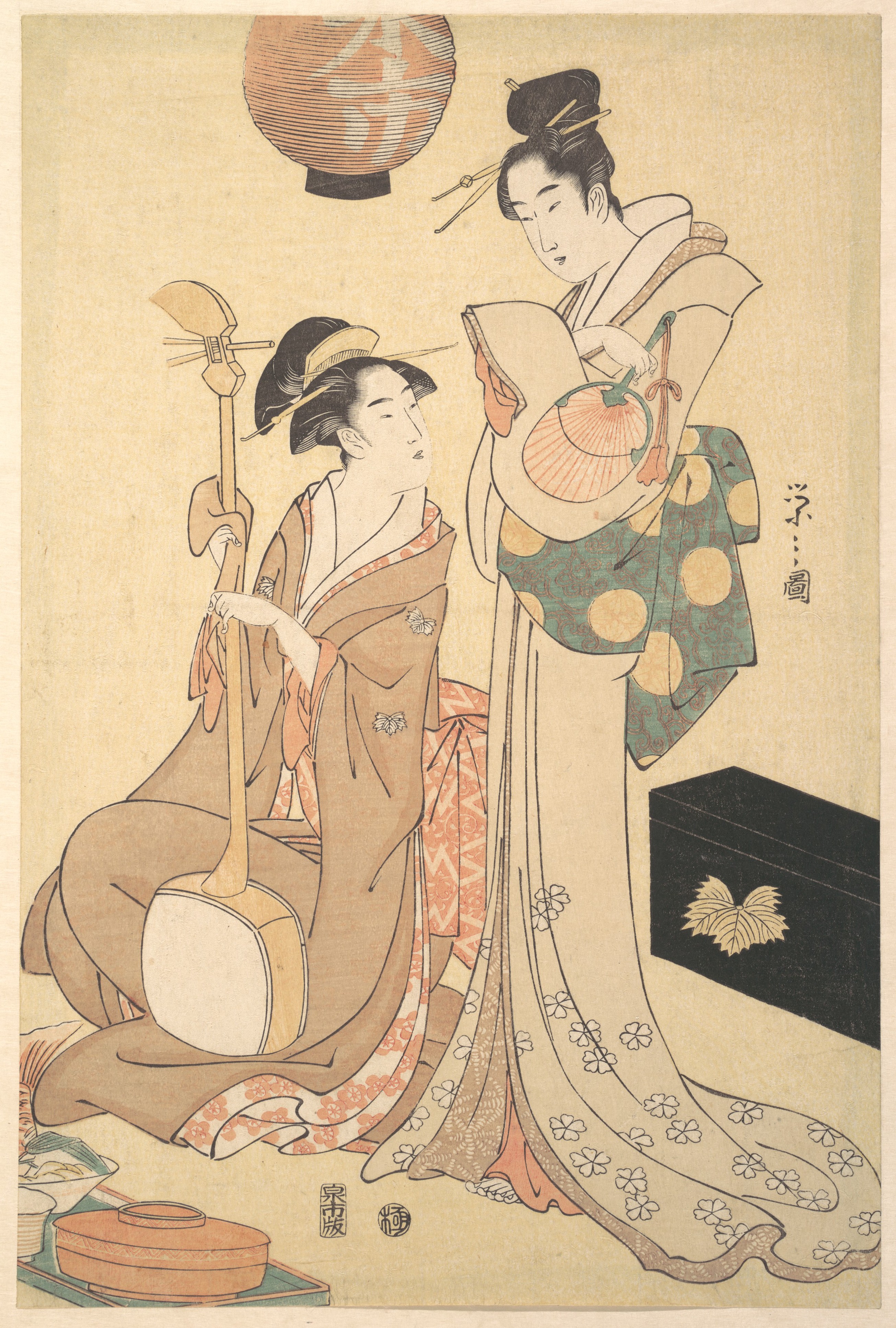
Two Geisha
- Date:
- ca. 1792
- Medium:
- One sheet of a triptych of woodblock prints; ink and color on paper
- Source:
- Metropolitan Museum of Art
Description
Two Geisha presents a quietly intimate double portrait at the heart of Chobunsai Eishi's exploration of the female entertainers of the floating world. Unlike the courtesans of the Yoshiwara, geisha were trained primarily in music, dance, and conversation, and Eishi's image emphasizes that distinct identity: the two women are dressed in tasteful, less ostentatious robes appropriate to performers rather than the elaborate finery of high-ranking oiran. The Metropolitan Museum of Art preserves this impression. The composition places the figures close together, their bodies overlapping in a way that lets Eishi orchestrate the patterns and lines of their kimono into a single rhythmic surface. As Edo bijin-ga, the work captures the urbane sociability of late eighteenth-century pleasure districts, where geisha moved between teahouses, banquets, and private parties as the city's most cultivated entertainers. The visual restraint of the print, with its clean contours, soft palette, and careful spacing, reveals Eishi's Kano-trained ukiyo-e background, in which orthodox brushwork discipline was translated into woodblock design. He never crowds his figures with extraneous incident; instead, he allows their gestures, the angle of a hairpin, the lift of a sleeve, the lowered glance, to do the work of characterization. The relationship between the two women, whether colleagues, friends, or rivals, is left intentionally ambiguous, inviting the viewer to read motive into their composure. Chobunsai Eishi here demonstrates how completely he had absorbed the lessons of refined painting and how skilfully he could apply them to the popular printmaking that supported his commercial career.
More Prints by Chōbunsai Eishi

Komurasaki of the Kadotamaya with Attendants Hatsune and Utano
c. 1790
Color woodblock print; oban

A Parody of the Tales of Ise
c. 1789/95
Color woodblock print; right sheet of oban triptych

Kiyomizu, from the series "Seven Komachi (Nana Komachi)"
c. 1791/92
Color woodblock print; chuban

A Woman's Poetry Party
c. 1793
Color woodblock print; oban triptych
Frequently Asked Questions
Two Geisha was created by Chōbunsai Eishi (鳥文斎栄之) in ca. 1792.