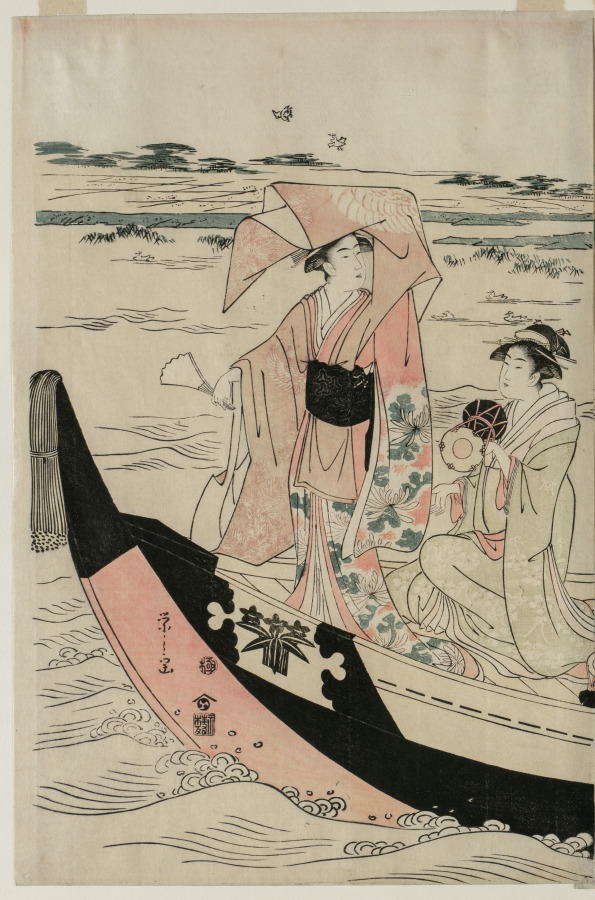
Women in a Pleasure Boat on the Sumida River
- Date:
- early 1790s
- Medium:
- woodblock print from a triptych; ink and color on paper
- Source:
- Cleveland Museum of Art
Description
Designed by Chobunsai Eishi about 1790 and preserved at the Cleveland Museum of Art under accession 1916.1122.a, this print depicts a party of fashionable Edo women aboard a pleasure boat on the Sumida River. The Sumida was the great social waterway of late-eighteenth-century Edo, and boating parties of this sort, often involving courtesans, geisha, and their patrons, were a recurring subject for ukiyo-e designers. Eishi handles the theme with his characteristic restraint. The women occupy the boat with a measured rhythm, their slender figures and long, lightly curved robes carrying the composition rather than animated gestures. The boat's slatted roof, mat-covered floor, and bamboo blinds are drawn with the disciplined keyblock work expected from a Kano-trained ukiyo-e master, and the water is suggested through softly modulated linear ripples rather than dramatic spray. The palette favors muted greys, pale indigos, and quiet ochres, consistent with the silvery tonality that distinguishes Eishi's Edo bijin-ga from the more saturated work of contemporaries such as Utamaro. The Cleveland impression preserves clean impressions of the keyblock and minimal toning, allowing the long, parallel folds of the kimono to read as the designer intended. The print is an exemplary statement of Eishi's approach to urban leisure, in which the social fashions of Edo are absorbed into a courtly visual idiom inherited from his Kano training, and contemporary women's lives are presented with the dignity normally reserved for classical scenes.
More Prints by Chōbunsai Eishi

Komurasaki of the Kadotamaya with Attendants Hatsune and Utano
c. 1790
Color woodblock print; oban

A Parody of the Tales of Ise
c. 1789/95
Color woodblock print; right sheet of oban triptych

Kiyomizu, from the series "Seven Komachi (Nana Komachi)"
c. 1791/92
Color woodblock print; chuban

A Woman's Poetry Party
c. 1793
Color woodblock print; oban triptych
Frequently Asked Questions
Women in a Pleasure Boat on the Sumida River was created by Chōbunsai Eishi (鳥文斎栄之) in early 1790s.