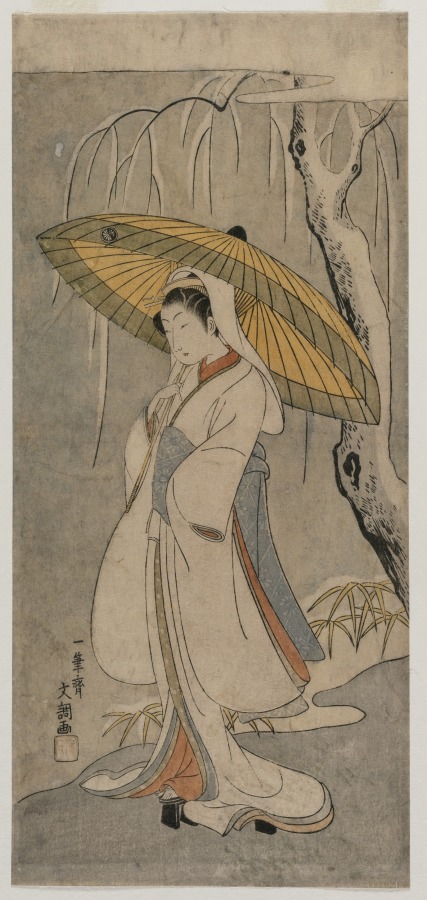
Segawa Kikunojo II as the Heron Maiden (from the series Ichimura Theater)
- Date:
- 1770
- Medium:
- color woodblock print
- Source:
- Cleveland Museum of Art
Description
Segawa Kikunojo II as the Heron Maiden (Sagi musume), from the series Ichimura Theater and dated 1770 by the Cleveland Museum of Art, captures one of the most cherished images in Edo theatrical visual culture. The Heron Maiden is a dance role in which the onnagata transforms gradually from a chaste, snow-white spirit into a more carnal courtesan and back again, a tour-de-force of costume change and movement. Segawa Kikunojo II was the leading onnagata of his generation, and Ippitsusai Buncho's print situates him at a moment of poised stillness, the costume's pale tones and the figure's hand gesture evoking the moment when the maiden lifts a paper umbrella against falling snow. The series identification, tying the design to the Ichimura Theater, confirms the print's function as a piece of theatrical journalism, marketing a specific production to fans of the Edo entertainment districts. The Cleveland Museum of Art holds the work as part of its strong holdings of Edo ukiyo-e yakusha-e, and the 1770 date positions it within Buncho's most productive phase. Stylistically the print exemplifies why Buncho is so often paired with Katsukawa Shunsho in discussions of mid-Edo actor portraiture. Both artists privileged the actor's face as the locus of likeness, both used controlled linework rather than expressionist exaggeration, and both helped move yakusha-e away from generic posture toward true nigao-e identification. The Sagi musume subject would be reprised by later artists across the nineteenth century, but Buncho's version retains a quiet authority precisely because it refuses melodrama. For collectors and researchers, the work is a key reference for the visual history of one of kabuki's most enduring dance roles.
More Prints by Ippitsusai Buncho

The Shrine Dancers (Miko) Ohatsu and Onami
1769
Color woodblock print; hosoban

The Actor Ichikawa Komazo II as Kudo Saemon Suketsune (?) in the Play Haru wa Soga Akebono-zoshi (?), Performed at the Nakamura Theater (?) in the First Month, 1772 (?)
c. 1772
Color woodblock print; hosoban

The Actor Segawa Kikunojo II in an Unidentified Role
c. 1771
Color woodblock print; hosoban

Actor Sanogawa Ichimatsu II as a Fashionable Young Man (Wakashu)
About 1769
Color woodblock print; hosoban
More Birds & Flowers Prints
Frequently Asked Questions
Segawa Kikunojo II as the Heron Maiden (from the series Ichimura Theater) was created by Ippitsusai Buncho (一筆斎文調) in 1770.
Segawa Kikunojo II as the Heron Maiden (from the series Ichimura Theater) depicts birds & flowers.