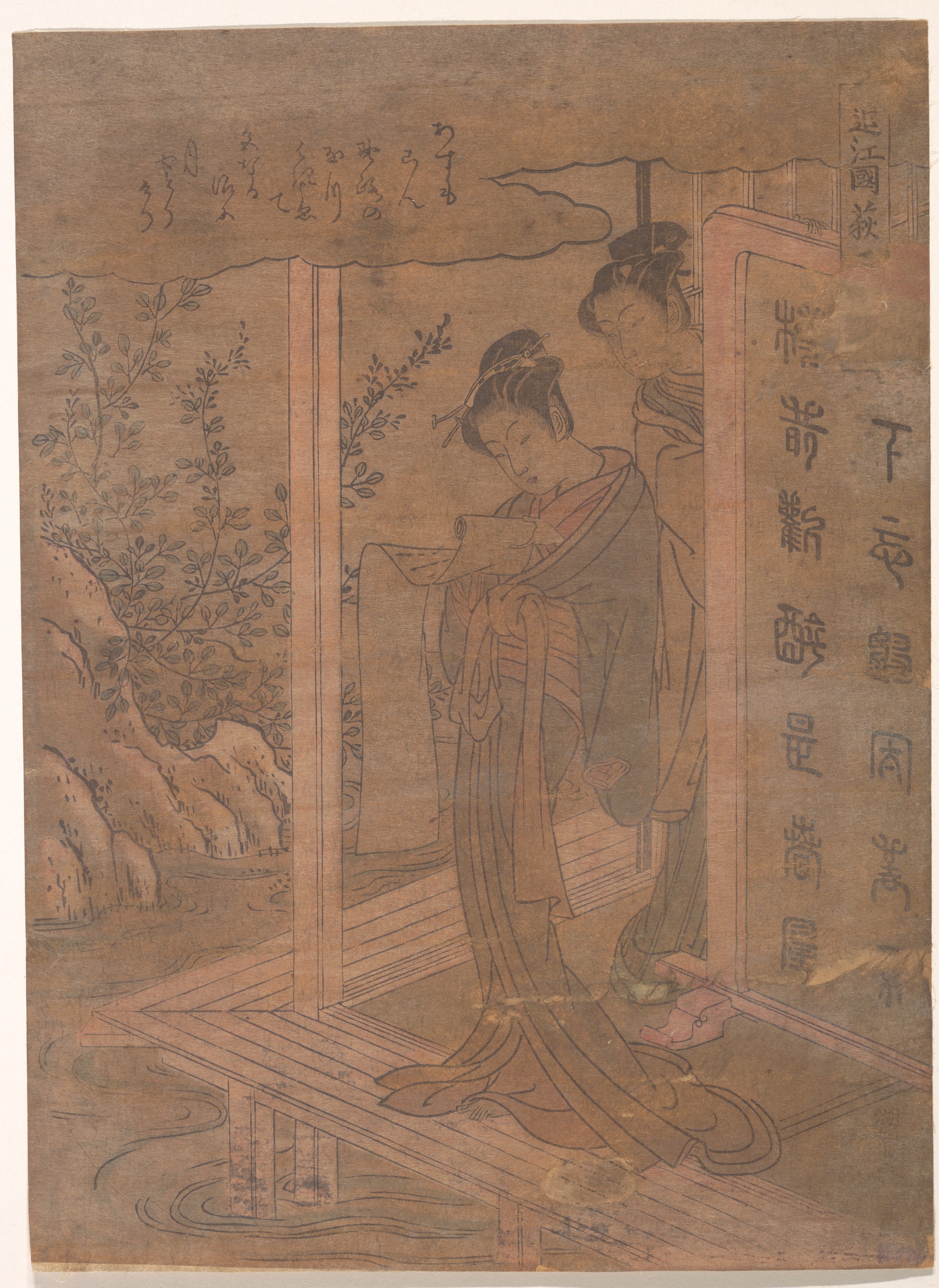
Bush Clover in Province of Omi
- Medium:
- Woodblock print; ink and color on paper
- Source:
- Metropolitan Museum of Art
Description
Isoda Koryusai's Bush Clover in Province of Omi, catalogued by the Metropolitan Museum of Art under accession 55941, takes as its subject the autumnal motif of hagi, or bush clover, in the celebrated Omi province on the eastern shore of Lake Biwa. The pairing of bush clover and Omi belongs to the long-standing meisho tradition through which Edo printmakers attached specific seasonal plants to specific places, and Koryusai uses the convention as the structural premise of the design. The composition combines the seasonal vegetation with a figural element drawn from Edo bijin-ga, in keeping with the broader practice through which Koryusai folded the meisho tradition into his survey of contemporary women's fashion and life. The bush clover itself is rendered with the slender stalks and small pendulous blossoms that signaled hagi to the period audience, while the figure is drawn in the small-mouthed, elongated convention that Koryusai used across his bijin output. The print belongs to the broader cluster of Koryusai sheets that work the seasonal-place format alongside the named-courtesan portraiture of Hinagata Wakana, demonstrating how the artist used Edo bijin-ga as a flexible idiom that could absorb famous-place imagery while preserving its primary commitment to the contemporary woman as subject. The Metropolitan Museum's catalogue preserves the title and the attribution to Koryusai.


