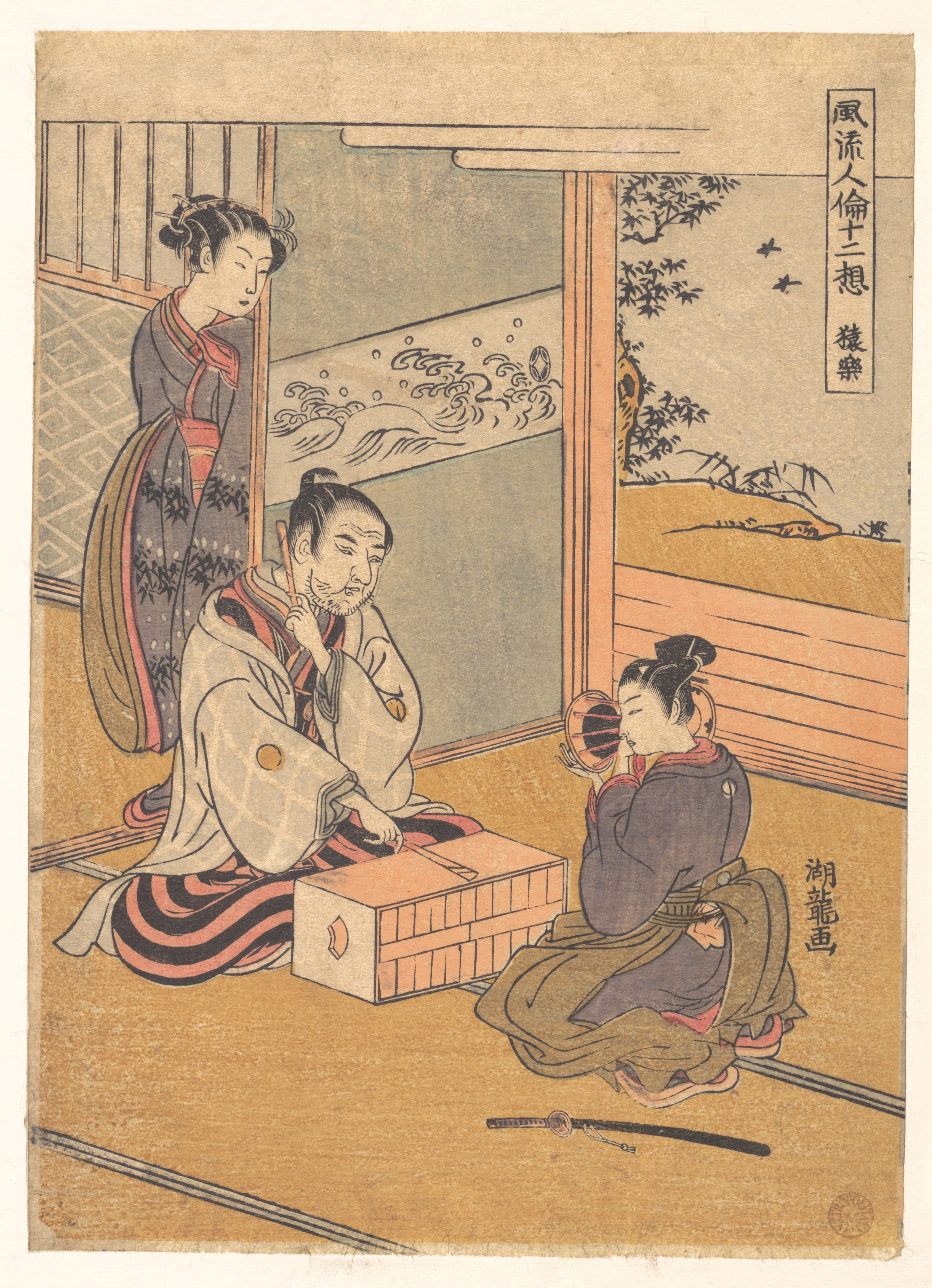
Monkey Dance
- Date:
- ca. 1760
- Medium:
- Woodblock print; ink and color on paper
- Source:
- Metropolitan Museum of Art
Description
Monkey Dance, a woodblock print attributed to Isoda Koryusai and held by the Metropolitan Museum of Art, depicts one of the most beloved itinerant performances of Edo street life, the saru-mawashi or trained monkey show. Performers traveled from neighborhood to neighborhood with small Japanese macaques outfitted in miniature costumes, and the monkey would dance and bow to the rhythm of its handler's drum or song while a small crowd gathered to watch and reward the act with coins. The performance held religious as well as entertainment value, since monkeys were associated with the stables of samurai households and with rituals of purification thought to protect horses, an association that linked the saru-mawashi to deep currents of folk belief. Koryusai's draftsmanship treats the encounter with characteristic precision, balancing the monkey's animated posture against the figure of the handler or audience and giving the scene the air of a quiet vignette rather than a noisy public spectacle. As a samurai-turned-printmaker, he brought a disciplined eye to genre subjects, allowing the everyday moment to acquire compositional weight without losing its sense of immediacy. The print belongs to the broader body of street-life imagery that ran alongside his celebrated Edo bijin-ga and his Yoshiwara fashion series Hinagata Wakana no Hatsu Moyo, demonstrating the breadth of subjects he handled. The Metropolitan Museum of Art preserves this impression among its eighteenth-century Japanese print holdings.
More Prints by Isoda Koryūsai


Frequently Asked Questions
Monkey Dance was created by Isoda Koryūsai (礒田湖龍斎) in ca. 1760.