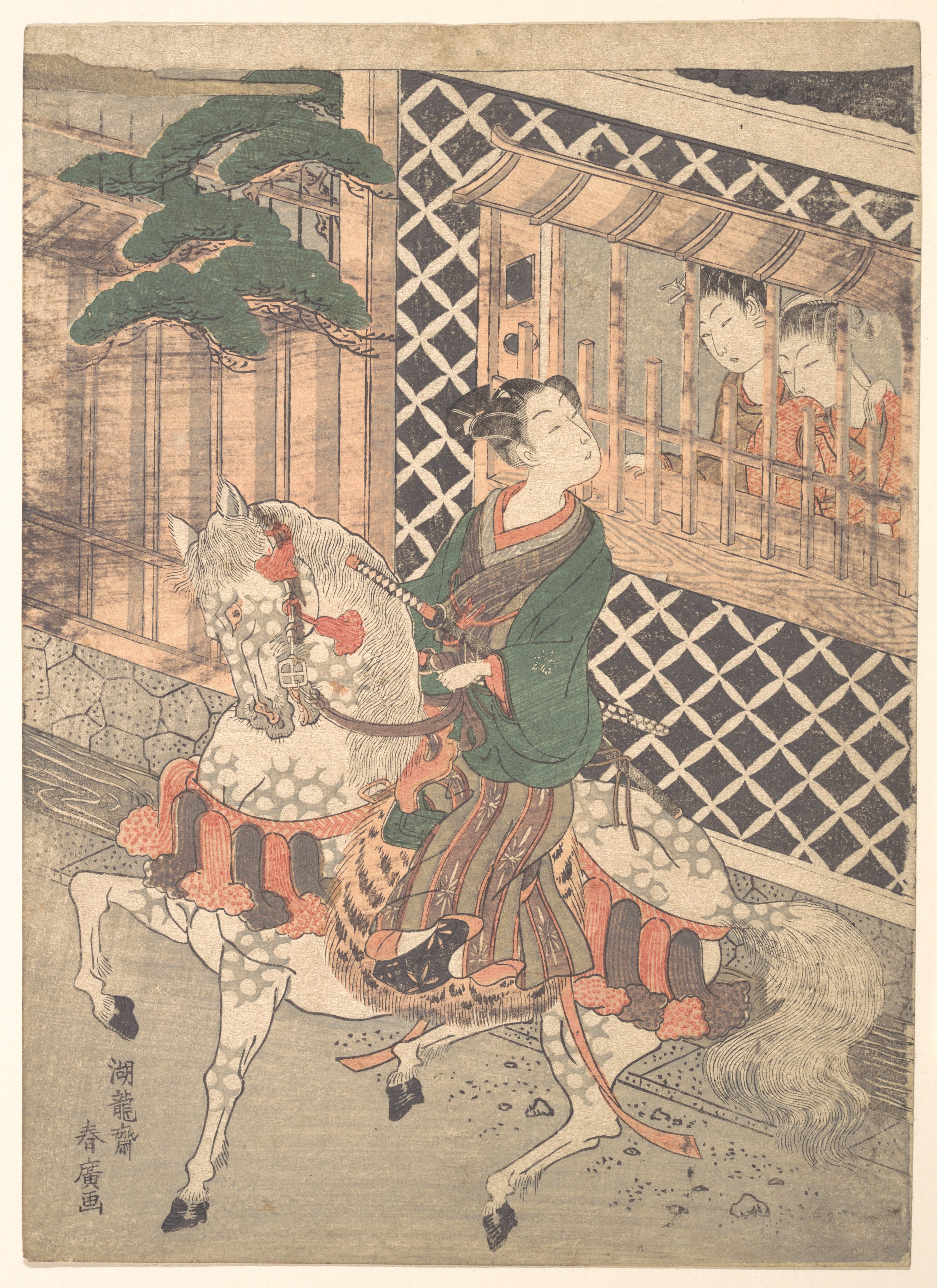
Young Samurai on Horseback and Women at a Window
- Date:
- ca. 1769–70 (Meiwa 6–7)
- Medium:
- Woodblock print (nishiki-e); ink and color on paper
- Source:
- Metropolitan Museum of Art
Description
Young Samurai on Horseback and Women at a Window by Isoda Koryusai pairs the warrior class with the courtesan world in a print that exemplifies the social mixing of late Edo street life. A young samurai rides past the latticed second-floor window of a tea house or brothel; women within lean out to look. The Metropolitan Museum of Art preserves the impression of this design, dating it to 1769, just as Koryusai was emerging from Harunobu's shadow after the older master's death the previous year. The composition uses the strict horizontal of the window grille to frame the women's faces and contrasts that geometry with the rounded forms of horse and rider below, a kind of structural play that would become a hallmark of Koryusai's mature designs. Koryusai's own samurai background made him unusually attentive to the etiquette and dress of mounted warriors, and his prints often include such figures as participants in everyday Edo bijin-ga rather than as historical heroes. The scene anticipates the easy social transit between samurai and courtesan that animates many of the fashion plates in his celebrated series Hinagata Wakana Hatsu Moyo, where samurai patrons and Yoshiwara women share the same visual field. For collectors, the print is a useful pivot point between Koryusai's Harunobu-period style and the bolder, more architectonic figure compositions he would produce throughout the 1770s.


