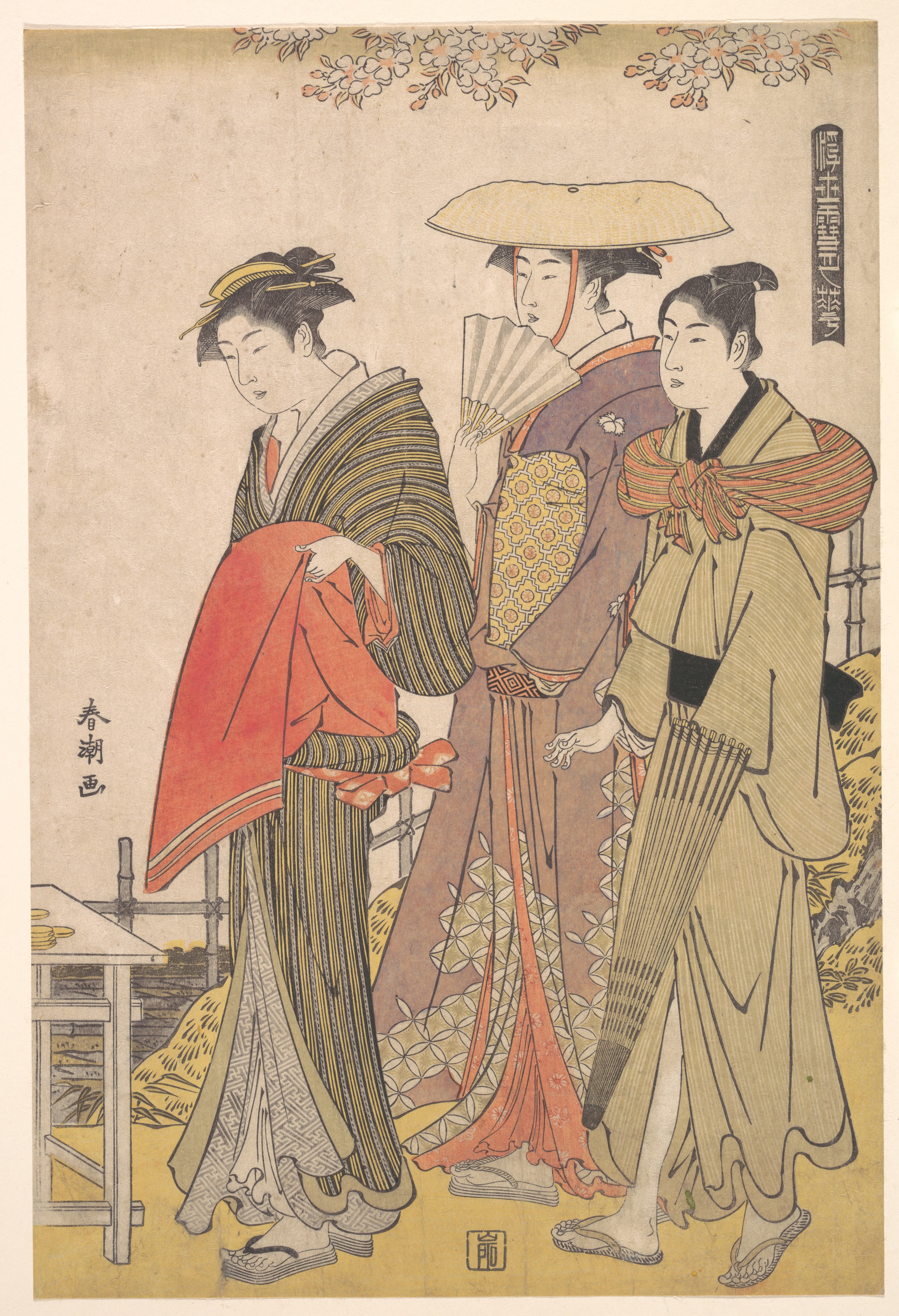
The Beauty of the Floating World
- Date:
- 1780–1795
- Medium:
- Woodblock print; ink and color on paper
- Source:
- Metropolitan Museum of Art
Description
The Beauty of the Floating World is an Edo bijin-ga by Katsukawa Shuncho, preserved in the Metropolitan Museum of Art. The phrase 'the floating world' (ukiyo) gave its name to the broader print culture of which Shuncho's work formed a central part, and prints titled in this way are emblematic of how Katsukawa school designers thought about their female subjects. Shuncho, working in the late eighteenth century, depicted the women of Edo's fashionable demimonde and respectable streets alike as embodiments of contemporary urban beauty, and this print compresses that programme into a single elegantly drawn figure. She is shown in the elongated proportions and softly curving posture that defined his mature manner, her robes patterned with motifs that the Katsukawa school rendered with crisp linear precision. The ground around her is largely open, allowing the figure to carry the composition without competition from setting or props. Her hair is dressed in a style current at the time of the print's production, and the few accessories visible — hairpins, perhaps a small fan or sash detail — all serve as discreet signals of fashion. By titling the print as a beauty of the floating world, the publisher framed it both as a portrait of a generalized urban type and as an emblem of the print culture itself: the ukiyo-e tradition in which Shuncho was a leading bijin-ga designer. The Metropolitan Museum of Art preserves this impression among its broad holdings of Japanese woodblock prints by Katsukawa Shuncho and his contemporaries.
More Prints by Katsukawa Shunchō

Women Admiring Peonies
c. 1789/1801
Color woodblock print; oban triptych

The Tanabata Festival, from the series "Amusements of the Five Festival Days (Gosetsu asobi)"
About 1790
Color woodblock print; chūban

Narcissus in Winter, from the series "Choicest Odes upon Flowers of the Four Seasons (Shuku awase, shiki no hana)"
c. 1792
Color woodblock print; chuban

Women Boarding a Pleasure Boat
1780s
Color woodblock print; oban diptych
Frequently Asked Questions
The Beauty of the Floating World was created by Katsukawa Shunchō (勝川春潮) in 1780–1795.