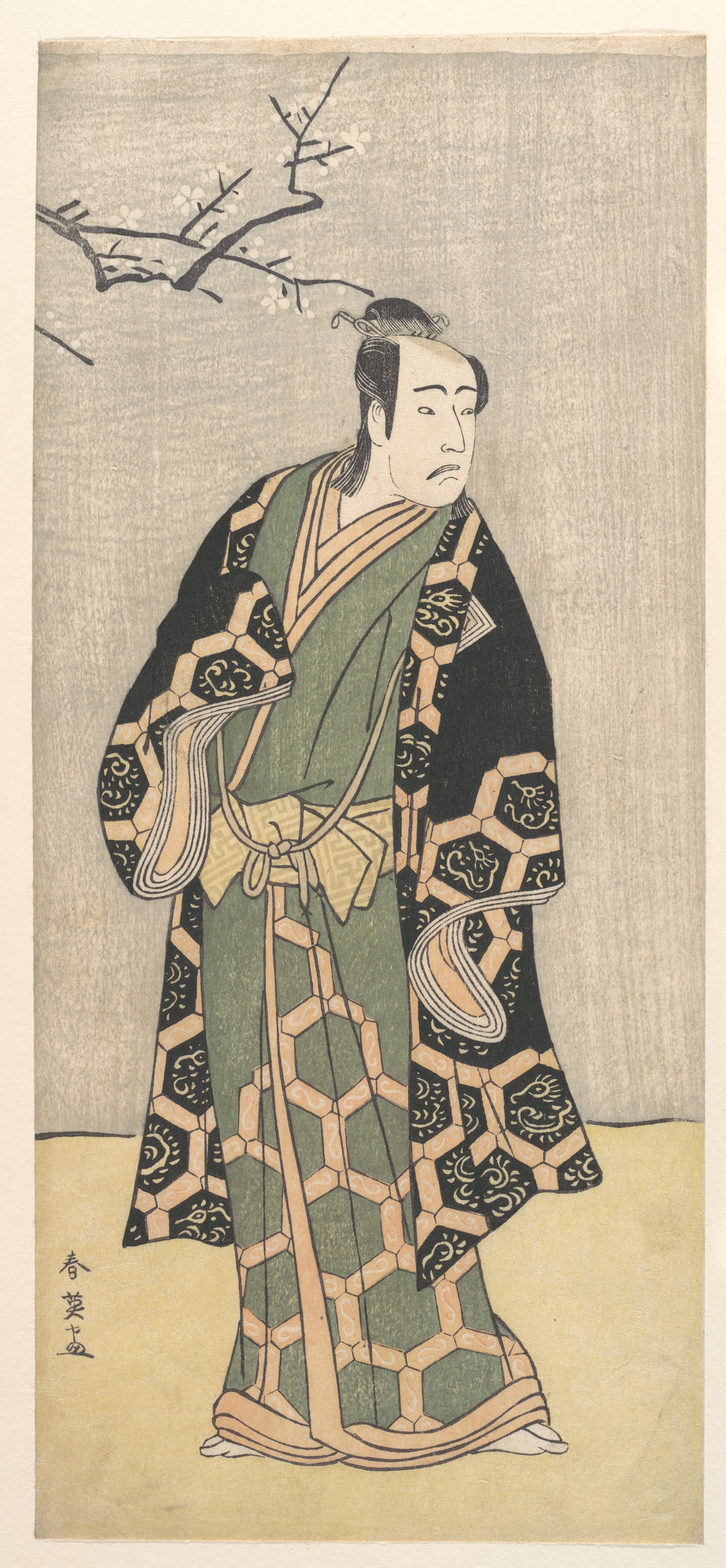
An Unidentified Actor
- Date:
- 1762–1819
- Medium:
- Woodblock print; ink and color on paper
- Source:
- Metropolitan Museum of Art
Description
Katsukawa Shunei's portrait of an unidentified kabuki actor, recorded by the Metropolitan Museum of Art with a date in the early Meiwa era around 1762, exemplifies the yakusha-e tradition that the Katsukawa school made central to late eighteenth-century Edo ukiyo-e. Shunei studied under Katsukawa Shunsho and emerged as one of the most accomplished portraitists of his generation, working in a manner that emphasized individual likeness over the more generalized actor types of earlier ukiyo-e. The sitter wears costume appropriate to the kabuki stage, and the composition isolates the figure against an unworked ground so that posture, expression, and textile pattern carry the full weight of characterization. Without a surviving inscription identifying play, theater, or role, the sheet now functions as a study in Shunei's facial drawing rather than as a record of a specific performance. Even so, it illustrates the technical conventions of Katsukawa school yakusha-e: the slightly elongated head, the careful articulation of jaw and brow, and the controlled use of line for hair and beard. Held in the Metropolitan Museum of Art and documented at https://www.metmuseum.org/art/collection/search/56009, the work demonstrates how Shunei's portraiture continued to shape the standard for theatrical likeness in Edo for the remainder of the eighteenth century.
More Prints by Katsukawa Shun'ei

Actor Sawamura Sôjûrô III as Oda Kazusanosuke Harunaga in “Muromacho Chronicle in Kana Script” (“Kanagaki Muromachi bundan”)
About 1791
Color woodblock print; hosoban triptych

Act Four: Enya Hangan's Castle from the play Chushingura (Treasury of the Forty-seven Loyal Retainers)
c. 1795
Color woodblock print; koban

The Actor Segawa Tomisaburo II in an Unidentified Role
c. 1793
Color woodblock print; hosoban; from a multisheet composition (?)

The Actor Yamashita Kinsaku II as the maid Tsumagi in the play "Otokyama O-Edo no Ishizue," performed at the Kiri Theater in the eleventh month, 1794
c. 1794
Color woodblock print; hosoban
Frequently Asked Questions
An Unidentified Actor was created by Katsukawa Shun'ei (勝川春英) in 1762–1819.