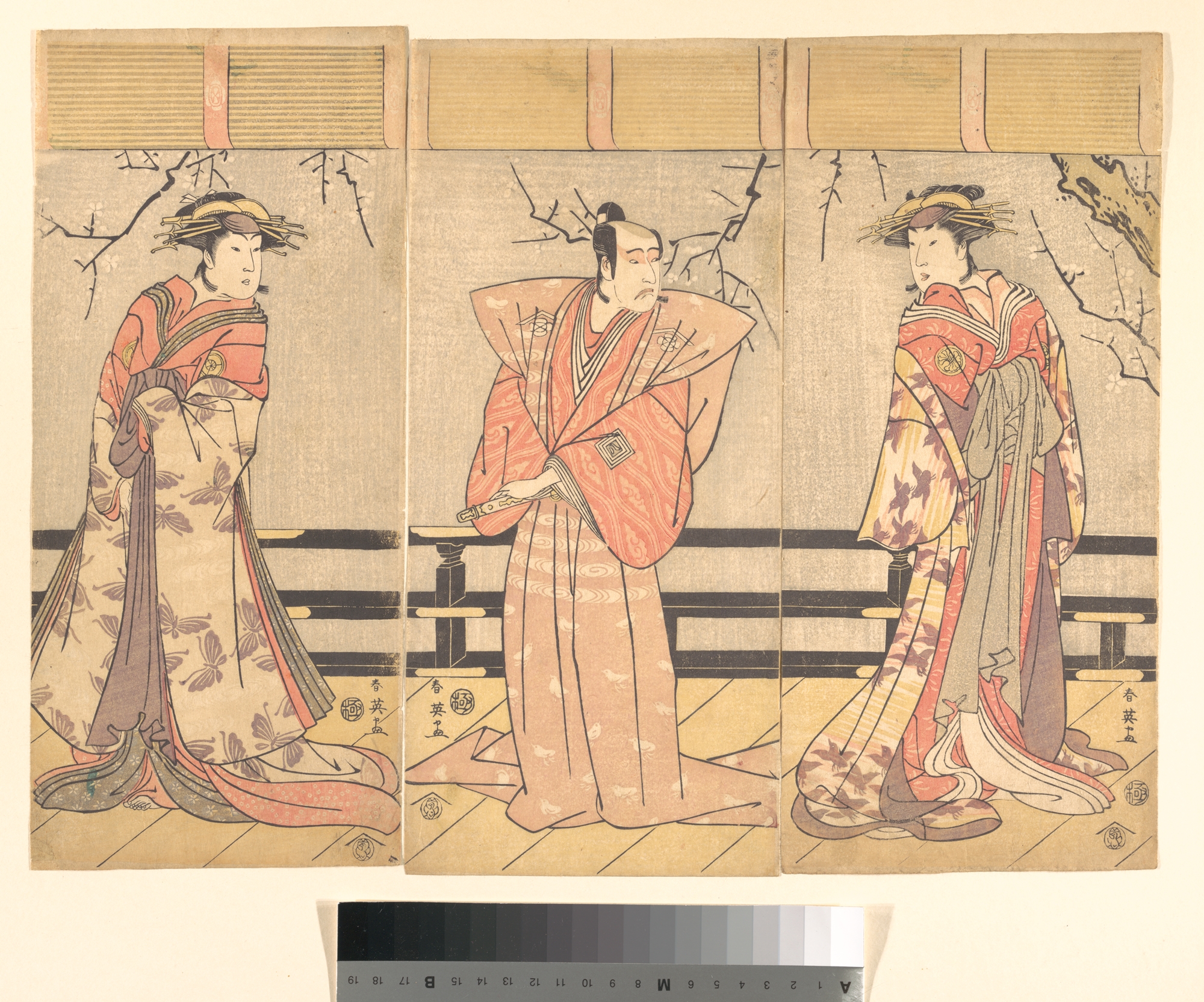
- Date:
- 1762–1819
- Medium:
- Triptych of woodblock prints; ink and color on paper
- Source:
- Metropolitan Museum of Art
Description
Katsukawa Shunei's print held by the Metropolitan Museum of Art, catalogued without a more specific title, illustrates the difficulty of reconstructing context for Edo ukiyo-e sheets that have become separated from their original inscriptions and surrounding publications. Even without a definite identification of subject or role, the work bears the visual hallmarks of Shunei's Katsukawa school yakusha-e: disciplined contour line, restrained colour applied in carefully balanced blocks, and attention to the individual features that distinguished named performers from one another. The composition isolates the figure so that the viewer's attention falls directly on face and costume, in the manner that had become standard for Katsukawa school theatrical portraiture during the late eighteenth century. Such prints functioned within Edo's commercial print economy both as celebrity images of particular kabuki actors and as objects of aesthetic appreciation in their own right. Shunei's continued productivity through the 1780s and 1790s helped maintain the Katsukawa school's dominance of yakusha-e during the years in which Edo ukiyo-e expanded across new formats and subjects. The sheet is documented by the Metropolitan Museum of Art at https://www.metmuseum.org/art/collection/search/56011, where it joins a broader holding of Katsukawa school prints that supports the comparative study of Shunei's work.
More Prints by Katsukawa Shun'ei

Actor Sawamura Sôjûrô III as Oda Kazusanosuke Harunaga in “Muromacho Chronicle in Kana Script” (“Kanagaki Muromachi bundan”)
About 1791
Color woodblock print; hosoban triptych

Act Four: Enya Hangan's Castle from the play Chushingura (Treasury of the Forty-seven Loyal Retainers)
c. 1795
Color woodblock print; koban

The Actor Segawa Tomisaburo II in an Unidentified Role
c. 1793
Color woodblock print; hosoban; from a multisheet composition (?)

The Actor Yamashita Kinsaku II as the maid Tsumagi in the play "Otokyama O-Edo no Ishizue," performed at the Kiri Theater in the eleventh month, 1794
c. 1794
Color woodblock print; hosoban
Frequently Asked Questions
Print was created by Katsukawa Shun'ei (勝川春英) in 1762–1819.