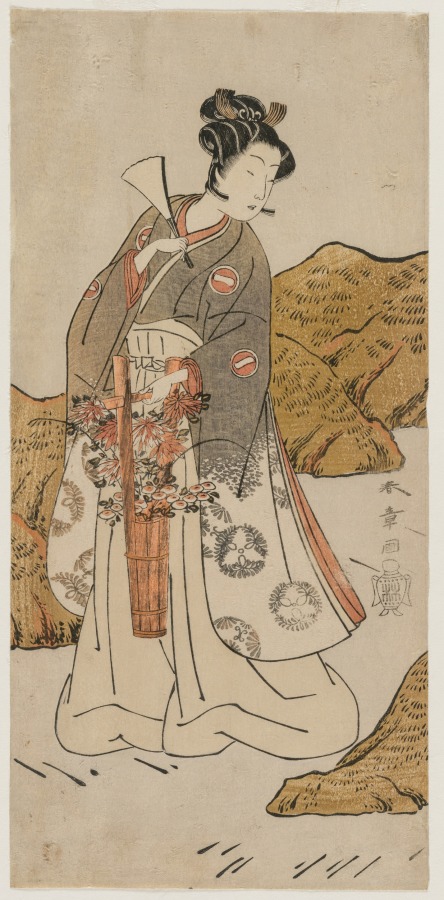
Ichikawa Monnosuke II as a Temple Page
- Date:
- early 1770s
- Medium:
- color woodblock print
- Source:
- Cleveland Museum of Art
Description
Held by the Cleveland Museum of Art and dated 1770, this Katsukawa Shunsho yakusha-e portrays Ichikawa Monnosuke II as a temple page (chigo). The chigo, an attendant boy attached to a temple, was a recurring kabuki role type that allowed onnagata-leaning young male stars to inhabit androgynous, elegantly costumed parts. Monnosuke II — among the most popular Edo actors of the late eighteenth century — is shown in such a role here, with the elaborate hair and patterned robes typical of the chigo type. Shunsho, founder of the Katsukawa school, was already at this date overturning the older Torii school approach to actor prints by giving each figure a specific face: Monnosuke II's distinct nose, jaw, and brow are evident, individuating him from any number of other actors who might play the same role. The composition follows Shunsho's preferred formula, placing the single figure against an unfilled ground so that the silhouette and the printed pattern of the costume carry the entire visual interest. Edo ukiyo-e prints of this kind functioned both as theater memorabilia and as collectible images of admired actors, and they were a primary engine for the Katsukawa school's commercial success. As an early-1770s example, this Monnosuke II portrait shows the formula that would dominate yakusha-e for the rest of the century already fully formed.
More Prints by Katsukawa Shunshō

The Actor Arashi Sangoro II as Sakura-maru in the Play Sugawara Denju Tenarai Kagami, Performed at the Ichimura Theater in the First Month, 1772
c. 1772
Color woodblock print; hosoban; right sheet of a multisheet print

The Actor Nakamura Tomijuro I as the female fox from Mt. Ubagadake in the play "Chigo Torii Tobiiri Kitsune," performed at the Ichimura Theater in the eleventh month, 1777
c. 1777
Color woodblock print; one sheet of hosoban tetraptych

The Warrior Ômori Hikoshichi Carrying a Demon on His Back
About 1772
Color woodblock print; chûban

The Actor Segawa Tomisaburo I as the Heron Maiden (Sagi Musume)
c. 1774
Color woodblock print; hosoban
Frequently Asked Questions
Ichikawa Monnosuke II as a Temple Page was created by Katsukawa Shunshō (勝川春章) in early 1770s.