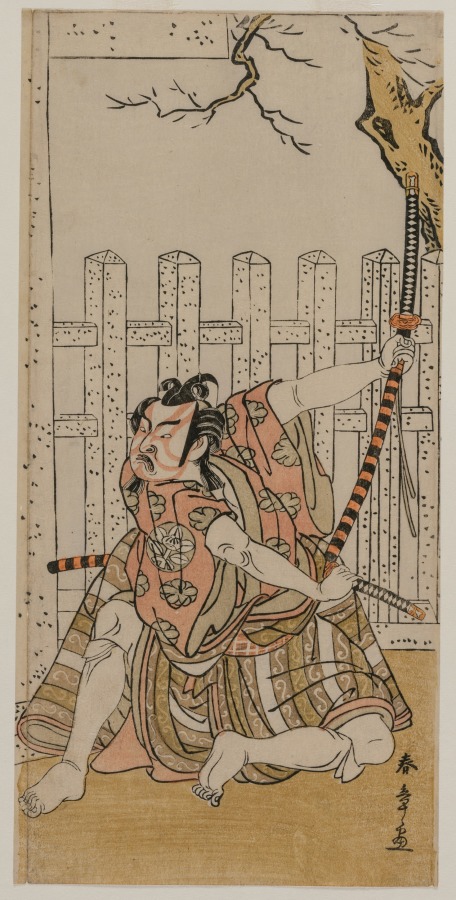
Ichimura Uzaemon IX as Umeomaru
- Date:
- mid 1770s
- Medium:
- color woodblock print
- Source:
- Cleveland Museum of Art
Description
This 1774 print by Katsukawa Shunsho captures the celebrated kabuki actor Ichimura Uzaemon IX in the role of Umeomaru, one of the three brothers central to the perennially popular play Sugawara Denju Tenarai Kagami. Held in the Cleveland Museum of Art, the work belongs to the mature phase of Shunsho's career, when his innovative approach to yakusha-e (actor pictures) had decisively redirected the course of Edo ukiyo-e away from the stylized conventions of the Torii school. As founder of the Katsukawa school, Shunsho insisted on capturing the distinctive physiognomy of individual performers rather than reducing them to interchangeable theatrical types. Umeomaru was a signature role for the Ichimura line, and Shunsho's design emphasizes the character's defiant energy through the actor's broad, planted stance and the sharply rendered features beneath the elaborate stage makeup. The bold patterning of the costume, with its dynamic interplay of curving and angular forms, exemplifies the visual sophistication that made Katsukawa school prints prized collectibles in Edo's theater districts. Shunsho's technique of identifying actors through their actual facial features rather than crests or inscriptions revolutionized the genre and trained a generation of artists, including Katsukawa Shunko, Katsukawa Shun'ei, and the young Katsushika Hokusai, who briefly worked under the name Shunro within the school. This impression in the Cleveland collection demonstrates the refined linework and balanced compositional sense that distinguished the Katsukawa style at its height in the An'ei era. Shunsho's collaboration with the Ichimura theater family produced numerous designs documenting their major productions, and prints such as this one remain essential primary sources for understanding the visual culture of late eighteenth-century kabuki.
More Prints by Katsukawa Shunshō

The Actor Arashi Sangoro II as Sakura-maru in the Play Sugawara Denju Tenarai Kagami, Performed at the Ichimura Theater in the First Month, 1772
c. 1772
Color woodblock print; hosoban; right sheet of a multisheet print

The Actor Nakamura Tomijuro I as the female fox from Mt. Ubagadake in the play "Chigo Torii Tobiiri Kitsune," performed at the Ichimura Theater in the eleventh month, 1777
c. 1777
Color woodblock print; one sheet of hosoban tetraptych

The Warrior Ômori Hikoshichi Carrying a Demon on His Back
About 1772
Color woodblock print; chûban

The Actor Segawa Tomisaburo I as the Heron Maiden (Sagi Musume)
c. 1774
Color woodblock print; hosoban
Frequently Asked Questions
Ichimura Uzaemon IX as Umeomaru was created by Katsukawa Shunshō (勝川春章) in mid 1770s.