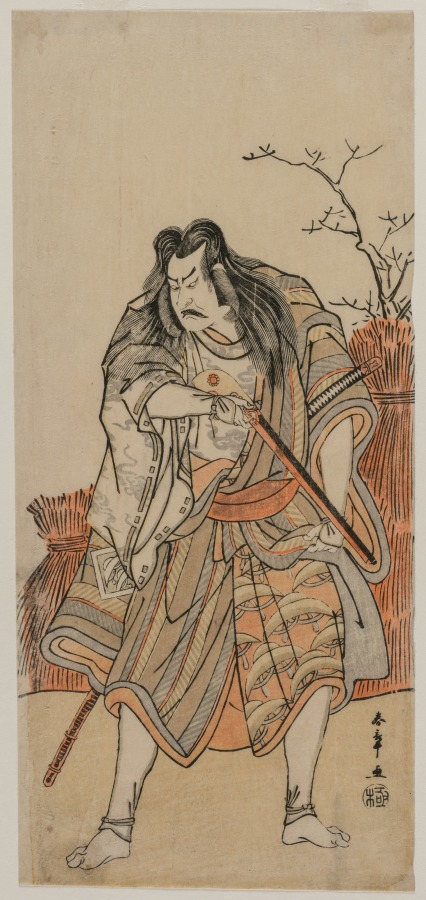
Nakajima Kanzaemon as a Lord Disguised as a Hunter with a Rifle
- Date:
- c. early 1780s
- Medium:
- color woodblock print
- Source:
- Cleveland Museum of Art
Description
This 1780 yakusha-e by Katsukawa Shunsho, held in the Cleveland Museum of Art, portrays the actor Nakajima Kanzaemon in a layered role typical of kabuki dramaturgy: a high-ranking lord who has gone undercover as a common hunter, complete with a matchlock rifle. Such disguise plots, in which noble characters move incognito through the world of farmers and townspeople, were a staple of Edo period stage writing, allowing playwrights to explore questions of class, identity, and loyalty. Shunsho captures the dramatic doubleness of the role by showing Kanzaemon in the rough costume of a hunter while suggesting through bearing and facial features that this is no ordinary woodsman. The rifle, an unusual prop in ukiyo-e, anchors the composition and signals the character's outsider status. As founder of the Katsukawa school, Shunsho was responsible for the principal innovation of late eighteenth-century Edo ukiyo-e in the field of actor portraiture: the rejection of stylized substitution in favor of recognizable individual likeness. Kanzaemon, primarily known as a supporting player who specialized in mature male roles, receives the same attentive treatment Shunsho extended to top stars, a democratic instinct that helped make Katsukawa school prints comprehensive visual records of the Edo stage. The composition is tightly framed around the standing figure, with crisp outlines and selective coloring directing the eye to the face and the weapon. This impression in Cleveland preserves Shunsho's characteristic balance of formal restraint and dramatic specificity, qualities that secured his school's commercial dominance for two decades.
More Prints by Katsukawa Shunshō

The Actor Arashi Sangoro II as Sakura-maru in the Play Sugawara Denju Tenarai Kagami, Performed at the Ichimura Theater in the First Month, 1772
c. 1772
Color woodblock print; hosoban; right sheet of a multisheet print

The Actor Nakamura Tomijuro I as the female fox from Mt. Ubagadake in the play "Chigo Torii Tobiiri Kitsune," performed at the Ichimura Theater in the eleventh month, 1777
c. 1777
Color woodblock print; one sheet of hosoban tetraptych

The Warrior Ômori Hikoshichi Carrying a Demon on His Back
About 1772
Color woodblock print; chûban

The Actor Segawa Tomisaburo I as the Heron Maiden (Sagi Musume)
c. 1774
Color woodblock print; hosoban
Frequently Asked Questions
Nakajima Kanzaemon as a Lord Disguised as a Hunter with a Rifle was created by Katsukawa Shunshō (勝川春章) in c. early 1780s.