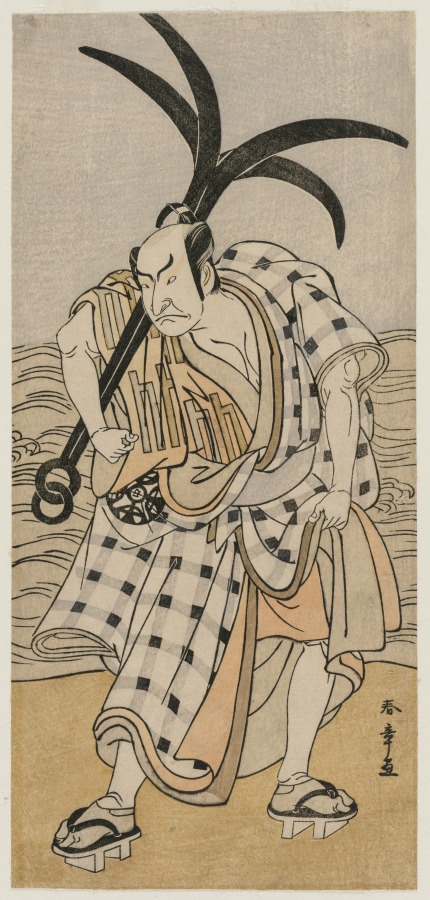
Nakamura Nakazo I as a Townsman Holding an Anchor
- Date:
- c. 1780
- Medium:
- color woodblock print
- Source:
- Cleveland Museum of Art
Description
Held by the Cleveland Museum of Art, this Katsukawa Shunsho print depicts the great actor Nakamura Nakazo I as a townsman holding an anchor, an unusual prop that grounds the figure in maritime or fishing-village symbolism. Nakazo I was one of the most intellectually adventurous performers of his generation, willing to reinvent established roles and to embrace dramatic challenges that called for psychological subtlety. Shunsho's image, with the actor's heavy posture and intent gaze, captures something of that thoughtfulness, while the anchor introduces an iconographic note that would have keyed Edo audiences to the play's particular setting. The townsman type, by the 1770s, was a well-developed Kabuki character, allowing actors to explore the cultural texture of urban and waterfront life with more naturalism than the more stylized samurai or supernatural roles required. As Katsukawa school yakusha-e, the print exemplifies Shunsho's interest in extending nigao-e likeness portraiture into the everyday social registers represented on the Kabuki stage. Within Edo ukiyo-e, sheets of this kind broadened the social repertoire of actor prints, showing that the Katsukawa school could chronicle merchants, fishermen, and other commoners alongside warriors and onnagata. The image survives as a quietly observed portrait of Nakazo, anchored both literally and visually by the implement at his side, and as a contribution to the ongoing visual archive of Edo's theatrical culture.
More Prints by Katsukawa Shunshō

The Actor Arashi Sangoro II as Sakura-maru in the Play Sugawara Denju Tenarai Kagami, Performed at the Ichimura Theater in the First Month, 1772
c. 1772
Color woodblock print; hosoban; right sheet of a multisheet print

The Actor Nakamura Tomijuro I as the female fox from Mt. Ubagadake in the play "Chigo Torii Tobiiri Kitsune," performed at the Ichimura Theater in the eleventh month, 1777
c. 1777
Color woodblock print; one sheet of hosoban tetraptych

The Warrior Ômori Hikoshichi Carrying a Demon on His Back
About 1772
Color woodblock print; chûban

The Actor Segawa Tomisaburo I as the Heron Maiden (Sagi Musume)
c. 1774
Color woodblock print; hosoban
Frequently Asked Questions
Nakamura Nakazo I as a Townsman Holding an Anchor was created by Katsukawa Shunshō (勝川春章) in c. 1780.