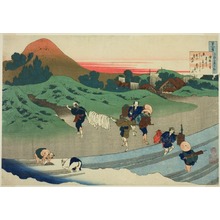
Empress Jito (Jito Tenno) from the series
- Medium:
- Woodblock print
- Source:
- Art Institute of Chicago
- Image courtesy of
- Art Institute of Chicago
Description
Empress Jitō (645–703) appears as the second poet in the Hyakunin Isshu anthology, the collection of one hundred classical tanka poems compiled by Fujiwara no Teika in the thirteenth century. Her poem, beginning "Haru sugite / natsu ki ni kerashi" (Spring has passed / and summer seems to have arrived), evokes the whiteness of bleaching cloth on the hills of Yoshino as a sign of the season's change. Hokusai's illustration, likely from his late series of designs for the Hyakunin Isshu, would have translated the poem into a composed landscape rather than a portrait, evoking hills, textile workers at a bleaching ground, or the residual white of snow. The series, begun in Hokusai's final years but left incomplete at his death, employs simplified landscape forms and broad areas of flat color, departing from earlier bijin-ga conventions that had dominated poem-illustration print traditions.
More Prints by Katsushika Hokusai

The Fishermen of Katase Hauling in Their Nets: The Purple Shell (Murasakigai)
1821
Color woodblock print with metallic pigments; surimono shikishiban

Burdock Root (Kurama gobo), from the series "A Selection of Horses (Uma-zukushi)"
1822
Color woodblock print; shikishiban, surimono

Horse Shells (Umagai), from the series "A Selection of Horses (Uma-zukushi)"
1822
Color woodblock print; shikishiban, surimono

Orange Orchids, from an untitled series of flowers
c. 1832
Color woodblock print; oban
Frequently Asked Questions
Empress Jito (Jito Tenno) from the series was created by Katsushika Hokusai (葛飾北斎).