
Evening Bell at Mii (Mii no bansho), from the series Eight Views of Omi in Etching Style (Doban Omi hakkei)
- Source:
- Art Institute of Chicago
Description
Evening Bell at Mii (Mii no bansho) belongs to Katsushika Hokusai's series Eight Views of Omi in Etching Style (Doban Omi hakkei), dated 1799 and held in the Art Institute of Chicago. The classical Omi hakkei pairs the evening bell theme with Mii-dera, the great temple complex on the western slopes above Lake Biwa whose bell was renowned in Japanese poetry as a marker of dusk. Hokusai's image gathers temple architecture, sloping forested grounds, and a sweeping view of the lake beyond, while small figures of pilgrims, monks, and visitors animate the staircase and courtyards. The doban or etching-style format of the series gives the print an emphatic recessional perspective and dense parallel hatching, qualities Hokusai borrowed from European prints traded through Nagasaki and adapted to ukiyo-e woodblock printing. As an Edo ukiyo-e design, Mii no bansho thus offers a hybrid visual experience: the subject is traditional and steeped in centuries of poetry, but the manner of representation experiments with imported conventions. The sound of the evening bell is, of course, untranslatable into image, so Hokusai relies on visual atmosphere, the lengthening of shadows, the orientation of figures, the gradation of distant water, to suggest the moment when the day exhales into evening. The result is a sophisticated example of how Edo ukiyo-e absorbed external influences without surrendering its grounding in classical Japanese scenery.
More Prints by Katsushika Hokusai
Hokusai manga (Hokusai Sketchbooks)
19th century
Woodblock-printed book; ink and light color on paper
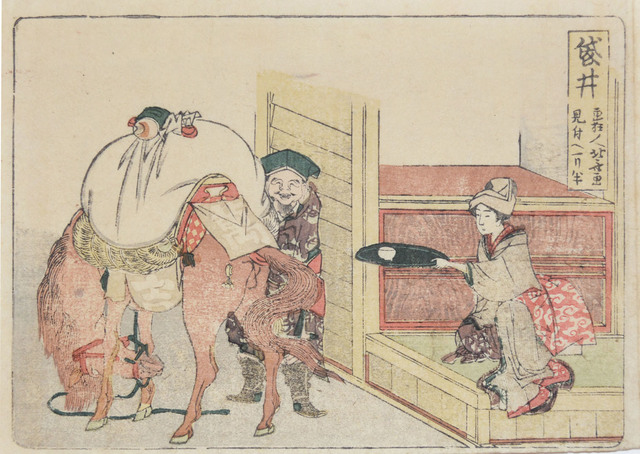
Fukuroi
1804
Japanese woodblock print

The Fishermen of Katase Hauling in Their Nets: The Purple Shell (Murasakigai)
1821
Color woodblock print with metallic pigments; surimono shikishiban

Burdock Root (Kurama gobo), from the series "A Selection of Horses (Uma-zukushi)"
1822
Color woodblock print; shikishiban, surimono
Frequently Asked Questions
Evening Bell at Mii (Mii no bansho), from the series Eight Views of Omi in Etching Style (Doban Omi hakkei) was created by Katsushika Hokusai (葛飾北斎).