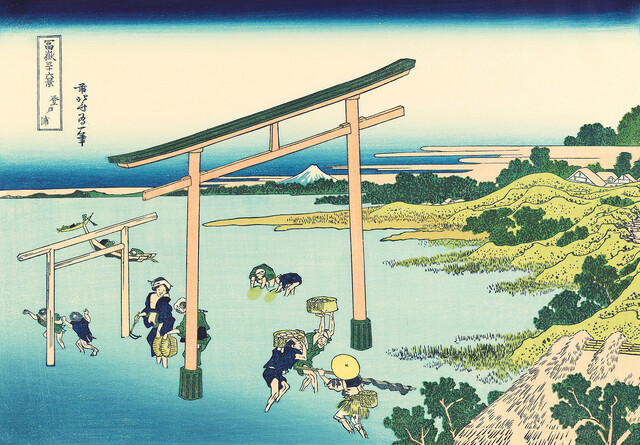
Katsushika Hokusai
- Date:
- 1960
- Medium:
- Original Woodcut print
- Image courtesy of
- Artsy
Description
This sheet is offered on Artsy at https://www.artsy.net/artwork/katsushika-hokusai-katsushika-hokusai-2 under the artist's name alone, with a 1960 date that reflects a posthumous twentieth-century impression rather than an Edo-period strike. The catalogue entry stands for a Hokusai design issued in a later edition of the kind that circulated widely after the war as publishers reissued the canonical Fuji and waterfall series from recarved or restored blocks. Katsushika Hokusai (1760-1849) is the most internationally recognized figure in the history of ukiyo-e, a printmaker, painter, and book illustrator whose six-decade career moved through actor portraits within the Katsukawa school, surimono commissions for poetry circles, the illustrated manga sketch volumes whose fifteen volumes appeared between 1814 and the artist's death, classical figure subjects, and ultimately the landscape series of his seventies that transformed the meaning of the Japanese woodblock for both domestic and foreign viewers. Issued in 1831 to 1833 by Nishimuraya Yohachi, the Thirty-six Views of Mount Fuji introduced the imported Prussian blue, bero-ai, that would shape Edo printmaking through the rest of the decade and produced the Great Wave and Red Fuji designs by which Hokusai has come to be globally known. The publisher Eijudo's later A Tour of Waterfalls in Various Provinces of 1833 and the Famous Bridges in the Various Provinces of the same window extended the working program of the Fuji series into specific landscape genres of their own, and the One Hundred Views of Mount Fuji illustrated book series of 1834 onward consolidated the artist's late vision in book form. Post-1945 reissues from these series circulated through American and European dealers as the global appetite for the Japanese print broadened, and listings of the kind seen here are best read in that history: the underlying design is Edo, but the impression is mid-twentieth-century. Confirmed Edo-period strikes of Hokusai's principal series are preserved in depth at the Metropolitan Museum of Art, the Art Institute of Chicago, the British Museum, the Museum of Fine Arts in Boston, the Tokyo National Museum, and the Sumida Hokusai Museum, which opened in 2016 in the artist's home district as the dedicated institutional home for the corpus.
More Prints by Katsushika Hokusai

The Fishermen of Katase Hauling in Their Nets: The Purple Shell (Murasakigai)
1821
Color woodblock print with metallic pigments; surimono shikishiban

Burdock Root (Kurama gobo), from the series "A Selection of Horses (Uma-zukushi)"
1822
Color woodblock print; shikishiban, surimono

Horse Shells (Umagai), from the series "A Selection of Horses (Uma-zukushi)"
1822
Color woodblock print; shikishiban, surimono

Orange Orchids, from an untitled series of flowers
c. 1832
Color woodblock print; oban
Frequently Asked Questions
Katsushika Hokusai was created by Katsushika Hokusai (葛飾北斎) in 1960.